

In the NBA, teams like to use zone defense to switch things up from time to time, especially if a team gets going offensively. Coaches like to throw a zone out there for a possession or two, just to break up the rhythm of the offense (the offense now has to react, realize the zone is being played, and then attack it. Slows things down considerably).
However, zones in the NBA look a lot different when compared to zones you see in college and what you see in the international game. Zones in the NBA have a lot more flow and movement to them (that is, defenders are moving more than you would see in say Syracuse’s zone), and the primary reason is the defensive three second rule that is in the NBA (as defined by NBA.com’s rule page):
a. The count starts when the offensive team is in control of the ball in the front-court.
b. Any defensive player, who is positioned in the 16-foot lane or the area extending 4 feet past the lane endline, must be actively guarding an opponent within three seconds. Actively guarding means being within arms length of an offensive player and in a guarding position.
c. Any defensive player may play any offensive player. The defenders may double-team any player.
d. The defensive three-second count is suspended when: (1) there is a field goal attempt, (2) there is a loss of team control, (3) the defender is actively guarding an opponent or (4) the defender completely clears the 16-foot lane.
e. If the defender is guarding the player with the ball, he may be located in the 16-foot lane. This defender is not required to be in an actively guarding/arms dis-tance position. If another defender actively guards the player with the ball, the original defender must actively guard an opponent or exit the 16-foot lane. Once the offensive player passes the ball, the defender must actively guard an opponent or exit the 16-foot lane.
Defensive Three Second’s Effect On Zone
So what kind of effect does the defensive three second rule have on the zone? Well, it prevents teams from sticking their center right in the middle of the lane and having him bother every shot that comes at them. Also, it results in a lot of 3-2 zones:

The reason you see a lot of 3-2 zones is because it naturally helps defenses avoid a defensive three second violation. Here, the Knicks are playing a 3-2 zone and the result is that the two big men in the back are either out of the paint (or one step away to easily get out of the paint).

Here is another look at the Knicks’ 3-2 defense. As you can see, they have both of their back players outside of the lane to prevent a defensive three second call. The reason they can’t be in the lane is because Brook Lopez is standing at the high post, and neither are close enough to be called “actively defending.”

As the basketball gets swung around, basic zone defense principles would call for Al Harrington to move his zone to cover the middle of the lane. The problem with that is because Brook is still in the high post, Harrington wouldn’t be an arms-length away from any offensive player. This leaves a gap, and the Nets take advantage:
Lopez makes a quick cut to the now open lane, gets the ball and is able to finish with the basket.
When The Zone Works
Against A Low Post Threat
When teams playing against a zone put their big man in the post, they are doing something that really helps the defense. The reason is that defenses now can place players in the paint without worrying about the defensive three second call (this is because when a offensive player is in the low post, defenders can be in the paint less then one arm-lengths away, negating the three second call). Using the Nets vs. the Knicks one more time as an example:
Here is the Knicks’ 3-2 zone yet again. This time, Brook Lopez is working the low post, and with the ball on the wing, Al Harrington is able to rotate to the middle of the paint.
Here is the ball on the other side and with Brook in the low post, the Knicks are able to have two guys in the paint, and not worry about a three second call, because they are both within arms-length of Brook Lopez.
Against Teams That Settle
Zone defense also works when playing against offenses that can be baited into just passing the ball slowly around the perimeter and taking poor outside shots. The best example of this is probably the Suns-Lakers series from this past postseason:
Here, the Lakers look surprised by the Suns’ zone and they eventually settle for an outside shot after slowly passing the ball around the perimeter.
Here is another example. Again, the Lakers are just slowly passing the ball around the outside. The big problem is that they are passing so slowly, they are allowing the Suns’ zone to regroup after every pass. This is what leads to the steal.
When The Zone Doesn’t Work
Against A Good Shooter
Teams usually play a zone when there is no real shooting threat out there (for example, the Nets saw a ton of zone last year, because they didn’t have anyone who can hit the rim from the three point line).
Here, the Bucks are playing a zone against the Hawks. The Hawks have a good three point shooter in Jamal Crawford on the court. With the ball on the opposite side of the court, the defender closest to Crawford has to leave him and cover his zone responsibilities. By the time Crawford makes the catch, there is too much ground to cover on the closeout and he is able to hit the open jumper.
Against High Post Players
We already showed one example about how high post play hurts the zone. Not only because it forces defenses to worry about three second violations, but also when the ball gets into the middle of the zone (which is the high post), it basically destroys the zone defense. The defense has to collapse to the basketball and it leads to a lot of rotations that the offense can take advantage of:
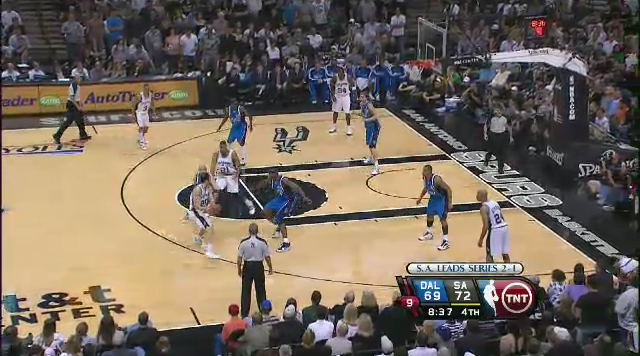
Here, Duncan shows at the high post, and Ginobili is able to squeeze the ball in there.
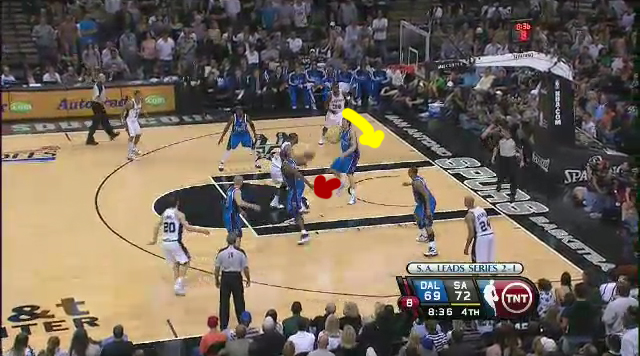
Once Duncan makes the catch, Dirk Nowitzki is forced to come up and play him. As Duncan comes up, Antonio McDyess makes a cut to the baseline.
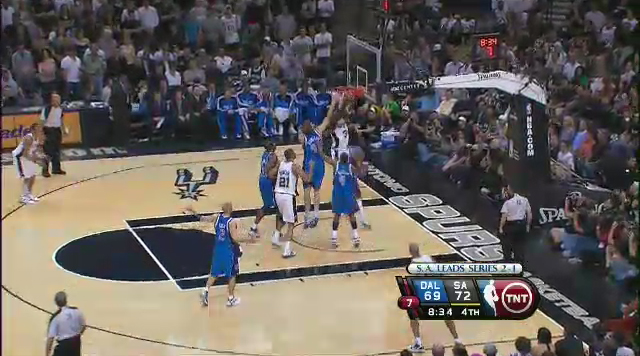
Antonio McDyess makes the catch and finishes at the rim. Here is video of the play:
Against Good Rebounding Teams
The job of the zone defense isn’t complete when the shot goes up in the air. The possession is only over when the defense can get the rebound, but when playing the zone that is a real challenge. The main reason is because in zone defense, players are responsible for areas and not an actual player. This makes it harder to box-out and secure the rebound. The zone rotations also lead to some mismatches when the basketball is in the air:
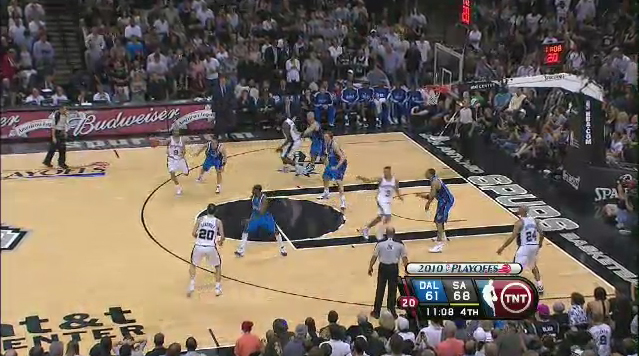
The Mavs first show the zone down 7, and the Spurs recognize it and start sending the ball around the perimeter. Quick ball movement is another key to beating the zone. You get guys moving around, the zone starts to lose it’s shape.
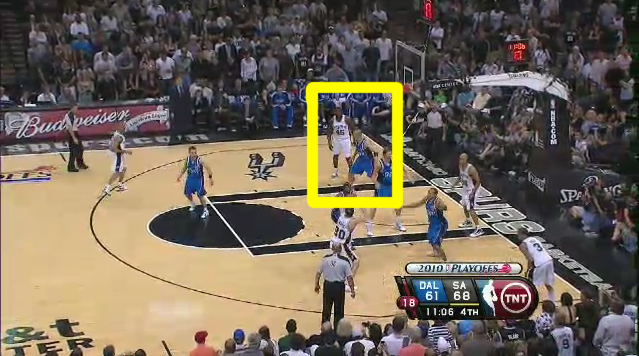
As Manu squares up for the shot, you can see that Jason Kidd is matched up against DeJuan Blair (with the lineup the Mavs had in, Kidd had to play the back of the zone). Jason Kidd is big for a point guard, but he has no chance of boxing out Blair.
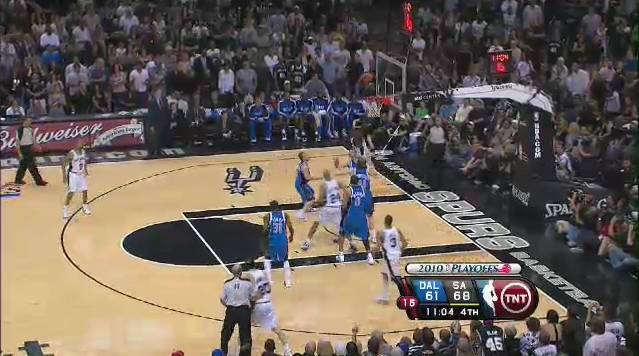
Blair pushes Kidd out of the way, and he gets himself the putback rebound. Here it is in real time:
Against Teams Who Run
If you get out in the open court and push the ball when a team is trying to get back in a zone look, it puts a ton a pressure on the defense. They have to get back to their zones, look for a man to cover, then actually get there. It is a lot to do, and sometimes it is hard to matchup with everyone:
Here, Nowitzki sets up too far into the paint, and he doesn’t have enough time to close out on the three point shooter.
