
The Lakers’ Triangle Offense | NBA Playbook

The Lakers’ Triangle Offense

The Los Angeles Lakers seem to be one of the only teams that can run the triangle offense successfully.  The triangle is an interesting set because there seems to be two basic motions, and then that’s it.  There is a lot of freelancing off of these two motions, as players are simply asked to maintain the principles of the triangle.  A system like this really relies on the players being able to play every spot on the court, understanding spacing principles, and most importantly, being able to read defenses.

Before we look at some of the freelance stuff in the triangle, let’s look at the two basic options:

Page 001

The basic set up for a triangle is your standard two guard offensive front except that the 4-man (usually Lamar Odom) is in the backcourt with the point guard.  The point guard gets it to the 2-man (usually Kobe Bryant), and then dives to the corner.

Now this dive after the ball entry is probably the one constant in the triangle.  Whenever the ball gets entered the point guard always dives either to the ballside corner or the weakside corner.  In fact, the Lakers do some interesting things off of this dive (more on that later).

Back to the option.  Now that the 2 has the basketball, the 5 comes to the high post to create the triangle.  You can do a lot of things off of this.  Pass to the corner and cut through, PNR with the high post, anything.  Here is what it looks like live:

Here, Sasha Vujacic makes the pass to Ron Artest and cuts to the corner.  Artest, gets it back to Vujacic and then cuts to the basket.

The above clip is a good example of the freelancing that goes into the triangle. Here, you see the first option getting run through where Artest gets the ball as Steve Blake flashes to the corner. Artest gives it back to Blake and flashes through (exactly the same way he did in the first clip), however he isn’t open, so he doesn’t get the basketball. The offense seamlessly turns into a pick and roll with Steve Blake and Pau.

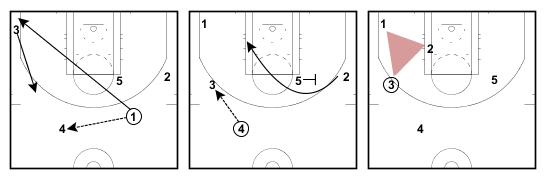
If the 2-man isn’t open on the wing, you see the Lakers get into their second option.  Here is what it looks like:
Page 001

If the PG can’t hit the 2-man, he swings it back to the 4-man, who is sharing the backcourt with him (one of the reasons why he is there). As the PG swings the ball, he again flashes towards the ballside corner as the 3-man shows to the basketball. The 4-man gets the ball into the 3-man, and as this is happening, the 2-man gets a screen from the center and flashes anywhere from the elbow to the block. This forms your triangle. Here is it live:

In the above clip, Fisher swings it to Odom who gets the basketball to Kobe.  As this is happening, Ron Artest flashes to the midpost and gets a really nice seal.  It’s a terrible pass and a turnover, but that seal by Artest is what the triangle tries to get you as an offense.

Here is what happens when Artest gets a good pass in the post like this. With the good floor spacing, he is able to work down low and get the easy basket. Now the man coming across and posting is usually Kobe Bryant.  This second option/motion is how the Lakers are able to get the ball into Kobe rather easily:

This is a variation of the second option we looked at above, but the basic motions remain the same and as the ball gets to Odom on the wing, Kobe comes across and posts.

We talked a little bit about the dive after the ball entry, and how you can do some interesting things off of it.  There are two different things the Lakers like to do in terms of variations of dives.
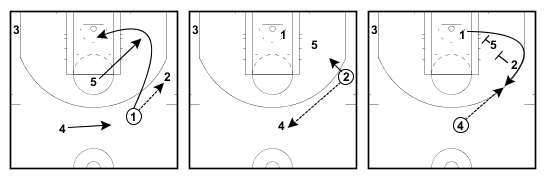
Page 001Basically, what happens here is Fisher enters the ball as if he is running option 1, however instead of flashing to the corner he flashes to the paint under the basket.  The 2-man quickly gets it back out to the 4-man and then sets the second screen in a double screen for Fisher who uses the double to get the basketball. Fisher can easily spot up for the three or let his natural movement take him to the middle of the paint.

The second variation of the dive is something the Lakers run to get ISO opportunities, as they use screens set by the dive man.

Here, Odom swings the ball and then starts through as if he is diving towards the ballside corner (on the opposite side of Kobe). Instead, he sets a quick screen for Kobe, who gets the basketball and then works one on one.

Here, Fisher gets the ball into the post, and instead of diving through he sets a screen on Odom’s man. Odom gets the ball on the move where he is able to attack the rim.

The beauty of these quick little options is that it forces the defense to pay attention at all times. The defender covering the dive man can’t just assume the dive is going to happen, because if he falls asleep, the Lakers can take advantage.

Besides these quick hitters, the Phil Jackson simply asks his players to freelance using the triangle as a base.

In the above clip, the Lakers set up their triangle and then enter the basketball into the post. Artest (the man in the corner) then sets a little brush screen so Fisher can flash to the corner and get the open jumper.

Here, you see the same basic motion. However, instead of setting the screen, Artest slips it and gets the ball on the cut.

The above clip shows another quick hitter that the Lakers like to run. Here, Pau looks like he is going to be the high post man in the triangle, but quickly cuts backdoor for the lob. He gets the ball and hits the shot, but the beauty of this is that the Lakers still have their triangle set up if Pau isn’t open.

The triangle just doesn’t set up quick hitters or offense that stays on one side. The basic principles and motions of the triangle allow for a nice offense that goes side to side while maintaining floor balance:

Now, Kobe takes a terrible shot in the above clip, but that isn’t what you should pay attention to. What you should pay attention to is how easily the ball moves side to side, while the Lakers keep their floor balance. Look at how easily the Lakers are able to get their triangle set up on each side of the court as the ball moves.

With a triangle offense that relies on players reading the defense and freelancing, things tend to freeze-up and the offense may breakdown from time to time. Phil Jackson knows this, and this is why it is good to have Kobe Bryant (or, you know, Michael Jordan) on your basketball team.

When things break down on the offensive end, the Lakers simply get the ball to Kobe and let him work:

Here, the Lakers freeze up and nobody is really sure what to do after the ball goes to Artest. Kobe recognizes this and flashes to the basketball. Once he gets it, the Lakers clear out and let him go one on one.

What I showed to you is a lot of the basic principles and motions of the triangle and a few of the sets the Lakers like to run off of it, but it isn’t even close to everything. What makes this offense so hard to teach, and conversely defend, is that Phil Jackson’s team is playing keeping the principles of the triangle in mind. It’s not like other sets or offenses where you defenses can see one part of an offense and know what is coming next. Players are asked to read and react defenses and play accordingly.

  • ihoop15

    Great post! Thank you.

  • ihoop15

    Great post! Thank you.

  • http://twitter.com/LakersNation Lakers Nation

    Great Tutorial . . I linked it to our facebook.com/LakersNation site to share with our fans . . . looking forward to more!

  • T S Turek

    Essential NBA Playbook post. Great job, man

  • http://twitter.com/LakersNation Lakers Nation

    Great Tutorial . . I linked it to our facebook.com/LakersNation site to share with our fans . . . looking forward to more!

  • T S Turek

    Essential NBA Playbook post. Great job, man

  • luffy3108

    thank you so much, I've wanted to see a detailed explanation of the triangle for a long time.

  • John

    I just would like to express that I love this blog. It's great for me personally, an avid watcher, that was too terrible to play as a kid. I would love to see an article on Rick Adelman's Princeton offense which gets a lot of press but rarely explained. Excellent job, keep up the good work!

  • onanoman

    Love this post. Many thanks. A few more like this, and I might comprehend something about this offense sometime before PJ retires!

  • luffy3108

    thank you so much, I’ve wanted to see a detailed explanation of the triangle for a long time.

  • http://probasketballtalk.nbcsports.com/2010/10/25/kobe-bryant-is-not-right-the-question-is-when-will-he-be/ Kobe Bryant is not right, the question is when will he be? | ProBasketballTalk

    [...] are a million variations of the triangle offense, and the Lakers do plenty of freelancing in it, but the basic idea is to keep spacing and movement [...]

  • John

    I just would like to express that I love this blog. It’s great for me personally, an avid watcher, that was too terrible to play as a kid. I would love to see an article on Rick Adelman’s Princeton offense which gets a lot of press but rarely explained. Excellent job, keep up the good work!

  • onanoman

    Love this post. Many thanks. A few more like this, and I might comprehend something about this offense sometime before PJ retires!

  • Steve

    Still confused but a little bit less so now. Great post

  • Chris

    Wow. Fantastic post. Great job explaining the principles of the triangle.

    It seems like the Lakers' triangle is often undermined by poor shot selection by some of their key players, like Kobe, Artest, and Fisher. You can see how easily it flows when run properly, though.

  • Steve

    Still confused but a little bit less so now. Great post

  • Chris

    Wow. Fantastic post. Great job explaining the principles of the triangle.

    It seems like the Lakers’ triangle is often undermined by poor shot selection by some of their key players, like Kobe, Artest, and Fisher. You can see how easily it flows when run properly, though.

  • Lunaticwolf

    Flex offense is easier to run and leads to better results. Triangle is difficult to run when you don't have a Jordan or Kobe on your team.

  • Lunaticwolf

    Flex offense is easier to run and leads to better results. Triangle is difficult to run when you don’t have a Jordan or Kobe on your team.

  • billy

    Great work! Thanks!

  • billy

    Great work! Thanks!

  • http://pulse.yahoo.com/_7BMFD6OJXIIRNAVNSGK52UFI6E Will

    Best explanation of the triangle I've read. The videos help immensely. Great work as usual.

  • http://pulse.yahoo.com/_7BMFD6OJXIIRNAVNSGK52UFI6E Will

    Best explanation of the triangle I’ve read. The videos help immensely. Great work as usual.

  • Anders

    Maybe you could make a part II, where comparisons are drawn to others teams playing the mythical triangle offense: T´Wolves and the old Lakers and Bulls-teams come to mind.

    Did Phil and Jordan play it the same way? How do young Kobe and old Kobe influence the triangle? How did Shaq shape the triangle?

    Oh… and about the Gasol lob. How did Odom know he needed to cut baseline to make room for Gasol´s backdooor lob? It doesn’t look like Gasol turns his head to see if there is room for a backdoor. Did they call this on the way up the floor?

  • Anders

    Maybe you could make a part II, where comparisons are drawn to others teams playing the mythical triangle offense: T´Wolves and the old Lakers and Bulls-teams come to mind.

    Did Phil and Jordan play it the same way? How do young Kobe and old Kobe influence the triangle? How did Shaq shape the triangle?

    Oh… and about the Gasol lob. How did Odom know he needed to cut baseline to make room for Gasol´s backdooor lob? It doesn’t look like Gasol turns his head to see if there is room for a backdoor. Did they call this on the way up the floor?

  • http://twitter.com/rubthemtogether rubthemtogether

    Another great post Sebastian

  • Edholden

    Fascinating – as always.

    I'd really enjoy a piece on the Jazz flex offense.

  • http://twitter.com/rubthemtogether White Ving Rhames

    Another great post Sebastian

  • Edholden

    Fascinating – as always.

    I’d really enjoy a piece on the Jazz flex offense.

  • Surya52k3

    Absolutely loved it. Keep up the good work :)

  • http://nbaplaybook.com/2010/10/26/how-can-the-timberwolves-run-the-triangle-effectively/ NBA Playbook – A Look At The Playcalling In The NBA Through Videos, Pictures, & Words » How Can The Timberwolves Run The Triangle Effectively?

    [...] we looked at the Triangle offense and how the coach/team that made it famous runs the offense.  Phil Jackson has been running this [...]

  • Surya52k3

    Absolutely loved it. Keep up the good work :)

  • JW23

    Great offense which is difficult to defend as the ball is constantly being moved from side to side. The Lakers run a clinic with their proper spacing as well as their ability to make the proper angles on their post entry passes.

    I like how some NBA teams use bits and pieces of the flex offense into their sets, but the offense as a whole is flawed as it is predictable and doesn't possess proper spacing.

  • http://nba-point-forward.si.com/2010/10/26/court-vision-4/ The Point Forward » Posts Court Vision «

    [...] • I have a suspicion that a lot of NBA fans — even some smart ones — talk a lot about the triangle offense but don’t really know what it is or how it works. If you fit into that category — and even if you don’t — you absolutely have to check out Sebastian Pruiti’s breakdowns of the triangle as run by the Lakers and Wolves. [...]

  • Anonymous

    Great offense which is difficult to defend as the ball is constantly being moved from side to side. The Lakers run a clinic with their proper spacing as well as their ability to make the proper angles on their post entry passes.

    I like how some NBA teams use bits and pieces of the flex offense into their sets, but the offense as a whole is flawed as it is predictable and doesn’t possess proper spacing.

  • http://thetriangleoffense.blogspot.com/ Thetriangleoffenseblog

    Hey, great work on this post! It's an interesting take on the offense.

    I actually run a small blog dedicated to the basic principles of the triangle offense:

    http://thetriangleoffense.blogspot.com/

    'Now this dive after the ball entry is probably the one constant in the triangle.”

    That's a pretty absolute statement. This is termed the “number 1″ pass in the offense: the pass from the lead guard to the wing. The dive afterwards (called “strong-side fill”) does not always have to be made. The triangle offense has numerous set ups where any of the other four players can “dive” to that strong side corner. The ball handler themselves can even bypass this dive option by directly dribbling into the wing position (known as “Wing Dribble Entry”) as seen in this clip:

    http://www.youtube.com/watch?v=uzCr49PUBFE

    “The above clip [Triangle Dive to Post PNR] is a good example of the freelancing that goes into the triangle.”

    These are actually built in options out of a “number 2 pass” to the corner, not free lancing.

    The number 2 pass to the corner calls for the wing man to banana cut baseline which you show in the clip entitled “Option 1.” Ideally, the post man would move to the high post so that the banana cutter can cut off the post man.

    If that man can not receive the pass, the post man moves from the high post to a side pick and roll, which you show in the clip “Triangle Dive to Post PNR”.”

    The set up you call “Option 2″ is termed “Center Opposite.” A breakdown of this setup can be found here:
    http://thetriangleoffense.blogspot.com/2010/05/center-opposite.html

    The clips you title as “Fisher Option” are the Triangle's setups for the classic basketball staple single double play. Fisher has the option to use the single or the double screen to get free depending on how his defender plays him.

    The clip you title “Set Up Kobe” is actually a badly executed “Number 2 pass” to the top. (more can be read up on the number 2 pass to the top at:

    http://thetriangleoffense.blogspot.com/2010/04/in-this-post-ill-break-down-good.html

    The clip you title “Enter Into Post Screen For Odom” is a play to counter pressing defenses called “Wing Reverse detailed in this post:

    http://thetriangleoffense.blogspot.com/2010/05/moment-of-truth.html

    The key read for this set up is that Kobe's man is denying the wing entry pass so they set up the backdoor for him when Gasol flashes to the high post. Fisher's squeeze action is the second option of this setup.

    The clips titled “Post Screen For Fisher” and “Off IB Corner Screen Slipped” are simply options out of the “number 2″ pass to the post. In a way it can be considered free lancing, as the triangle never really has a play called, but the options themselves are based off the pass to the post.

    The clip “Side to Side Basic Motions Bad Shot” would then be tagged as: a center opposite setup, N2 pass to the post with a split action, then a N2 pass to the top.

    I apologize in advance for being nit picky (I simply have a lot of passion for the triangle!) and I really do enjoy reading all the great insights you share with us.

  • http://thetriangleoffense.blogspot.com/ Thetriangleoffenseblog

    Hey, great work on this post! It’s an interesting take on the offense.

    I actually run a small blog dedicated to the basic principles of the triangle offense:

    http://thetriangleoffense.blogspot.com/

    ‘Now this dive after the ball entry is probably the one constant in the triangle.”

    That’s a pretty absolute statement. This is termed the “number 1″ pass in the offense: the pass from the lead guard to the wing. The dive afterwards (called “strong-side fill”) does not always have to be made. The triangle offense has numerous set ups where any of the other four players can “dive” to that strong side corner. The ball handler themselves can even bypass this dive option by directly dribbling into the wing position (known as “Wing Dribble Entry”) as seen in this clip:

    “The above clip [Triangle Dive to Post PNR] is a good example of the freelancing that goes into the triangle.”

    These are actually built in options out of a “number 2 pass” to the corner, not free lancing.

    The number 2 pass to the corner calls for the wing man to banana cut baseline which you show in the clip entitled “Option 1.” Ideally, the post man would move to the high post so that the banana cutter can cut off the post man.

    If that man can not receive the pass, the post man moves from the high post to a side pick and roll, which you show in the clip “Triangle Dive to Post PNR”.”

    The set up you call “Option 2″ is termed “Center Opposite.” A breakdown of this setup can be found here:
    http://thetriangleoffense.blogspot.com/2010/05/center-opposite.html

    The clips you title as “Fisher Option” are the Triangle’s setups for the classic basketball staple single double play. Fisher has the option to use the single or the double screen to get free depending on how his defender plays him.

    The clip you title “Set Up Kobe” is actually a badly executed “Number 2 pass” to the top. (more can be read up on the number 2 pass to the top at:

    http://thetriangleoffense.blogspot.com/2010/04/in-this-post-ill-break-down-good.html

    The clip you title “Enter Into Post Screen For Odom” is a play to counter pressing defenses called “Wing Reverse detailed in this post:

    http://thetriangleoffense.blogspot.com/2010/05/moment-of-truth.html

    The key read for this set up is that Kobe’s man is denying the wing entry pass so they set up the backdoor for him when Gasol flashes to the high post. Fisher’s squeeze action is the second option of this setup.

    The clips titled “Post Screen For Fisher” and “Off IB Corner Screen Slipped” are simply options out of the “number 2″ pass to the post. In a way it can be considered free lancing, as the triangle never really has a play called, but the options themselves are based off the pass to the post.

    The clip “Side to Side Basic Motions Bad Shot” would then be tagged as: a center opposite setup, N2 pass to the post with a split action, then a N2 pass to the top.

    I apologize in advance for being nit picky (I simply have a lot of passion for the triangle!) and I really do enjoy reading all the great insights you share with us.

  • Anders

    Umn… great site, thanks for the link.

    But even if the dive to the corner is not a stable, then a man in the corner is? The example with Odom dribling into the wing position just results in Kobe sliding down to the corner.

  • Anders

    Umn… great site, thanks for the link.

    But even if the dive to the corner is not a stable, then a man in the corner is? The example with Odom dribling into the wing position just results in Kobe sliding down to the corner.

  • http://thetriangleoffense.blogspot.com/ Thetriangleoffenseblog

    That's right. To establish a triangle, someone must fill the corner position.

    But, as Sebastian notes, the strong side corner is not always filled. You'll often see the lead guard cut across the lane to the weakside corner and allow a “solo” to be established (detailed here: http://thetriangleoffense.blogspot.com/2010/05/solo-cut-series.html).

  • http://thetriangleoffense.blogspot.com/ Thetriangleoffenseblog

    That’s right. To establish a triangle, someone must fill the corner position.

    But, as Sebastian notes, the strong side corner is not always filled. You’ll often see the lead guard cut across the lane to the weakside corner and allow a “solo” to be established (detailed here: http://thetriangleoffense.blogspot.com/2010/05/solo-cut-series.html).

  • http://thetriangleoffense.blogspot.com/ Thetriangleoffenseblog

    That's right. To establish a triangle, someone must fill the corner position.

    But, as Sebastian notes, the strong side corner is not always filled. You'll often see the lead guard cut across the lane to the weakside corner and allow a “solo” to be established (detailed here: http://thetriangleoffense.blogspot.com/2010/05/solo-cut-series.html).

  • http://write.keinism.com/?p=2194 Basketball: Thoughts before the next game | Writings in keinism

    [...] Triangle offense, about how the guard dives after passing the ball on (from Sebastian Pruiti’s… [...]

  • http://basketballoutsider.wordpress.com/2010/11/03/the-minnesota-timberwolves-and-when-planning-goes-wrong/ The Minnesota Timberwolves and When Planning Goes Wrong « Basketball Outsider

    [...] triangle offense requires skilled big-men who are capable of passing off the post, perimeter players able to play [...]

  • http://nbaplaybook.com/2010/11/27/quick-hitter-lakers-use-the-triangle-to-get-two-free-throws/ NBA Playbook – A Look At The Playcalling In The NBA Through Videos, Pictures, & Words » Quick Hitter – Lakers Use The Triangle To Get Two Free Throws

    [...] I mentioned in my post detailing the Lakers’ Triangle offense, there are a number of things that can be done off of it.  Most of these things involve Kobe [...]

  • http://nbaplaybook.com/2010/12/31/top-5-posts-of-2010/ NBA Playbook – A Look At The Playcalling In The NBA Through Videos, Pictures, & Words » Top 5 Posts Of 2010

    [...] 1) The Lakers’ Triangle Offense [...]

  • A. L. E.

    I am wondering: what's the play when Artest just stays in a corner?

  • A. L. E.

    I am wondering: what’s the play when Artest just stays in a corner?

  • A. L. E.

    I am wondering: what's the play when Artest just stays in a corner?

  • http://bucketsoverbroadway.com/2011/02/11/friday-nyk-mz/ Friday NYK-MZ « Buckets Over Broadway | A New York Knicks Blog

    [...] spout off about Phil Jackson’s triangle offense without actually knowing what it is.  Thus here is an excellent primer on the triangle from the incomparable Sebastian Pruiti of nbaplaybook.com. [...]

  • Ben

    After a year of frustration trying to teach under 13 girls set plays that they just don’t seem to get, I have decided to give this a try.  Probably taking a big risk as it is 4 weeks until finals time, but at the moment, they seem to have grasped the basics of it….