
Last month, with a break during the Finals, I took a look at Mike Brown and what his time in Cleveland will tell us about how he will try to put Kobe Bryant in positions to score. Today, we are going to look at Mike Brown and how he plans on getting his two seven-footers involved on the offensive end. During his introductory press conference, coach Brown explained how his time with San Antonio will help shape his offense when using two seven-footers:
I thought it would be interesting to go through some old San Antonio Spurs’ game tape and see what sets coach Brown can bring from San Antonio to Los Angeles. Much like the sets we looked at with coach Brown and Kobe Bryant, these are very simple sets, but that doesn’t mean that these sets will be ineffective with Los Angeles.
Note: For the purposes of this post, David Robinson will be playing the role of Andrew Bynum and Tim Duncan will be playing the role of Pau Gasol.
Positioning/Spacing & Basic Post Principles
The first thing that you notice when watching the Spurs with Duncan and Robinson is how they were positioned on the court. In an effort to promote proper spacing, you always had one of the two bigs standing out by the three point line, getting the basketball, and initiating the offense while the other worked the block (early in Duncan’s career, it was Duncan hanging out by the three point line. Once Duncan turned into a dominating force, Robinson started hanging around the three point line):
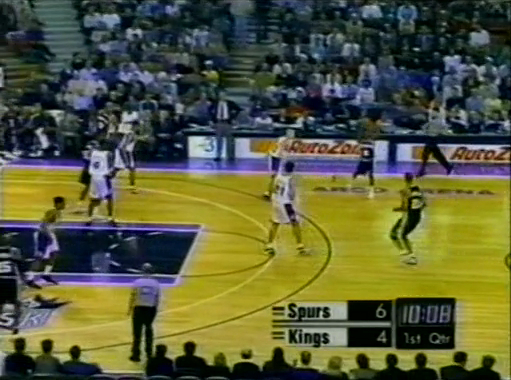
There are two reasons for this positioning. First, it provides the offense with an automatic option in delayed transition:
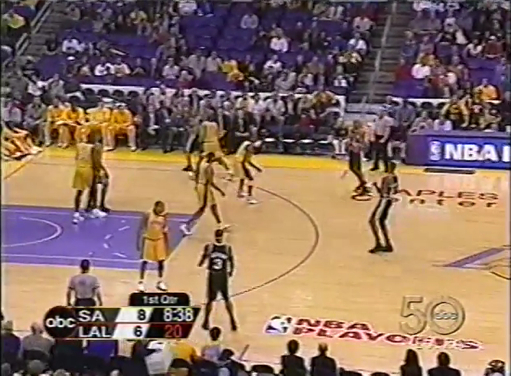
Look at how smooth the Spurs go from trying to explore a transition opportunity to getting into their halfcourt offense. There is no time wasted and everyone is naturally in position. So when the ball goes to Duncan, everyone knows what they want to do. A dribble handoff straight to a post up opportunity.
In transition, the rule for the two bigs is that the first big down the court heads towards the rim while the second big gets in position at the top of the key. The fact that the two seven-footers are basically interchangeable allows for transition opportunities.
Having both bigs being able to play both spots is a factor for this offense. You don’t see either Tim Duncan or David Robinson looking and saying “hey, I don’t go down low on this offense” and stand at the top of the key. They look around and if they are the first big down the court, they go straight to the rim, and that is exactly what happens in both of the clips above.
Taking things from transition to the halfcourt, let’s look at how the Spurs’ coaching staff set up post up opportunities with two seven footers on the court. There are two post ups that the Spurs’ liked to run, and I think Los Angeles will be featuring both types next season. The Spurs either hit a big on the block with the other at the top of the key or they swing it through the big at the top of the key and let him post up.
Again, a big factor in this offense is the Spurs’ ability to post up either Tim Duncan or David Robinson easily. The team doesn’t have to go out of its way if it wants to post up Duncan vs. Robinson. This is something that will work well in Los Angeles in my opinion. In the current era of basketball where teams usually play a stretch four, the Lakers are probably going to have a mismatch with one of their bigs. Getting the ball to that mismatch easily means that you are able to take advantage of said mismatch more effectively.
Now, once the ball got caught on the block (by either Duncan or Robinson) you probably noticed how the bigs were spaced:
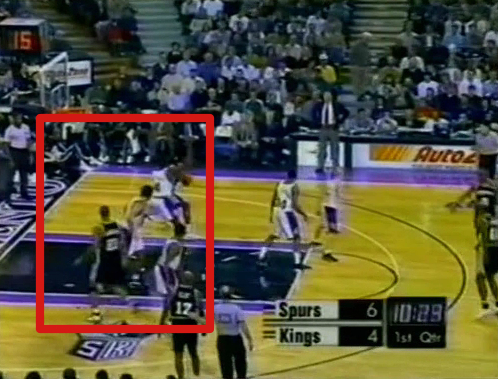
When the ball gets entered to the block, you go from a high low set (with a big at the top of the key and a big at the block) to a double low block set (with each big at a block). The reason why the Spurs do this is because it allows the big posting to work one on one, because they aren’t going to double off of the other big. If that happens, it is an easy dump pass:
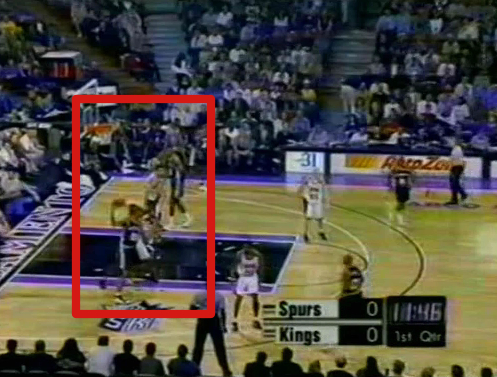
Duncan and Robinson were very good at playing off of each other, reading what they were going to do and cutting accordingly. Here, Robinson knows that Duncan is going to make his move to the middle and cuts along the baseline (so much so, he starts out of bounds), once Robinson’s man leaves him to double, he quickly gets inbounds and makes himself available for a pass under the rim. If no double comes? Robinson simply stays out of bounds and lets Duncan work. It might take a little while to get to this point, but I definitely think Bynum and Gasol can get to this point where they are reading the other big and flashing to the rim depending on how the defense plays it.
Another reason why the double low block set when you have a post up works is because it provided the Spurs with a nice quick hitting cut set.
Here, you have a post entry to David Robinson and the man making the entry pass cutting through to the opposite corner. Tim Duncan cuts right off of the cutter’s back, going through the paint, and looking for the ball. Robinson hits him and Duncan has a shot in the paint.
The Pick And Pop
Other than post up opportunities, the next most used “set” that the Spurs’ liked to run with their two bigs was the pick and pop (while the Spurs’ ran this with either big setting the screen in the pick and pop, the Lakers probably will be doing this exclusively with Pau Gasol as the screener). Again, the success of this pick and pop is predicated on spacing. When running the pick and pop, it is the same basic spacing, but instead of Duncan or Robinson trailing on the play, they come up from the foul line to set the screen for the pick and pop.
The reason why they bring the screener from the foul line instead of the usual trail position is that it provides a better angle for the screen. The first look in the pick and pop is Tim Duncan (who will be Pau Gasol) popping around the foul line.
Another option that the Spurs liked to run was a pick and pop with the big on the block quickly sealing, looking for a post up opportunity:
Here, Avery Johnson (AVERY!) comes off of a screen set by David Robinson who pops out to the elbow. As soon as Johnson comes off of the screen, Tim Duncan quickly seals, establishing terrific position (with the Lakers, it will probably be Gasol setting the screen and Bynum sealing hard). Essentially, this rocks the defense to sleep, seeing the pick and pop, thinking they are not involved, and then BOOM he is getting sealed.
With a shooting threat (Duncan/Gasol) and a posting threat (Robinson/Bynum), this forces the defense to stay home on both bigs, allowing the point guard to get all the way to the rim.
Here, Robert Horry stays at home with Tim Duncan (because he just hit two straight shots) and Shaq is hesitant to leave David Robinson. This allows Tony Parker to come off of the screen and get all the way to the rim, where he is fouled.
This is what I am talking about when I say spacing is important. You have a big at the top of the key setting a screen and a big on the block, and with the defense forced to stay at home on both of them, the lane opens up for everyone else.
A Sweet Quick Hitter
While most of the Spurs’ offense when Mike Brown was around was basic stuff revolving around principles and spacing than actual “sets,” the Spurs did have at least one sweet play that they used to run coming out of a timeout. That play was a pick and roll involving both Duncan and Bynum.
Here, the Spurs bring the basketball up the court and get the ball to Tim Duncan at the elbow. Instead of Duncan working one on one, David Robinson comes over and sets a screen for Duncan, allowing the Spurs’ to run a pick and roll with two bigs. This works because Duncan, who is handling the ball, has the size to dump the ball to David Robinson rolling to the basket.
If Robinson isn’t open, that doesn’t mean the play failed:
Here, Robinson sets the screen and rolls, but it isn’t open. Duncan is a strong enough of a ball handler where to take the basketball from the elbow to the block, turning it into a post up opportunity.
With the Lakers, you could definitely see Gasol getting the basketball at the elbow with Andrew Bynum coming over setting a screen for him. Gasol is a good enough passer and ball handler and he would be able to replicate Tim Duncan’s actions above.
“A lot of teams run bits and pieces of the Triangle Offense, it’s just basketball, it’s spacing, it’s reads…”
That’s how Mike Brown started his answer in the video at the start of the post and when watching through the Spurs’ offense, you understand why he said it as there are a lot of similarities between the Triangle and the Spurs’ offense when coach Brown was there.
We don’t know how often the Lakers will get into this offensive formation, but I wouldn’t be surprised if they ran it every single time down when they were playing Bynum and Gasol together or the entire game all together (they could even run this with Gasol playing the Robinson role and Odom playing the Duncan role). What I showed you above is what I think Mike Brown will be bringing over to the Lakers and now we have done two posts on the Lakers and their new offense (one on Kobe and one on the bigs), what is going to be interesting is how Mike Brown incorporates the two, giving Kobe Bryant his touches and letting the two bigs work in the offense. Right off the top of my head, the pick and pop with Kobe Bryant as the ball handler could be extremely interesting (Also, Brown can set it up that the swing pass from the big at the top of the key to the wing can go to Kobe Bryant and let him work one on one).
