

Confetti fell as the 2024 Celtics celebrated their win. But the joy couldn’t erase 56 years of memories. Boston’s victory showed us something important: defensive greatness lingers like a championship hangover. How do we measure Bill Russell’s stare in today’s stats?
The Spurs dynasty was a perfect example of this. Their teams moved like synchronized sharks. Tim Duncan’s positioning was as deadly as Kawhi Leonard’s steal skills. Yet, even Gregg Popovich’s genius couldn’t capture the magic of wanting it more.
Today, we have advanced stats. Boston’s 2024 team allowed just 102.3 points per 100 possessions. This would make Red Auerbach amazed. But can numbers explain why Dennis Rodman once guarded an empty backcourt? We’re trying to measure shadows while the ghosts laugh.
This isn’t just about basketball history. It’s about how we see dominance. Can we track when a defender’s stare turns a fastbreak into a funeral march? Let’s explore where stats end and the steel curtains begin.
Measuring Great Defense: Stats vs Soul
When the Warriors scored their lowest points last season, was it Boston’s analytics or defensive magic? The 2024 Celtics’ +243 point differential shows one side. But true championship defense is found in the spaces between numbers and hard work. Let’s explore how we measure defense.
Bill Russell’s 1969 Celtics were all about vertical defense, holding teams to 93.9 PPG with simple schemes. Today, Boston allows 105.3 points per game, but in a league where three-pointers are common. Which is more important: raw points or contextual dominance?
| Era | Team | PPG Allowed | Defensive Innovation |
|---|---|---|---|
| 1969 | Celtics | 93.9 | Russell’s Paint Lockdown |
| 2024 | Celtics | 105.3 | Switch-Everything Perimeter D |
| Difference | +11.4 PPG | +18.7% 3PT Attempt Rate | ||
Today, defensive efficiency metrics consider pace and shot quality. Jrue Holiday’s “matador” steals wouldn’t show in 1969. But watching both eras, we see the same truth: great defenses dictate the game.
Does the eye test matter? Ask anyone who saw Draymond Green call out defensive plays. Stats show outcomes, but film reveals championship defense DNA. The ’24 Celtics might use AI, but their closing lineup’s chemistry is pure jazz.
Celtics and Pistons Examples
Imagine Emily Dickinson writing about blocked shots and Henry Rollins screaming through an elbow drop. That’s what Celtics vs. Pistons defense was like. Boston’s 1980s team treated defense like jazz, with Bill Russell’s shots being performance art.
Their elegant approach was a stark contrast to Detroit’s tough, assembly-line style. This showed that defense could be both elegant and brutal.
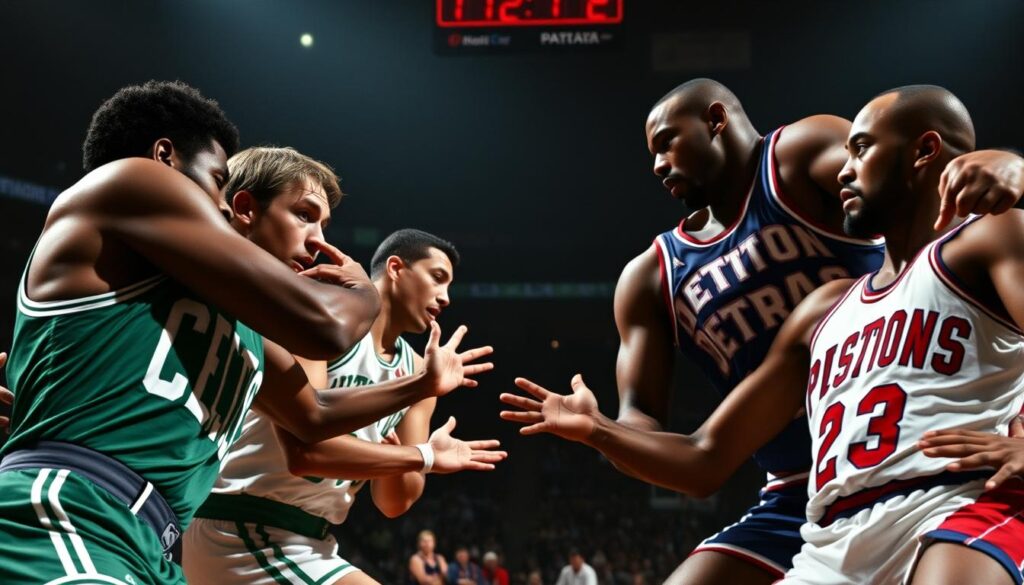
The Celtics-Lakers rivalry was more than just Magic vs. Bird. It was like a game of chess with shoulder checks. Larry Bird used trash talk like a defensive playbook, once saying he’d get it to Xavier McDaniel and bury it in his face. His prediction came true 12 seconds later.
Boston’s system was all about anticipation, turning steals into a form of psychological warfare against the Lakers’ flashy style.
On the other hand, Detroit’s Bad Boys treated defense like an economic policy. They crashed the market and then charged you for the cleanup. When Isiah Thomas played Game 6 of the 1988 Finals with a dislocated finger and blood-soaked jersey, it was more than heroism—it was branding.
Their pulling-the-chair tactic was like a sucker punch with a plausible excuse.
Let’s look at some numbers:
- Celtics held opponents under 100 points in 72% of 1986 playoff games
- Pistons led the league in technical fouls three straight seasons (1988-1990)
- Boston’s defensive rating improved by 5.2 points when Kevin McHale entered games
Detroit’s Rick Mahorn once said, “We didn’t just want to beat you—we wanted your shoes untied.” Boston’s defense whispered insults, while the Pistons used flying elbows and floor burns. Both teams had their own way of winning, but one thing is clear: defense wins championships, and how you win them shapes basketball history.
Spurs and Modern DPOY Squads
The San Antonio Spurs dynasty didn’t just win titles—they perfected defense. While others focused on flashy plays, Popovich’s team excelled in defensive efficiency. Tim Duncan, for example, averaged 2.2 blocks per game without moving an inch.
He did this by anticipating plays like a chess master. It was his secret to success.
Three key elements made their system work:
- The “No Stats” All-Star: Bruce Bowen’s defense was unmatched. He made shooters hit only 32.3% of their three-pointers at his best.
- Kawhi’s Vise-Grip Era: In 2015, Kawhi Leonard was unstoppable on defense. He took 2.3 steals per game, all while looking like a DMV clerk.
- Rotational Alchemy: The 2014 team was a defensive powerhouse. They allowed just 97.6 points per 100 possessions, showing off their teamwork.
The Spurs’ real trick was making opponents think they had open shots. Their defense was like saying, “Sure, take that 18-footer. We’ve made sure you can’t make it.” Later, data showed they made shooters’ chances 12% worse than average.
Could Bowen’s defense work today? Maybe not, thanks to today’s strict rules. But the Spurs’ legacy lives on in teams like the 2020 Lakers. They combined Anthony Davis’ defense with Caruso’s aggressive play to create a similar style.
The Spurs’ 2014 title run was a defensive masterpiece. Opponents shot just 43.6% in clutch situations. That’s not just defense—it’s forensic basketball. Popovich’s “pound the rock” philosophy is the key to success in the NBA.
Defensive Game-Changers
Defensive specialists are like artists, turning chaos into beauty. They make fast breaks slow and dunk attempts abstract. While stars chase scores, these court custodians change games with strategy and sabotage.
Bobby Jones was the first to show the power of defense. He was called the “Secretary of Defense” for his work as a sixth man. He averaged 2 steals and a block in just 26 minutes during Philly’s 1983 title run.
Dennis Rodman was a rebound master. He grabbed 18.7 rebounds per game in 1991-92, with 38% being offensive rebounds. This meant every missed shot was a chance for opponents to start over.
| Game-Changer | Specialty | Impact Metric |
|---|---|---|
| Draymond Green | Defensive Playmaking | 5.6 Deflections/Game (2016) |
| Bill Russell | Player-Coach Defense | 11 Rings as Dual Threat |
| Marcus Smart | Rulebook Revisions | 3 Flop Fines/Season Avg. |
Draymond Green made small-ball lineups deadly. His 2016 defensive playmaking turned the Warriors’ “Death Lineup” into a trap. Every defensive layer was a new problem for opponents.
Coaches like Pat Riley and Bill Russell left their mark. Riley’s teams solved for X (where X = opponent’s will to live) through defense. Russell’s player-coach approach created the first most influential NBA coaches handbook.
Marcus Smart’s flopping was a game-changer. His 15 career flop warnings led to rule changes. His performance art changed how officials call games, a defensive innovation.
Defensive Identity and Championships
Great defenses don’t just win games—they change the game. The 2004 Pistons were like a heist movie, stealing a title from Kobe and Shaq’s team. They used smart defense to make superstars work hard.
Today, teams like the 2023 Nuggets and 2024 Celtics show the power of defense. The Nuggets used Jokić’s smart defense to control the game. The Celtics used Derrick White’s long reach to stop Steph Curry.
Finals Defense: Championship Catalyst
Why do top teams lose in the Finals? It’s because defense becomes a psychological battle. Here are some key NBA Finals moments:
| Team | Defensive Tactic | Opponent FG% | Result |
|---|---|---|---|
| 2004 Pistons | Wallace Twin Towers | 41.6% Lakers | 4-1 Upset |
| 2013 Spurs | Kawhi’s “Claw” Coverage | LeBron 44.7% | Game 7 Win |
| 2023 Nuggets | Jokić Passing Lane Theft | Heat 37% 4thQ | First Title |
| 2024 Celtics | White’s Curry Shadow | GSW 29% 3PT | Historic Margin |
Championship defense is all about personality. Horace Grant’s defense in 1991 was more than just a stop. It was a statement. Kawhi’s block in 2013 was a chess move in disguise.
The key to success is a strong defensive identity. The Warriors learned in 2016 and 2024 that even great offenses need strong defense. In the NBA, the best defense is not just good offense—it’s relentless defense.
Notable Stats and Innovations

The 2024 Celtics didn’t just break records—they changed how we measure greatness. Their 112.9 defensive rating was higher than even MJ’s ’96 Bulls. But here’s the twist: today’s defensive efficiency isn’t just about individual effort. It’s about the evolution of NBA team building. Now, teams use players who can do many things, not just one.
Remember when the ABA-NBA merger banned hand-checking in 1979? Julius Erving’s chasedown blocks became legal, just like Giannis’s today. Modern defenses are like software, not stone tablets. Load management? It’s just a fancy way of saying “keeping your best for the big moments.”
| Era | Defensive Strategy | Key Innovation | Impact |
|---|---|---|---|
| Pre-2000s | Man-to-man lockdown | Illegal defense rules | Isolation stars thrived |
| Post-2004 | Zone defenses legalized | Spurs’ “Hybrid” system | Back-to-basket centers extinct by 2015 |
| 2020s | Switch-everything schemes | Celtics’ positionless roster | 7 players averaging 1+ steals/blocks |
The 2001 rule change did to traditional centers what streaming did to Blockbuster. Shaq’s footwork is now a museum piece. Today, bigs either shoot threes like KAT or guard all five positions like Bam Adebayo.
So, is Boston’s success about talent or trends? It’s both. Their roster is like a defensive efficiency fantasy draft. They have 6’8” wings who switch screens and a center who knows all the coverages. The evolution of NBA team building is all about new ideas, not old ways.
Conclusion
Wyc Grousbeck’s Celtics sale shows us a truth: NBA teams with strong defenses face big challenges. The luxury tax and Twitter can shake up rosters. But Red Auerbach’s legacy lives on.
Boston’s 11 titles were built on Bill Russell’s defense and leadership. Today, it seems like a different era. But San Antonio’s success after Duncan shows us that defense is key.
Modern teams use data to make smart moves, but Draymond Green’s smarts win championships. Toronto’s gamble on Kawhi in 2019 paid off, showing defense can beat big opponents. Miami’s undrafted players prove that with the right culture, you can win.
Can today’s teams match Bill Russell’s success? Maybe not. But the greatest teams in NBA history were adaptable. The Spurs and Celtics show us that defense can evolve and win.
Great defenses are not just about winning. They’re about constantly improving and adapting. They focus on steals and switches until they win the championship.
