

Imagine a basketball court so balanced, it rivals a Swiss watchmaker’s precision. The 5 out offense is more than a strategy; it’s a lesson in geometry and flow. It turns chaotic teams into scoring machines, thanks to smart spacing.
Basketball can seem like a mess of limbs and missed rotations. By removing the big man from the lane, we create a space. This space calls for aggressive attacks to the rim and constant awareness on the perimeter.
We focus on specific rules to keep defenders on their toes. This approach makes every player a threat, no matter their height. Success depends on reading the defense and keeping the right spacing.
Key Takeaways:
- Spacing creates clear paths for aggressive rim attacks.
- Positionless play develops versatile athletes with high IQs.
- Specific rules eliminate hesitation during fast-paced possessions.
Intro: 0.5 decision-making and spacing equity
Good decision-making is key to a winning 5-out motion offense. This offense has rules that players must follow for smooth play. One important rule is the 0.5 rule for making decisions when faced with pressure.
The 0.5 rule teaches players when to make a back cut under defensive pressure. It’s about understanding the game and making quick decisions. Learning this rule can greatly improve a player’s chance to score.
Understanding the Basics of 5-Out Motion
The 5-out motion offense focuses on spacing, movement, and decision-making. It’s designed to be flexible against different defenses. Spacing equity is vital to keep the attack balanced.
Players need to know their roles and the spacing needed for effective play. This requires a deep game understanding and the ability to read defenses. Here are some important points:
- Keeping players evenly spaced for a unified attack.
- Understanding the 0.5 rule and its impact on decision-making.
- Adapting to defensive strategies.
By focusing on these areas, teams can boost their offense’s performance. This creates more chances to score and puts pressure on the defense. The 5-out motion offense, when done right, is a strong asset for any team.
Spots and spacing: slots, wings, corners, dunker-none concept
The 5-out motion offense focuses on precise spacing and player positioning. It’s not just about being far apart. It’s about being in the right spots to exploit defensive weaknesses.
Knowing the five key spots on the court is key. These spots are the base of the 5-out motion. Players must fill these spots unless they’re doing something else like screening or cutting.
Setting Up the 5-Out Motion Offense
Players line up in the left corner, left wing, top, right wing, and right corner. They usually stand on or near the NBA three-point line. This setup is vital for a balanced offense that stretches the defense.
Understanding the Five Spots
The five spots are essential for the 5-out motion. Here’s a quick overview:
- Left Corner: A sharpshooter or player who can create from the corner usually takes this spot.
- Left Wing: A versatile player who can shoot and drive often fills this spot.
- Top: The point guard or primary ball handler usually directs the offense from here.
- Right Wing: Similar to the left wing, this player is expected to be versatile.
- Right Corner: This spot mirrors the left corner in terms of expectations and player skills.
Keeping these positions ensures the offense stays balanced and hard to defend.
| Position | Typical Player Role | Key Responsibilities |
|---|---|---|
| Left/Right Corner | Sharpshooter/Creator | Shoot, create for self or others |
| Left/Right Wing | Versatile Player | Shoot, drive, pass |
| Top | Point Guard/Primary Ball Handler | Direct offense, make decisions |
By understanding and maintaining these spots, teams can effectively execute the 5-out motion offense. This creates a dynamic and challenging attack for defenses to handle.
Penetration rules: Middle vs baseline drive; drift, shake, and 45 cut responsibilities
Penetration is key in the 5-out motion, making the defense react. It’s not just about one player getting past their defender. It’s about creating chances for the whole team.
Knowing when to drive to the middle or baseline is important. A middle drive can really push the defense back. This can lead to a scoring opportunity for the driver or a teammate.
Driving and Creating Scoring Opportunities
When driving, players must watch their teammates and the defense. The drift and shake actions are vital. Drifting creates space, while shaking gets free from the defender.
The 45 cut is also key. It offers a passing option and stretches the defense. Players must know their defender’s strengths and weaknesses to decide to drive or pass.
Deciding to drive depends on the player’s skills and the defender’s. If a player thinks they can attack, they should do it right away. This can surprise the defense and give an advantage.
Good penetration also needs teamwork. If a player drives to the baseline, teammates must be ready to react. They might need to set up for a three-pointer or get a rebound.
- Identify the defensive alignment and look for weaknesses.
- Make a decisive drive to either the middle or baseline based on the defensive setup.
- Use drift and shake movements to create confusion and open up passing lanes.
- Be prepared to make a 45 cut or other movements to create scoring opportunities.
Advantage creation: Slot-to-slot swing, catch-go, re-drive windows
In the 5-out motion offense, creating advantages is an art. It requires precision, timing, and a deep understanding of the game. It’s about making the defense work harder than your offense. Teams can outmaneuver their opponents by using specific movements and player actions.
The slot-to-slot swing is a key action. It involves a player swinging the ball from one slot to the other. This can catch the defense off guard and create a scoring chance. It’s a simple yet effective way to exploit defensive weaknesses.
Creating Advantages in the 5-Out Motion
The catch-go is another important element. It involves a player receiving a pass and then driving to the basket or creating a scoring opportunity. The catch-go is very effective when combined with the slot-to-slot swing. It can put the defense in a vulnerable position.
Re-drive windows are also key in the 5-out motion offense. These are chances for a player to drive to the basket again after being defended. By recognizing and using re-drive windows, players can get more scoring chances and keep the defense guessing.
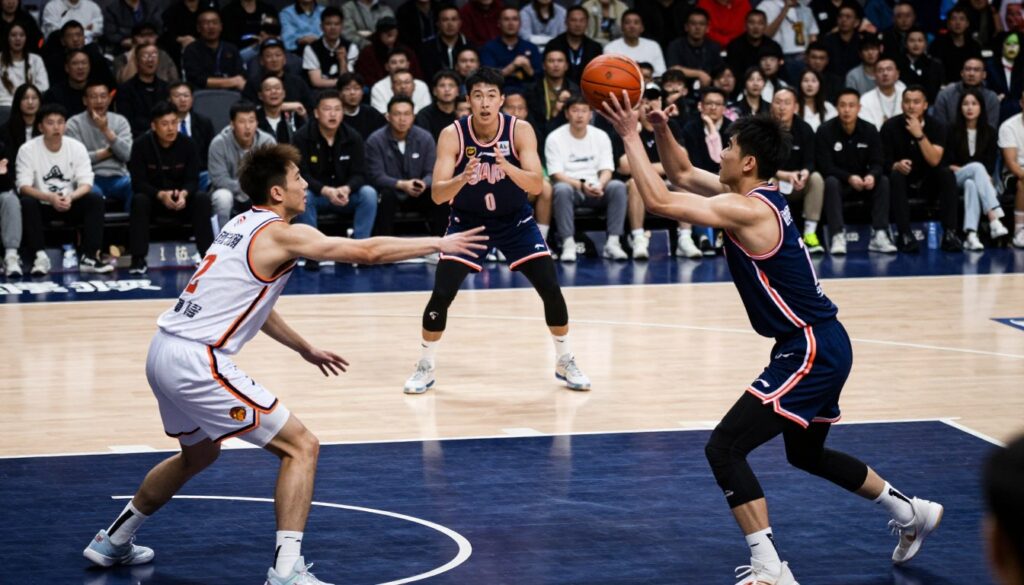
To make these actions work best, players need to be aware of their surroundings and make quick decisions. The 5-out motion offense is not just about individual skill. It’s about how players work together to create advantages and exploit defensive weaknesses.
- Identify defensive weaknesses and target them.
- Use the slot-to-slot swing to create mismatches.
- Capitalize on catch-go opportunities to drive to the basket.
- Recognize re-drive windows to create additional scoring chances.
Finishing map: Rim, floater, spray 3s; paint-touch goals and shot spectrum
The goal of the 5-out motion offense is to score. It starts with knowing the finishing map. This map shows how players can score, like at the rim, with floaters, or with 3s. Learning these skills makes players versatile and balanced in their shooting.
To finish plays well, players must know the game and the defense. This knowledge helps them decide when to drive, shoot a floater, or pass for a 3. Being flexible and adjusting to the defense is key.
Executing Finishing Plays
Finishing plays well needs skill, awareness, and quick decisions. Players must read the defense and choose wisely. They need to know their own and teammates’ strengths and weaknesses.
A good finishing play can lead to many scoring chances. These include shots in the paint, open 3s, and other scoring chances. The goal is to have a balanced shot spectrum that keeps the defense guessing.
| Finishing Type | Description | Defensive Challenge |
|---|---|---|
| Rim Finish | Driving to the basket for a layup or dunk | Defenders must protect the paint and contest shots |
| Floater | A high-arcing shot over outstretched defenders | Defenders must time their jump to contest without fouling |
| Spray 3s | Open 3-point shots from various locations | Defenders must close out quickly and contest the shot |
Understanding and executing different finishing plays is key to a strong offense. Teams can use these skills to find and use defensive weaknesses. The paint-touch goals are important for measuring the offense’s success, as they show how well the team scores.
Counters vs help: Nail stunt counters, x-out reading, skip vs pocket kick
The 5-out motion offense is more than just scoring. It’s about beating the defense too. As defenses get tougher, teams must be ready to outsmart them.
When secondary defenders step in, teams must quickly adjust. This is where nail stunt counters come in. They confuse defenders and help teams use the defense’s strategy against them.
Countering Defensive Strategies
Understanding the defense is key. Teams must know if it’s man-to-man or zone defense. X-out reading helps players spot these and make smart moves.
Teams have two main ways to pass: skip passes and pocket kicks. Skip passes go across the court, while pocket kicks are to teammates closer by. The choice depends on the defense and the team’s plan.
To beat help defense, teams need to throw a skip pass. They can then shoot or attack the defender. This requires great court vision, passing, and reading the defense. With these skills, teams can outsmart opponents and score, even against strong defenses.
- Identify the defensive strategy and make adjustments
- Use nail stunt counters to create confusion
- Employ x-out reading to recognize defensive alignments
- Choose between skip passes and pocket kicks based on the defense
Teaching progression: No-dribble to one-dribble constraints; 3v3/4v4 games
Starting with the basics helps players learn the 5-out motion offense. Coaches break down the complex offense into simpler parts. This makes it easier for players to learn and get better.
Progressive Teaching Approach
A progressive teaching approach is key for the 5-out motion offense. Coaches start with no-dribble constraints. This lets players focus on movement and spacing without dribbling.
When players get more comfortable, coaches add one-dribble constraints. This lets players work on their decision-making while dribbling. It’s a step towards handling more complex game situations.
3v3/4v4 games are great for teaching the 5-out motion offense. These smaller games let players practice in a controlled setting. They help players understand the game dynamics and make better decisions.
For more on game dynamics, coaches can check out scouting an NBA offense. It offers insights on team strategies and player movements.
Film & data: How analysts tag paint touches, potential assists, corner 3 frequency
Film and data analysis are key to understanding the 5-out motion offense. Teams can learn a lot by watching game footage and looking at stats. This helps them see how they’re doing and where they can get better.
It’s important to analyze how well the 5-out motion offense works. Analysts look at paint touches and potential assists to judge the team’s performance. They watch game footage closely to spot scoring chances and see if the team can take advantage of them.
Analyzing Performance Metrics
Teams need to focus on certain metrics to understand their 5-out motion offense better. These include paint touches, potential assists, and corner 3 frequency. These numbers show how well the team can get into the paint, create scoring chances, and run their offense well.
Here’s how these metrics are analyzed:
| Metric | Description | Importance |
|---|---|---|
| Paint Touches | Number of times a player or team touches the ball in the paint | Shows how well the team can get into the paint and score |
| Potential Assists | Number of passes that lead to a scoring opportunity | Measures the team’s ability to create chances and run their offense |
| Corner 3 Frequency | Number of 3-point shots taken from the corners | Shows how well the team can stretch the defense and find space |

By looking at these metrics, teams can understand their strengths and weaknesses. This helps them make smart decisions to get better. Remember, “you can’t improve what you don’t measure.” In basketball analytics, the right metrics are key to success.
Troubleshooting: Over-dribbling, dead corners, poor lift timing
The 5-out motion offense is great but can be hard to master. Players might forget to look for ways to score. This can cause problems like over-dribbling, dead corners, and poor lift timing, which can hurt the team’s performance.
Common Issues in the 5-Out Motion
One big problem is over-dribbling. This happens when a player focuses too much on dribbling and forgets to pass or look for scoring chances. Coaches can teach the importance of decision-making and spacing equity to fix this.
Dead corners are another issue. This is when the corners don’t create scoring chances. Teams can work on slot-to-slot swing and catch-go plays to keep the offense moving.
Poor lift timing is also a problem. Players might miss scoring chances because they don’t time their lifts right. Coaches can help by practicing re-drive windows and stressing communication.
- Practice decision-making drills to improve players’ ability to read the game.
- Emphasize the importance of spacing and movement to avoid dead corners.
- Work on timing and communication to improve lift timing.
By tackling these common issues and using effective strategies, teams can get better at the 5-out motion offense. This will help them find more ways to score.
Terminology cheat sheet
Mastering the 5 out offense is more than just knowing the basics. It’s about understanding its unique terms. Key terms like “drive and kick” and “hammer action” are essential for clear communication among players and coaches.
Decoding Key Terms
The “drive and kick” is a basic action. A player drives to the basket and then kicks the ball out to teammates. This allows them to take open shots. The “hammer action” is another key play. It involves a post player setting a down screen for a teammate.
Knowing these terms is key to running the 5 out offense well. For deeper insights into basketball strategies, check out the analysis on the pick and roll.
By learning the terminology, players can improve their game. They can also help their team work together better.
