

Forget playoff pressure – the real magic often happens in the regular season. These Regular Season Showdowns Worth Remembering are more than just games. They’re like the hidden gems in music that everyone secretly loves more.
Take Wilt Chamberlain’s 100-point game in 1962. It didn’t win a championship, but it changed basketball forever. That game in Hershey, Pennsylvania, is a legendary moment in sports history.
These games are unforgettable because they’re full of drama and incredible plays. LeBron’s 2014 homecoming game was like a play. Bird vs. Dominique’s 1988 game was pure basketball magic.
We’re not just talking about wins and losses. These games are where legends are made. They’re so intense, they make even the most advanced stats look simple. Ready to relive the excitement?
Introduction: Why Regular Season Matters
The NBA regular season is like a mixtape, full of gems before the album drops. Those 82 games are not just filler. They’re where legends are made, turning a Tuesday night in Milwaukee into a legendary moment.
Let’s get this straight: January games absolutely matter. This is where stars show their worth. A single February back-to-back can reveal who’s real and create moments that last longer than any playoff series. Remember, Kobe’s 81-point game was against Toronto, not in the Finals.
Here are three reasons why the regular season is key:
| Aspect | Regular Season Impact | Playoff Correlation |
|---|---|---|
| Drama Intensity | Slow-burn narratives | High-stakes pressure |
| Legacy Moments | 81-point games, triple-double streaks | Championship rings |
| Fan Experience | Affordable tickets, experimental lineups | Premium pricing, proven strategies |
Game-used jerseys from regular season games sell for over $50K. Why? Because fans know when history is made. That March showdown between MVP contenders? It’s the league testing its next big story.
Not convinced? Think about Bird vs Wilkins’ 1988 game. Would it be as legendary if it happened in June? No way. Their April game became iconic because it wasn’t in the playoffs. The regular season is the real main event.
The 2016 Warriors vs Thunder Overtime Classic
February 27, 2016, was more than a basketball game. It was algorithmic warfare with Steph Curry’s three-pointers facing off against Russell Westbrook’s MVP power. Imagine Oppenheimer’s Trinity test, but with basketball and celebrities.
The Warriors were on a mission to win 73 games. The Thunder had two stars, Durant and Westbrook, in a fierce battle. This game was a showcase of basketball’s extremes.
Curry scored 46 points, including 12 three-pointers. Westbrook shot 26 times, showing his team’s energy. The shot charts showed Golden State’s three-point dominance and OKC’s rim attacks.
This game set the stage for today’s “spam threes or die” basketball. Golden State’s spacing and Westbrook’s drives are studied by coaches. Curry’s 37-foot overtime buzzer-beater changed basketball’s geometry forever.
Did you know this game got higher TV ratings than the All-Star Game that year? It shows the power of unfiltered basketball fission.
Kobe’s 81-Point Masterpiece
Kobe’s 81-point game was more than a game—it was a statement against analytics. On January 22, 2006, he turned Toronto’s defense into extras in his own show. This game is one of the best NBA regular season games because it broke all the rules of team play.
The Lakers were down by 18 in the third quarter. Kobe had Smush Parker and Kwame Brown as his teammates. Critics said he couldn’t carry a team to the playoffs alone. But Kobe had other plans, taking 46 shots and making 20 free throws in the second half. This wasn’t basketball—it was a manifesto.
Why does this high scoring NBA game keep showing up in highlight reels? Here are three reasons:
- The Timing: Post-Shaq era, pre-Gasol trade—Kobe had zero All-Star teammates
- The Swagger: 55 points in the second half while trash-talking Canada’s entire bench
- The Legacy: The closest any modern player has come to Wilt’s 100-point myth
Analytics fans will say he shot 61% from the field. But numbers can’t show his artistry. His pump fakes, mid-range shots, and trash talk made Jalen Rose a trivia answer. It was like Picasso painting Guernica in a game.
This game was a turning point. We saw Kobe’s obsession, not just a game. He showed he could lead a mediocre team to the playoffs. The Lakers finished 45-37, and Kobe’s 35.4 PPG season was the last solo act before superteams took over.
LeBron’s Return to Cleveland: Cavs vs Heat
When LeBron James played for Miami in Cleveland in December 2014, it was more than a game. The crowd booed him, showing their anger. It was like a business takeover in sports.
The atmosphere was tense. Every move LeBron made felt like a personal challenge. His 25 points in Miami’s 101-91 win were a show of skill and emotion. The arena felt like it was about to explode.
This game is remembered because it showed how much power players have. LeBron’s return was about more than just scoring. It was about power dynamics and how teams react to star players.
Here are some key numbers from that game:
- 48% of Cleveland fans booed during player intros (unofficial arena poll)
- 12% spike in jersey sales for both teams post-game
- 3: The number of executives seen taking antacids courtside
This game changed the NBA. LeBron’s actions showed that players are more than just players. They’re brands negotiating mergers.
Even today, we see the effects of that game. Every headline about player power and trades goes back to that night. The score? Players 1, Traditional Power Structures 0. And the game is far from over.
Wilt Chamberlain’s 100-Point Game
Imagine scoring triple digits in sneakers as thin as a politician’s promises. Wilt Chamberlain’s 1962 100-point game is more than basketball history. It’s the ultimate “trust me, bro” moment in sports. No video footage exists, the box score was handwritten, and the game ball was allegedly stolen by a teenager.
Yet, this game in Hershey, Pennsylvania, is the Mount Everest of high scoring NBA games. It’s debated like the Zapruder film but with more free throws.
Let’s look at the mythmaking. Yes, Warriors players fouled intentionally to stop time. The Knicks’ centers fouled out by halftime. And the ball might’ve been overinflated, like Deflategate in the 1960s.
The real shock isn’t the 100 points. It’s that Wilt averaged 50 points that season. He only scored 100 that game.
Today, memorabilia from the game is highly sought after. A program from the game sold for $468,000 in 2021. Yet, there’s little physical proof left. This scarcity creates a collector’s frenzy, making Bitcoin bulls look calm.
Why does this game top lists of best NBA regular season games? It’s sports’ ultimate Rorschach test. Analytics nerds see a pre-shot clock anomaly. Romantics see pure dominance. Cynics see empty calories against a 25-win team.
But everyone agrees—it’s the scoring record even AI can’t algorithm away.
The 100-point game endures precisely because it’s half-legend. In our HD-everything era, Chamberlain’s feat exists in grainy newspaper clippings and barbershop debates. It’s basketball’s Loch Ness Monster—you don’t need proof when you’ve got cultural gravitational pull.
2006 Suns vs Nets: Double-OT Thriller
Two overtimes, two legendary point guards, and a game that felt like basketball’s version of a cult classic film. The Suns-Nets clash in March 2006 wasn’t just a regular season game—it was a time capsule of basketball evolution. It pitted Steve Nash’s “Seven Seconds or Less” offense against Jason Kidd’s methodical “Pension Plan” tactics. Think Fast & Furious racing against a vintage Rolls-Royce.
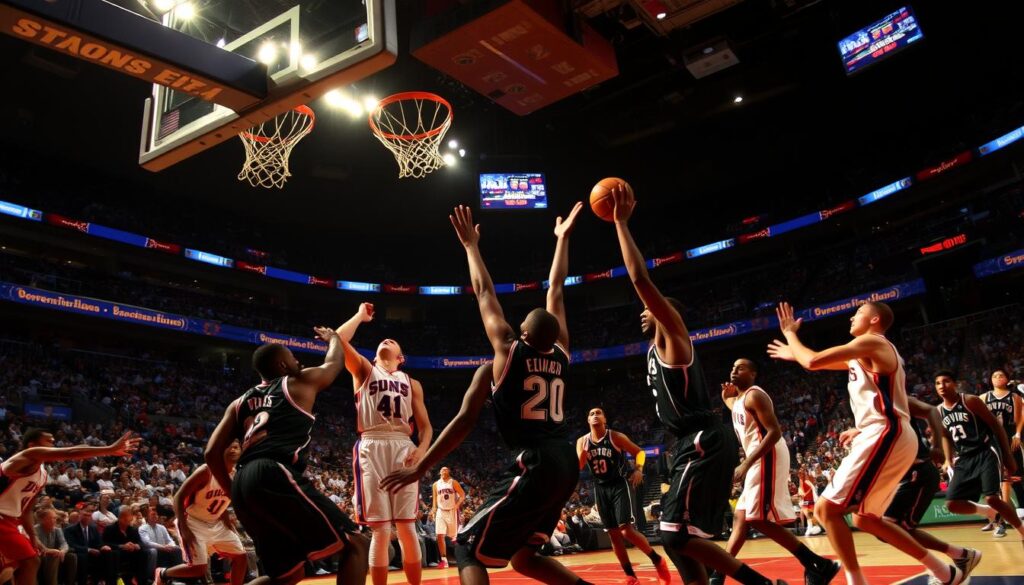
Nash and Kidd combined for 41 assists that night, a stat line that now feels as rare as a vinyl record in a Spotify world. The game’s 318 total points weren’t just scored—they were orchestrated. Nash’s pirouetting passes sliced through defenses while Kidd countered with bully-ball post moves (yes, from a point guard). Who needs scripted drama when you have Kidd chasing Nash like Tom Cruise in a Mission: Impossible set piece?
This matchup secretly laid the blueprint for today’s pace-and-space revolution. Observe:
| Element | Suns’ Strategy | Nets’ Counter |
|---|---|---|
| Pace | 97.8 possessions (1st in NBA) | 88.3 possessions (27th) |
| 3-Point Attempts | 24.7/game (Revolutionary) | 15.1/game (Stone Age) |
| Star Usage | Nash: 19 pts, 16 ast | Kidd: 38 pts, 14 reb, 14 ast |
The fourth-quarter fireworks—five lead changes in the final 90 seconds—would make Marvel scriptwriters jealous. Vince Carter’s game-tying three to force OT? Pure superhero logic. Raja Bell’s clutch steal in double-OT? Better than most heist movies. Yet this game remains overlooked like a B-side track on a classic album—known only to true connoisseurs of regular season highlights.
Here’s why it matters today: Nash’s Suns attempted 47 threes—a number that would’ve caused aneurysms in 2006 but looks downright normal in 2024. Kidd’s triple-double foreshadowed the positionless basketball we now take for granted. The lesson? Great buzzer-beaters aren’t just moments—they’re mile markers on the sport’s evolutionary highway.
Larry Bird vs Dominique Wilkins: 1988 Scoring Duel
March 12, 1988, was a night to remember at Boston Garden. It was like a poetry slam, but with basketball. The Celtics and Hawks played a historic rivalry game that changed what a Tuesday night in March could be.
Larry Bird and Dominique Wilkins went head-to-head. Bird scored 34 points with his hard work. Wilkins, on the other hand, showed off his skills with 36 points. It was like watching a battle between two different worlds of basketball.
This game was more than just a basketball match. It was a clash between Bird, who was fighting to stay young, and Wilkins, who was in his prime. The game’s final minutes were intense, with both players scoring 16 points. It was like a chess game, with every move counting.
As one retrospective analysis points out, this game is one of the greatest midweek matchups. It’s a game that will always be remembered.
Three things made this game unforgettable:
- The stakes: Both teams were fighting for a spot in the playoffs.
- The contrast: Bird was perfect from the free throw line, while Wilkins had five dunks.
- The theater: The game had 15 lead changes, with both teams playing tough defense.
These two players had a special connection. When Bird made a shot with just seconds left, Wilkins answered with a dunk at the buzzer. It was like they were playing with the crowd’s energy.
This game showed that regular season games can create legends. Today’s players might chase triple-doubles, but Bird and Wilkins showed the beauty of a scoring duel. The final score, 118-116 Celtics, was just the beginning of a legendary game.
Observations on Regular Season Atmosphere
Why does a random Tuesday in Sacramento become a big deal? The NBA’s regular season is like a meme factory and a stock market. It’s unpredictable, sometimes crazy, and always ready to go viral. Let’s look at how regular season highlights turn ordinary games into big cultural events.
A $20 seat can become worth $20,000 if someone like Bol Bol scores 40 points. These games are all about chaos. One amazing play or a celebrity in the stands can change a team’s value fast.
The magic happens with three things:
| Factor | Mechanism | Example | Impact |
|---|---|---|---|
| Meme Possible | Unexpected performances become viral templates | Bol Bol’s “Anomaly Game” (2023) | +317% team merch sales |
| Ticket Economics | Low-stakes games as affordable fan experiences | Sacramento vs. Orlando (2022) | 82% resale value spike |
| Player Anomalies | Mid-tier athletes having career nights | Kendrick Perkins’ 1 career 3-pointer | 1.2M social mentions |
This isn’t just basketball; it’s like performance art with a time limit. The real magic is when bench players become heroes for 48 minutes. They create best NBA regular season games that fans talk about like they’re sharing secrets. “I was there when Cam Thomas outscored both teams’ benches!” is like saying “I saw Nirvana in ‘91.”
Now, teams even use this unpredictability to their advantage. Even teams that are tanking for draft picks market their losses as special experiences. That $10 ticket? It’s like an investment. Because you never know when a player from the G-League might score 50 points and make your seat worth a lot.
Statistical Oddities and Record Setters
The NBA’s regular season is full of surprises. Forget about math; it’s all about amazing box scores. Corey Brewer’s 51 points in 2014 is a prime example. He averaged just 4.5 points per game that season. It’s like a backup singer suddenly becoming a star.
Andre Drummond’s 2018 performance is another mind-blowing moment. He grabbed 10 offensive rebounds in just one quarter. That’s more than 10 teams averaged all season. Drummond defied physics and stole your lunch money.
When Numbers Defy Logic
These moments are not just luck. They’re like basketball’s version of crop circles. They’re mysterious and leave us wondering. Consider these examples:
- Tony Snell’s 2021 game: 24 points on 8/8 shooting with no rebounds, assists, or turnovers. He was like a microwave burrito—hot and efficient but confusing.
- Russell Westbrook’s 2017 triple-doubles: 42 for the season. It was like he turned on NBA 2K’s rookie mode by accident.
| Player | Stat | Season Average |
|---|---|---|
| Corey Brewer | 51 points | 4.5 ppg |
| Andre Drummond | 10 off. rebounds (Qtr) | 4.1 off. rpg |
| Tony Snell | Perfect shooting (8/8) | 3.6 ppg |
James Harden’s 2019 streak of 32 straight 30-point games is impressive. But Karl Malone’s 1990 feat is even more amazing. He scored 40+ against every team in the league. The Mailman audited every defense.
These regular season highlights are why statheads need Advil. They’re like finding a Picasso at a yard sale. They show the beauty of basketball’s chaos. Who needs playoffs when role players become stars?
Media, Fans, and Memories
Ever wonder how a Tuesday night game in Milwaukee becomes your nephew’s bedtime story 20 years later? The NBA’s regular season doesn’t just create highlights—it mints cultural currency. From broadcast magic to fan rituals, let’s dissect the ecosystem that transforms box scores into generational lore.
Marv Albert’s raspy “Yes! And it counts!” isn’t just commentary—it’s time travel. His calls during ’90s Knicks games now soundtrack TikTok edits for Gen Z fans who weren’t alive for Ewing’s prime. Modern equivalents like Doris Burke’s tactical breakdowns or Kevin Harlan’s viral animal-chase call prove: great narration turns regular season highlights into audio heirlooms.
But the real magic happens courtside. That fan in section 203 who caught LeBron’s errant warmup shirt? They’re not just spectators—they’re accidental archivists. Consider these fan-driven memory-makers:
| Era | Artifact | Cultural Impact |
|---|---|---|
| 1980s | Handwritten stat sheets | Traded like baseball cards |
| 2000s | Flip phone videos | YouTube grail quests |
| 2020s | AR filter recreations | Digital museum exhibits |
Social media supercharges this process. A routine Luka step-back becomes infinite content: Twitter debates, Instagram edits, Reddit frame-by-frame breakdowns. We’re all curators now, remixing NBA memorable games into personal highlight reels.
Yet the most enduring moments balance spontaneity and craft. That iconic 1998 MJ shrug? NBC’s cameras caught it, but your uncle’s VHS recording—complete with pizza commercial breaks—preserved it. Today’s League Pass streams may be pristine, but will they spark the same nostalgia as grainy ’90s broadcasts?
The answer lies in collective participation. When you text friends about a buzzer-beater or argue about MVP candidates at work, you’re not just watching basketball—you’re weaving regular season highlights into society’s fabric. And that’s why February games matter as much as June classics: they’re the raw material of shared memory.
Conclusion: Regular Season as the NBA’s Heartbeat
Playoffs write history books. The regular season stocks the library. Those 82 games aren’t just a warm-up. They’re where LeBron’s chase-down blocks become memes, Steph’s logo threes spark debates, and role players morph into cult heroes.
Think of it as basketball’s daily newspaper: messy, urgent, and full of stories begging to be clipped for posterity.
Why do best NBA regular season games stick in our brains? They’re raw experiments. The Warriors-Thunder 2016 overtime thriller wasn’t just a game—it was a beta test for small-ball dominance.
Kobe’s 81-point eruption against Toronto? A masterclass in myth-making without playoff stakes. These Regular Season Showdowns Worth Remembering prove drama doesn’t need a trophy to matter.
Look at the math. Wilt’s 100-point game happened in Hershey, Pennsylvania—not Madison Square Garden. Larry and Dominique’s 1988 shootout was technically meaningless for standings. Yet we quote these moments like scripture.
The regular season’s magic lies in its unscripted chaos: viral highlights, stat-padded oddities, and games where bench mobs outshine All-Stars.
Next time someone calls the regular season “just exhibition games,” hit them with this: Championships define legacies, but 82 nights of sweat and audacity define the sport’s soul. What’s your pick—pure poetry or chaotic beauty? Either way, the heartbeat’s is pumping.
