

What makes a basketball game unforgettable? It’s not just the sweat or “and-one” cheers. It’s the historic rivalry games where grudges turned into legacies. These games were battles fought on the hardwood.
The late-80s Bulls vs Pistons rivalry was like Game of Thrones for basketball. Michael Jordan’s rise was tested against Detroit’s “Bad Boys.” This epic battle led to rule changes and new stars.
NBA rivalries change the game. They move beyond just scores. They shape the league’s future, from slow big-man play to fast-paced, positionless basketball. These rivalries pushed coaches and players to new limits.
Get ready for the matchups where pride was more important than points. These games shaped today’s NBA. They were filled with smack-talkin’ and pure chaos.
What Makes a Great NBA Rivalry?
What makes an NBA game more than just a game? It’s the three key ingredients that turn it into a cultural event. Let’s dive into what makes these rivalries unforgettable.
1. Frequency Breeds Contempt: Great rivalries need many games, like the Lakers vs Celtics in 12 NBA Finals. Without these, it’s just two teams missing their shots.
2. Narrative Juice: Every rivalry needs a compelling story. Think Magic vs Bird or Jordan vs Detroit. The drama should be so intense, even the popcorn vendors take sides.
| Rivalry Element | Why It Matters | Modern Example |
|---|---|---|
| Playoff Meetings | Creates legacy-defining stakes | Warriors vs Cavs (2015-2018) |
| Star Power | Drives media hype and fan investment | Jokić vs Embiid MVP battles |
| Style Clash | Showcases contrasting basketball philosophies | Seven Seconds Suns vs Grit-and-Grind Grizzlies |
3. The Mercy Rule Doesn’t Apply: Great rivalries are always back and forth. If one team always wins, it’s not a rivalry. The Bulls vs Pistons and Spurs vs Lakers are perfect examples.
Forget about jersey colors. The best rivalries are about pride, talent, and revenge. They’re why we remember Russell vs Chamberlain and why Drake wears a Raptors jersey to Warriors games. That’s cultural impact.
Celtics vs Lakers: 1960s–2010s—A League Defined
Imagine Shakespeare writing a basketball epic with dynasties clashing in Technicolor shorts. The Celtics-Lakers saga is more than a rivalry. It’s the DNA helix of modern NBA storytelling, spanning 12 championship duels over six decades. From Boston Garden to Staples Center, this feud turned basketball into America’s Cold War theater.
The 1960s set the stage: Bill Russell’s 11 rings haunted Elgin Baylor. Baylor dropped 61 points in a Finals game… and lost. What a tragic hero.
The 1980s brought basketball’s version of Rocky IV. Magic Johnson’s Showtime offense faced Larry Bird’s precision. It was ideological warfare:
- East Coast grit vs West Coast glam
- Fast breaks vs half-court chess
- White superstar vs Black icon (in a league desperate for both)
The 2008 revival reignited the feud. Kobe Bryant sought revenge for Shaq’s 2004 collapse. Paul Pierce won Finals MVP, while wheelchair memes trended. When these teams meet in June, history joins the game.
| Era | Celtics Weapon | Lakers Counter | Legacy Moment |
|---|---|---|---|
| 1960s | Russell’s Defense | Baylor’s Scoring | 1962 Finals: Baylor’s 61 pts in loss |
| 1980s | Bird’s Clutch Gene | Magic’s No-Look | 1984 Finals: Bird’s steal & layup |
| 2000s | Pierce’s Truth | Kobe’s Mamba Strike | 2010 Game 7: 83-79 defensive slugfest |
What makes these NBA Finals Classics last? They reflect basketball’s evolution. The Celtics’ team-first ethos vs LA’s superstar focus. Red Auerbach’s cigar smoke vs Pat Riley’s slicked-back hair. Even the revivals matter – the 2008/2010 bouts drew higher ratings than the Cold War’s finale.
Today’s players feel the Celtics-Lakers legacy. Jayson Tatum studies Bird’s footwork. Anthony Davis channels Kareem’s skyhook. The rivalry lives because it’s about who’s watching. From owners to TikTok teens, we’re all part of basketball’s longest drama.
Bulls vs Pistons: Bad Boys vs Airness
Before Michael Jordan soared, he had to fight through Detroit’s tough defense. The Bulls-Pistons rivalry was more than just basketball. It was a clash of cultures, with Detroit’s “Bad Boys” facing off against Jordan’s rise to fame. Their battles changed how the NBA viewed physical play, making today’s “load management” seem like a break from the action.

The Pistons’ Jordan Rules were not just rules, but a way to survive against Jordan. They used:
- Triple-team MJ on drives
- Hard fouls disguised as “momentum stoppers”
- Psychological warfare via trash talk and walk-offs
Detroit’s plan worked for a while, but then Jordan came back. He had 12 lbs of muscle and Phil Jackson’s triangle offense. The 1991 Eastern Conference Finals were a turning point, with Jordan’s skills overpowering the Pistons.
| Year | Playoff Stage | Pistons’ Tactics | Bulls’ Counter |
|---|---|---|---|
| 1988 | EC Semis | 47 personal fouls on Jordan | MJ averages 27 PPG |
| 1989 | EC Finals | Isiah’s “injury timeout” exit | Pippen emerges as defensive anchor |
| 1991 | EC Finals | Laimbeer’s “accidental” elbows | Jordan’s 29.8 PPG sweep |
The Pistons’ last move was a walk-off heard ’round the world. It was more like a tantrum than sportsmanship. But this behavior fueled Chicago’s dynasty. Jordan won his first title just 12 days later.
This rivalry was legendary not just for the elbows or injuries. It was about a major change in NBA philosophy. The Pistons showed you could win without being pretty. The Bulls showed that beauty could be just as tough. And we’ve been debating “the right way to play” ever after.
Lakers vs Spurs: Western Conference Supremacy
Imagine a Hollywood blockbuster where Zen masters and tacticians duel for basketball dominance—welcome to Lakers vs Spurs. This wasn’t just a rivalry; it was a iconic NBA team battle. Coaching philosophies collided like tectonic plates. Gregg Popovich’s whiteboard strategies met Phil Jackson’s triangle offense in a cerebral showdown.
Tim Duncan’s methodical bank shots became the Spurs’ heartbeat, while Kobe Bryant’s killer instinct fueled L.A.’s fire. Their clashes weren’t decided by flashy dunks but by chess moves disguised as pick-and-rolls. Remember Derek Fisher’s 0.4-second miracle in 2004? That shot didn’t just win a game—it exposed how thin the margin between genius and disaster truly was.
Popovich’s Spurs played like a Swiss watch: precise, relentless, and slightly boring unless you appreciated the craftsmanship. Jackson’s Lakers? More like a jazz improvisation—structured chaos with Shaq’s dominance and Kobe’s artistry. The contrast created must-watch theater every playoff season.
Three elements defined this rivalry:
- Coaching chess: Pop’s defensive schemes vs Phil’s psychological warfare
- Legacy plays: Duncan’s fundamentals vs Kobe’s flair
- Momentum swings: Robert Horry’s clutch threes or Manu Ginóbili’s Eurosteps
By 2008, these teams had combined for 9 championships in a decade. Their battles weren’t just about rings—they redefined how franchises build dynasties. The Spurs prioritized system over stardom, while the Lakers bet on superstar alchemy. Both approaches worked, proving there’s no single blueprint for iconic NBA team battles.
Next time someone calls basketball “just a game,” show them tape of Lakers-Spurs in the 2000s. You’ll see Shakespearean drama disguised as a box score.
Knicks vs Heat: Physicality and Passion in the 90s
Madison Square Garden in the late ’90s was more like a WWE ring than a basketball court. The rivalry between the Heat and Knicks was so intense that it’s often used in NBA referee training. It showed what “physical play” really means.
When Pat Riley left New York for Miami in 1995, the rivalry turned personal. It was like Darth Vader joining the Rebel Alliance, but with more hair gel. The fights between 1997-2000 were like watching two bulldozers argue over parking.
Three moments stand out from the chaos:
- 1998 Playoffs: Jeff Van Gundy’s leg clamp on Alonzo Mourning was a coaching masterpiece.
- 1997 Brawl: Mourning’s right hook almost hit Larry Johnson, starting a 10-player fight.
- 1999 Eastern Conference Finals: The series was so intense, the league thought about penalty boxes.
| Knicks | Heat | |
|---|---|---|
| Playstyle | Street brawl with jump shots | Boxing match with pick-and-rolls |
| Signature Move | Charles Oakley’s “negotiation tactics” | Tim Hardaway’s killer crossover |
| Cultural Impact | Made Spike Lee’s courtside rants mainstream | Turned Miami’s white-hot jerseys into villain uniforms |
This rivalry changed the Eastern Conference. It invented the idea of “playoff fouls.” Players got technicals like badges, and coaches planned who to send in first. Riley’s hair stayed perfect, showing slicked-back pomade was key.
Today’s NBA focuses on three-pointers, but the Heat vs Knicks rivalry shows why physicality is important. Those intense games made us appreciate the beauty of a well-timed hard foul.
Celtics vs Sixers: Wilt vs Russell to Doc vs Bird
Basketball’s first big question wasn’t about stats—it was Wilt Chamberlain’s 100-point game versus Bill Russell’s 11 championships. Could sheer offense beat a defense-first team? The Celtics and Sixers made this question a 20-year battle in the air.
Russell’s Celtics ruled the 1960s with a defensive strategy. They kept Chamberlain to just 30.1 PPG in their playoff games. But Wilt averaged 28 rebounds in those series. Two legends, two ways to win—stats versus championships.
In the 1980s, Larry Bird and Julius Erving turned trash talk into a show. Their 1984 Eastern Conference Finals were unforgettable:
- Bird scored 27 points in the fourth quarter of Game 7 (“I’m stealing your soul, Doc!”)
- Erving made a famous baseline scoop over McHale
- And there were more elbows than a heavy metal concert
| Era | Celtic Weapon | Sixers Counter | Outcome |
|---|---|---|---|
| 1960s | Russell’s Defense | Wilt’s 50.4 PPG Season | Boston 7-1 Playoff Wins |
| 1980s | Bird’s Clutch Gene | Dr. J’s Aerial Assaults | Split 3 Playoff Series |
This rivalry showed greatness isn’t just about numbers—it’s about stylistic battles. The Celtics’ team-first approach faced off against Philly’s star power. This rivalry inspired every underdog story. Even Magic Johnson said: “We copied the Lakers-Celtics drama—Philly did it first.”
So, when you talk about the Celtics vs Lakers rivalry, remember where it all started. Russell vs Wilt was like Avengers: Endgame before comic books had infinity stones.
Rivalry Game Highlights: Most Iconic Matchups
NBA rivalry games are like summer blockbusters. They have twists, villains, and endings that make you go “wow.” These games are not just games. They shake the sports world and leave lasting marks.
Let’s look at three moments where Game 7 dramatics made athletes legends and turned gyms into theaters:
- Reggie Miller’s 8 points in 9 seconds (1995): The Knicks found out why you shouldn’t mess with a Hall of Famer. Reggie’s sign to Spike Lee was as cold as the AC at Madison Square Garden.
- LeBron’s Block on Iguodala (2016): This chase-down was so iconic, it should have had its own documentary crew. It was the key to Cleveland’s first title.
- Ray Allen’s Corner Three (2013): This shot broke San Antonio’s heart and made Miami fans forget about statistics.
| Year | Teams | Iconic Moment | Legacy Impact |
|---|---|---|---|
| 1969 | Celtics vs Lakers | Don Nelson’s bounce-shot | Extended Boston’s dynasty |
| 1988 | Pistons vs Lakers | Isiah’s 25-point quarter | Redefined playoff toughness |
| 2010 | Celtics vs Lakers | Artest’s putback dagger | Sealed Kobe’s legacy |
What makes these rivalry games special? The stakes are higher. It’s not just about winning. It’s about pride, redemption, and changing stories that have been building for years.
The 2016 Finals showed even Vegas oddsmakers can be wrong. When Kyrie hit that three over Curry, it felt like all of Cleveland’s curses were broken. That’s the power of Game 7 dramatics – they turn numbers into legends.
Modern stats can’t explain why these moments are so memorable. But your goosebumps? Those are real, rivalry-grade chills.
Key Player Duels: When Personal Beefs Became Basketball Theater
The NBA’s greatest dramas weren’t scripted. They unfolded through sneaker squeaks and trash talk. Legends turned games into personal vendettas. These top NBA feuds were more than stats; they were psychological warfare.
Take Magic Johnson’s Hollywood grin versus Larry Bird’s Indiana frostbite stare. Their 1979 NCAA championship clash was just the start. For 13 seasons, their rivalry redefined team basketball. It sparked a debate: Showtime elegance vs. blue-collar fundamentals. Bird joked he’d “prefer to pass to a cockroach” than let Magic win.
Then came Michael Jordan’s cold war with Isiah Thomas. When the Pistons’ “Bad Boys” walked off without shaking hands after the 1991 ECF? That was more than poor sportsmanship. It was gasoline on MJ’s competitive fire. The Bulls’ dominance felt like Jordan sending revenge postcards to Detroit.
| Players | Era | Defining Moment | Legacy |
|---|---|---|---|
| Bird vs Magic | 1980s | 1984 Finals Game 7 | Saved NBA ratings |
| Jordan vs Thomas | Late 80s-90s | 1991 ECF Walk-off | Shaped “killer instinct” narrative |
| Kobe vs Pierce | 2000s-10s | 2008 Finals MVP duel | Last pre-social media feud |
Kobe Bryant and Paul Pierce took the rivalry into the digital age. Their 2008 Finals clash was pure theater. Pierce’s wheelchair dramatics versus Kobe’s “I’ll shoot until my arm falls off” resolve. When reporters asked Bryant about their rivalry post-game, he pointed to his ring finger. Message received.
What made these top NBA feuds endure? They combined Shakespearean stakes with playground intensity. These weren’t just athletes competing; they were auteurs crafting rivalries that outlasted their careers. Today’s viral Twitter beefs? They’re just footnotes compared to legends who turned personal animosity into basketball canon.
How Rivalries Shape the NBA
Think NBA rivalries are just for show? Think again. They are where the game changes fast, like a superhero’s powers. Let’s see how rivalries lead to growth.
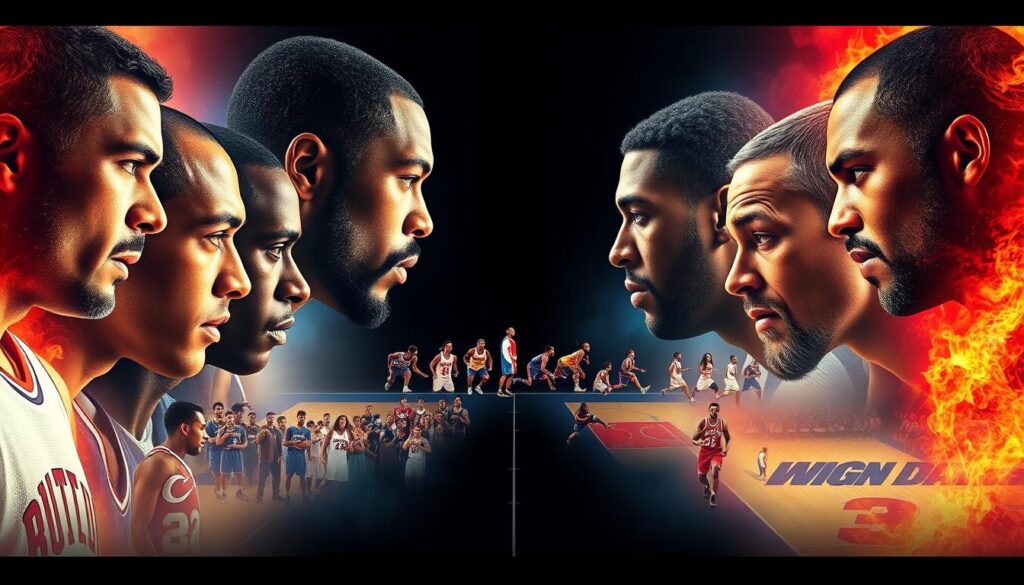
The Pistons, known as the “Bad Boys”, changed the game. Their tough play led to new rules, like banning hand-checking. Now, teams focus on spacing, thanks to Detroit’s influence.
Golden State’s small-ball style shook things up. Their rivalry with LeBron’s Cavaliers led to new strategies. Draymond Green’s antics tested the league’s limits, shaping the future.
| Rivalry Catalyst | League Innovation | Cultural Impact |
|---|---|---|
| Pistons’ Physicality (1980s) | Defensive rule changes | Made stars untouchable |
| Warriors’ Small Ball (2010s) | 3-point revolution | Democratized scoring |
| Knicks/Heat 90s Brawls | Flagrant foul system | Turned enforcers obsolete |
NBA rivalries are strategic battles. The ’60s rivalry between Boston and LA pushed smaller teams to innovate. Magic vs Bird showed the world how to play globally.
So, when you watch a heated game, remember it’s more than just fun. It’s the game evolving right before your eyes. The real question is, what will the game look like next?
Conclusion: The Role of Rivalries in Basketball Lore
Iconic NBA team battles are more than just scores. They are like epic stories, filled with drama and excitement. The Celtics-Lakers rivalry is a prime example, spanning decades with legendary moments.
From Bill Russell’s 11 championships to the 2017 tiebreaker game, this rivalry has shaped the league. It has created legends, divided families, and made “Beat LA” a sacred phrase in New England.
Today’s NBA is different, with superteams and load management changing the game. Does Tyrese Haliburton’s scowl at Jalen Brunson in a play-in game compare to Bird stealing Isiah’s lunch money? History suggests true rivalries take time to develop.
Yet, there’s hope. Boston’s slight edge in all-time wins over LA shows the rivalry is alive. The 2008 championship was a moment of pure joy. Modern players may not bleed team colors, but they seek immortality.
The next chapter of NBA rivalries will be different from Magic vs Bird. But with time and heartbreak, rivalries will only grow stronger. Like fine wine and Charles Barkley’s golf, rivalries get better with age.
