
The Frank Vogel Warriors pairing gives Golden State a clear defensive reference point entering the 2026-27 staff cycle. Vogel agreed on July 12-13, 2026 to become Steve Kerr’s associate head coach, with the move following the departures of assistants Terry Stotts and Jerry Stackhouse. The safest read is not that Golden State plans to remake its identity around a new assistant. Kerr’s motion principles and established offensive habits still frame the team. Vogel’s value is more specific: defensive organization, coverage accountability, possession discipline, and a scouting lens shaped by head-coaching stops in Indiana, Orlando, Los Angeles, and Phoenix.
That distinction matters. Assistant-coach influence can be real, but it is rarely absolute. Vogel can install terminology, sharpen film standards, and push lineup decisions toward defensive reliability. He cannot solve every roster limitation by scheme alone. The question is where his history points and which parts translate cleanly to a Warriors team that has long depended on communication, switching feel, and Draymond Green’s defensive command.
Frank Vogel Warriors Defensive Baseline
The Frank Vogel Warriors Scouting Lens
The Frank Vogel Warriors scouting lens starts with defense as the first organizing principle. Vogel’s teams have been associated with strong defensive results across several stops, and the NBA’s own film-room analysis of his work with Indiana and Orlando described his emphasis on size, rebounding, rim protection, and disciplined contests. That piece also highlighted his belief that length sits at the center of his defensive approach, while noting Indiana’s strength on the glass and ability to cut down second-chance chances during his Pacers tenure NBA film-room analysis.
Golden State has not traditionally been a pure drop-coverage team or a rigid possession-control outfit under Kerr. The Warriors’ best defenses have leaned on layered reads: early help, pre-switching, back-line talk, and the ability of Green to see actions before they fully develop. Vogel’s background does not necessarily conflict with that. His best work has often come when the structure around the ball is clear and the help defenders understand the next rotation. The fit depends on whether Golden State can pair its improvisational defensive intelligence with fewer soft spots in the possession.
Why His History Points To Possession Control
Vogel’s defensive identity has not been built only on shot contests. The research record points to three connected habits: defensive rebounding, limiting fouls, and removing easy follow-up chances. That matters for Golden State because a great initial stand can be wasted by a loose box-out or a reach-in foul late in the clock. The Warriors have often preferred to turn stops into flow offense. Vogel’s influence may push the first priority back toward completing the stop before releasing into transition.
There is also a pace-related note. Vogel’s head-coached teams have often played with more structure than speed, including a 2013-14 Indiana team noted in the research as ranking 23rd in pace and 21st in offensive rating. That does not mean Golden State should expect a slow offense. It does mean his defensive preferences usually reward organized floor balance. Quick shots that leave the back line exposed may draw more scrutiny if he is shaping the defensive review process.
How Vogel’s Principles Translate To Golden State
Length, Rim Help, And Rebounding
Vogel’s phrase about length is the cleanest bridge from his history to Warriors rotation analysis. Golden State has used small lineups for years, but small does not have to mean undersized at every defensive point. A Vogel-informed approach could favor wings and bigs who can cover space, contest without leaving their feet too early, and finish possessions on the glass. That could affect role-player evaluation as much as play calling.
The key is not simply playing taller lineups. It is playing lineups with functional reach and recovery speed. A slow big who cannot defend in space may not satisfy the assignment. A wing who can switch but does not rebound may create a different problem. Vogel’s history suggests Golden State’s staff will be looking for combinations that preserve Kerr’s spacing while giving the defense more margin behind the ball.
Discipline Without Overfouling
The foul-discipline thread is just as relevant. Vogel’s Indiana teams were noted for limiting fouls and opponent free throw attempts in multiple seasons. That detail travels because it is less roster-specific than some scheme elements. Coaches can drill verticality, hand placement, closeout angles, and help timing regardless of personnel. The Warriors, with a veteran defensive leader in Green, should have enough communication infrastructure to absorb those habits if the staff makes them daily priorities.
- Earlier help on drives, with the second rotation already assigned.
- More attention to weak-side rebounding responsibility after contests.
- Stricter grading of unnecessary fouls at the end of defensive possessions.
- Lineup choices that reward length, communication, and repeatable rotations.
Those are not flashy changes. They are possession-management changes. For a team trying to stabilize defensive performance, they may matter more than a new coverage label.
What Changes May Be Visible In 2026-27
Rotation Signals To Monitor
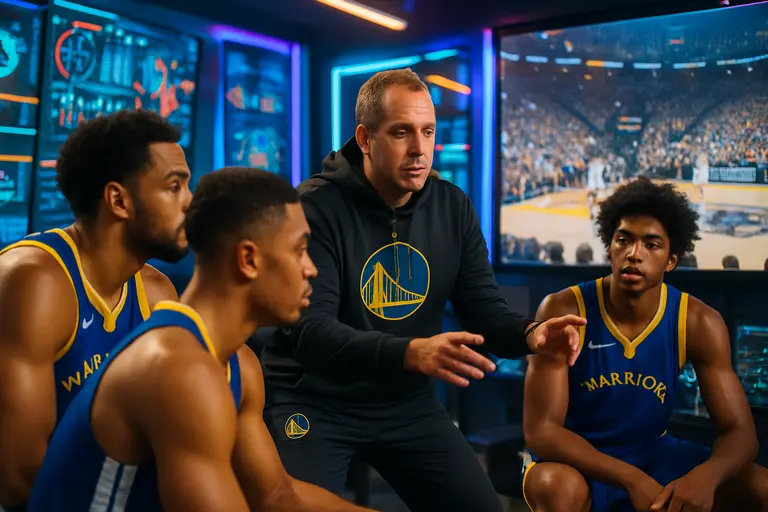
The most visible sign of Vogel’s influence may be which players close quarters and halves. If Golden State leans toward longer, more versatile groups in high-leverage defensive stretches, that would fit his profile. It would also show that the staff values defensive completion as much as offensive rhythm. This is where the Frank Vogel Warriors fit becomes a scouting question rather than a press-release item.
Green’s role is central, but not because Vogel needs to reinvent him. Green has long been the Warriors’ defensive organizer. The more realistic adjustment is that Vogel gives the staff another experienced voice to align the players around Green’s calls. In playoff-style possessions, clarity is often as valuable as creativity. If the first coverage, the low-man responsibility, and the rebounding assignment are all understood before the ball is inbounded, Golden State’s defense has a better chance to hold up late in games.
Offensive Fit Beside Kerr
Vogel’s history should not be read as anti-offense. His later stops showed some adaptation to pace, spacing, smaller lineups, and increased three-point volume. In a 2023 Sports Illustrated interview tied to his Phoenix role, he discussed working with high-end offensive players and fitting his approach around the roster rather than forcing a single template Sports Illustrated interview. That matters in Golden State, where Kerr’s offense depends on movement, spacing, passing reads, and the gravity of elite shooting.
The likely change is not an offensive overhaul. It is more likely a tightening of shot selection in relation to defensive floor balance. A missed quick three is not automatically a bad shot for the Warriors, especially if it comes from their core actions. But if those shots repeatedly produce runouts, the staff may ask for better spacing behind the attempt or stronger crash-and-retreat rules. That is where a defensive assistant can influence offensive habits without taking the ball out of Kerr’s system.
Readers who wish to explore related coverage within the same network should check out Back2Tap.
Frank Vogel Warriors Fit
The most cautious projection is that Vogel raises Golden State’s defensive floor more than he changes its ceiling. The ceiling still depends on personnel, health, and whether the Warriors have enough point-of-attack resistance and back-line size to execute against elite offenses. Scheme can cover mistakes, but it cannot erase every physical mismatch. Vogel’s track record suggests he can improve the rules around those mismatches: where help comes from, how the glass is protected, and how the team avoids bailing out opponents with fouls.
The cleanest Frank Vogel Warriors projection is a staff that keeps Kerr’s offensive freedom while adding a firmer defensive spine. Expect more attention to length in rotation choices, more detailed rebounding accountability, and more emphasis on contests that do not turn into free throws. If those habits show up consistently in 2026-27, Vogel’s arrival will be felt less through slogans and more through the quiet math of defensive possessions: one shot allowed, no foul, rebound secured, offense reset on Golden State’s terms.
