

The Finney-Smith role in Charlotte is best understood as a low-usage offensive support assignment, not a reset of the Hornets’ scoring hierarchy. On July 6, 2026, Charlotte acquired Dorian Finney-Smith and three second-round picks from Houston, a deal the league described through the lens of his veteran shooting and defensive profile, with his 2025-26 Houston averages listed at 3.3 points, 2.5 rebounds and 1.0 assists in 16.8 minutes per game while shooting 33 percent from the field and 27 percent from three-point range, according to NBA.com’s trade report. Those numbers create a cautious starting point. Charlotte did not acquire a volume scorer. It acquired a wing whose best offensive value has usually come from spacing, finishing possessions, and allowing higher-usage teammates to keep the ball moving.
That distinction matters for offensive strategy. Finney-Smith’s 2025-26 shooting was poor by his standards, especially from three-point range. The counterpoint is his career three-point mark of 35.9 percent, which keeps him in the category of players defenses usually cannot ignore without some cost. Charlotte’s recent offensive identity has emphasized shooting from deep, attacks to the rim, and offensive rebounding. A forward who can stand in the weak-side corner, lift into slot spacing, or cut behind a tilted defense fits that framework better than his latest counting stats might suggest.
Trade Context And Offensive Baseline
A Veteran Wing With A Narrow Shot Diet
Finney-Smith’s offensive baseline is modest. His reported 15.0 percent usage rate in 2025-26 points to a player who was rarely driving the offense. That aligns with his broader history as a finishing wing. He has been most useful in systems where creators bend the defense first, then trust him to punish rotations with spot-up threes, cuts, or quick extra passes. Charlotte should not evaluate him as a creator who can rescue stagnant late-clock possessions. The more realistic question is whether he can improve spacing quality in second-unit or mixed-lineup minutes.
The efficiency numbers from Houston complicate the picture. His 43.6 percent effective field goal rate and 43.3 percent true shooting rate in 2025-26 were inefficient. Those figures do not prove that the shot has permanently left him, but they do show why Charlotte’s usage should stay disciplined. If Finney-Smith is asked to attack off the bounce too often or manufacture shots against set defenders, the offense is probably leaning too far away from his best use. The cleanest version is simple: touch the ball after the advantage has already been created.
| 2025-26 Houston Category | Finney-Smith Figure |
|---|---|
| Points Per Game | 3.3 |
| Rebounds Per Game | 2.5 |
| Assists Per Game | 1.0 |
| Minutes Per Game | 16.8 |
| Field Goal Percentage | 33% |
| Three-Point Percentage | 27% |
Why The Finney-Smith role Fits Charlotte
The Finney-Smith role As A Low-Usage Spacer
The tactical case begins with ball economy. Charlotte’s offense does not need Finney-Smith to dominate touches for him to matter. If he occupies the corner and holds defensive attention, driving lanes become cleaner. If he lifts from the corner to the wing as the ball handler turns the corner, he gives the offense a release valve. If his defender overhelps on a rim attack, the possession can turn into a catch-and-shoot chance rather than a contested paint attempt.
That keeps the Finney-Smith role narrow, but useful. A low-usage spacer can be valuable in lineups that already have enough shot creation. The concern is whether his 2025-26 shooting dip causes defenders to help off him more aggressively. If opponents treat him as a non-shooter, the spacing benefit shrinks. If he returns closer to his career three-point level, the Hornets can use him as a stabilizing wing who does not need a play call to stay involved.
Small Forward Minutes And Lineup Balance
Roster context also shapes the assignment. SI’s Hornets coverage projected that Finney-Smith would likely spend the majority of his minutes at small forward rather than power forward because of Charlotte’s frontcourt mix, including Naz Reid, Grant Williams and Tidjane Salaün, as noted in SI’s trade analysis. That matters offensively because the three-position asks for enough shooting to keep the floor spaced and enough size to survive lineups with bigger wings.
At small forward, Finney-Smith can be used as a connector rather than a hub. The ball should move through him quickly: catch, shoot; catch, swing; catch, cut. That approach keeps possessions from stalling. It also reduces the burden created by his limited self-creation. Charlotte can place him next to higher-usage players and ask him to maintain shape within the offense. He does not need to be dynamic to help the spacing math; he needs to be decisive.
How Charlotte Can Use Him Off The Ball
Spot-Ups, Cuts, And Paint Access
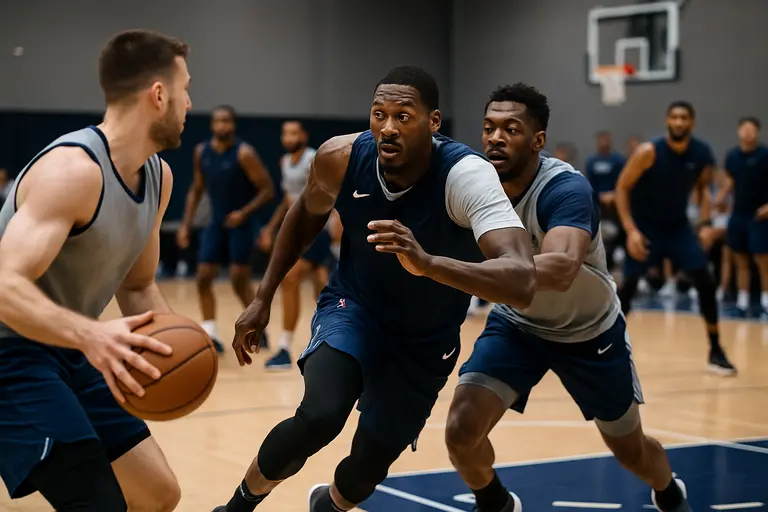
Finney-Smith’s best offensive possessions should come before he dribbles. Spot-up chances are the obvious first layer. The second layer is cutting. In an offense that attacks the rim, defenders often turn their heads toward the ball. A weak-side wing who cuts at the right time can turn that attention into layups or quick passes around the restricted area. Finney-Smith has been described as a player who has often finished plays rather than created them, which fits that kind of off-ball movement.
The third layer is offensive rebounding support. Charlotte’s recent identity has included strong work on the offensive glass. Finney-Smith’s 2025-26 rebounding average was not high, but his role at forward still gives him chances to crash selectively from the corner or wing. The key word is selectively. If he crashes every time, Charlotte can lose floor balance. If he chooses moments when the shot comes from the opposite side or the defense is already pulled inside, he can support second-chance possessions without damaging transition defense structure.
Why The Contract Context Reinforces The Rotation View
The contract structure described in the research, with salary flexibility after the 2026-27 season, points toward a rotational interpretation. Charlotte can use Finney-Smith as a veteran option without needing to force him into a central offensive job. That is a sensible fit for a team trying to balance young-player development, floor spacing, and lineup variety.
Fans interested in how local sports habits and related activities, such as enjoying a game at the Bass Lake Roadhouse, reflect on broader regional trends can explore further at Bass Lake Roadhouse. The basketball point remains direct: Finney-Smith’s value is tied to whether his presence makes Charlotte’s main actions easier to run. If the answer is yes, his scoring average can remain modest while his minutes still carry value.
What The Finney-Smith role Means For Charlotte
A Cautious But Logical Offensive Bet
The final read is cautious. The Finney-Smith role gives Charlotte a veteran wing template that makes strategic sense, but the success of the move depends on shooting recovery and disciplined usage. His 2025-26 season with Houston did not provide evidence of high-level offensive production. It did provide evidence that he can survive in a low-touch role, and his career shooting record gives Charlotte a reason to test whether better context can restore some spacing value.
Charlotte should treat him as a backup or stretch forward who supports actions, not as a player who drives them. His minutes can help if he keeps defenders attached, makes fast decisions, and finishes possessions created by others. If the shot remains near his 2025-26 level, the offensive fit becomes thinner. If it moves back toward his career norm, the Hornets gain a useful small-forward option who can widen the floor, cut into open seams, and help the offense stay connected without demanding many touches.
