

Looking for a spark (and for points) late in the 4th quarter, the Dallas Mavericks were searching for a play that would work against Miami’s tough/quick defense. At some point towards the end of the game, coach Rick Carlisle started running a staggered pick and roll with Dirk Nowitzki and Tyson Chandler as the screener, a play that the Mavericks haven’t run at all during the Finals to this point. It was obvious that this play gave Miami trouble as Dallas scored 8 points on the 4 possessions they ran it while shooting 75% (including 2-2 from three). Here is the play that sparked Dallas’ comeback:
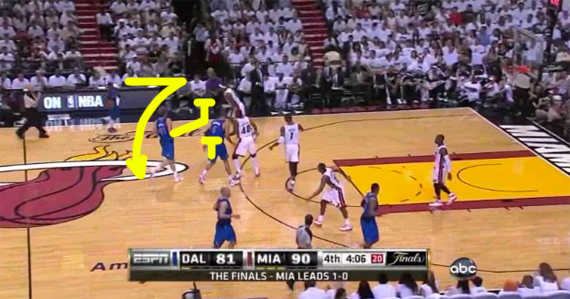
As Jason Terry brings the basketball along the wing, Dirk Nowitzki and Tyson Chandler get in position and set a staggered ball screen for Terry (with Nowitzki as the front screener and Chandler as the second screener).
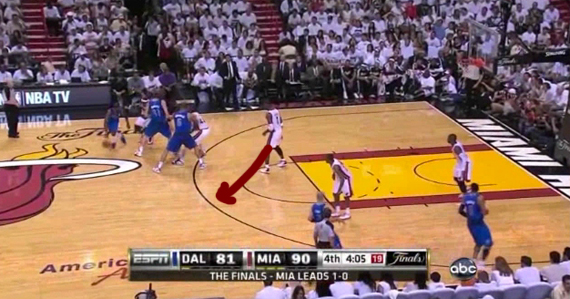
What this staggered screen for Jason Terry is that it negates the Heat’s hard trap/hedge on the ball handler, especially on this first position, where the Heat seemed to look a little confused. Initially, Chris Bosh (who was defending Tyson Chandler) steps out to prevent Terry from getting to the rim.
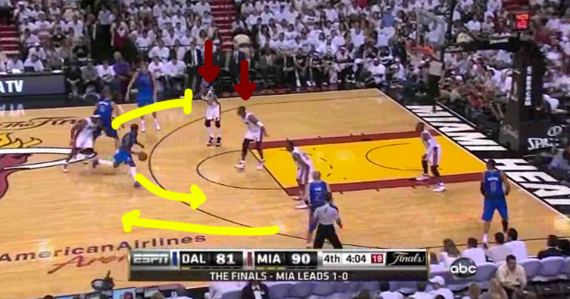
As Terry works his way around the staggered screen, the Heat’s confusion becomes a little bit more obvious as you have both Udonis Haslem and Bosh playing off of their men, not sure who should be hedging on the screen, who should be staying with Nowitzki, or who should be defending Chandler on a potential roll to the rim. As this is happening, Terry dribbles the basketball over to Jason Kidd, who gets a dribble handoff from Terry. All of this confusion and action allows Chandler to come off of his initial ball screen and set a pindown screen on Haslem for Nowitzki.
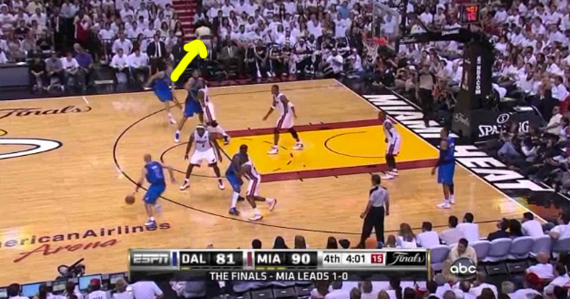
Nowitzki uses Chandler’s pindown and flares out towards the corner as Kidd reads Nowitzki’s cut and makes the pass over the defense.
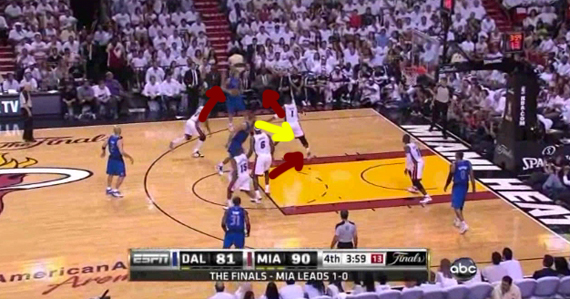
This is where Miami’s confused shows up yet again. Instead of one defender closing out on Nowitzki and one sticking with Chandler rolling to the rim, both Haslem and Bosh sprint out towards Nowitzki to keep him from getting the shot up. The problem is that it leaves Tyson Chandler uncovered as he cuts to the rim. To keep Chandler from getting wide open, LeBron James has to hang around the foul line, sink in, and stay near Chandler.
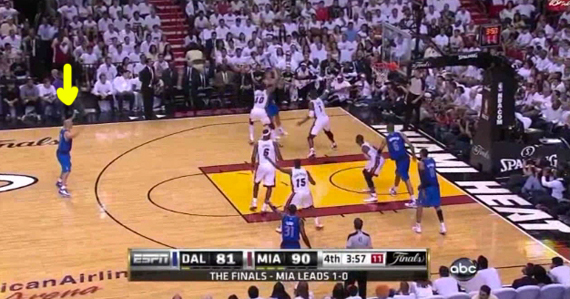
All of that confusion, extra helping, and over rotation leaves Jason Kidd open at the top of the key, with no defender within 5 to 10 feet of him.
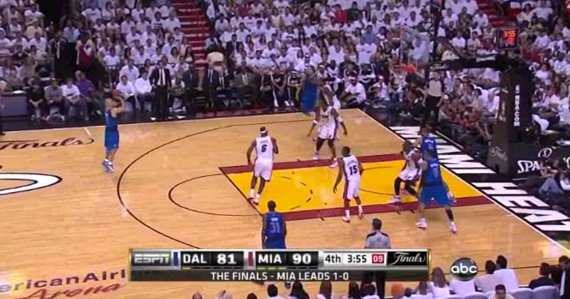
Nowitzki does a fantastic job of passing out of the double team and hitting Kidd for the wide open three that he knocks down. Here is the play in real time:
The fact that the Mavericks’ “sprung” this offensive play on the Heat definitely lead to most of the confusion and over rotation. I haven’t seen the Mavericks run this play at all in this series (and maybe not even during the entire playoffs, though I can’t say that with certainty). Coach Carlisle made a great decision to go with this set because it negated the Heat’s tremendous pick and roll defense where they blitz the ball handler.
The staggered ball screen worked so well for Dallas that they tried it again. With Miami being more prepared for it, they tried to attack it a different way defensively:
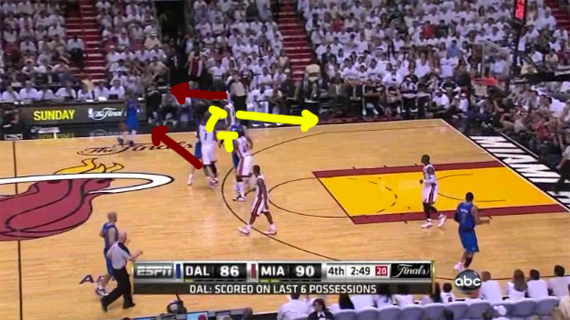
As Terry brings the basketball up along the sideline, he starts to use the staggered screen, again set by Nowitzki and Chandler. However, instead of letting Terry use the screen, the Heat decide to trap Terry before he comes off of the screen with LeBron James (Terry’s initial defender) and Chris Bosh (Dirk Nowtizki’s defender). Dirk reads the trap and slips the screen, popping out to the corner.
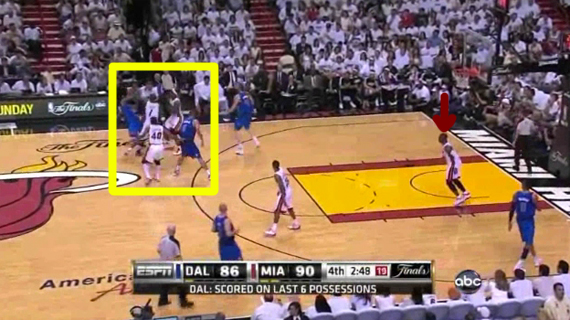
With Nowitzki slipping the first screen as the Heat trapped Terry, you now have a similar situation to the pick and pop play towards the corner that Dallas ran so often in game one. Now, normally the Heat want to shade towards Nowitzki with either the man from the corner or a big on the block. However, staggered pick and roll, the Mavericks are occupying a lot of bodys that would normally be in the paint at the top of the key (you have the Heat’s two bigs and LeBron James at the top of the key). Dwyane Wade is now your last line of defense, basically playing a two on one situation. Wade wants to head over before the pass to Nowizki is made, but he simply can’t because it would leave Shawn Marion open.
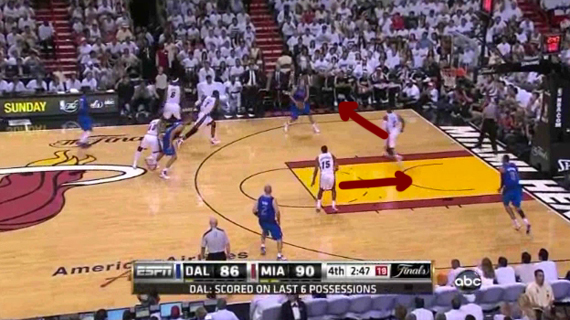
Once Nowitzki makes the catch, Wade commits to running out at Nowitzki as Chalmers drops down to Marion. Now, you have a situation where two Heat defenders are trying to defend three Mavericks.
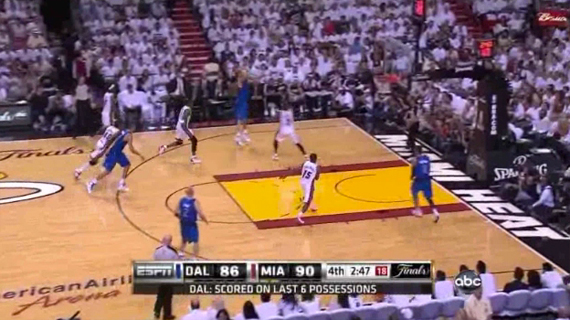
Because Wade had to wait until Nowitzki made the catch before committing on the closeout, he was unable to make it in time allowing Nowitzki to get a clean shot off, one that he makes. Here is the play in real time:
Nowitzki does a fantastic job here of reading the Heat’s trap and slipping the screen as soon as the Heat commit to trapping Terry. As soon as Nowitzki slips the screen, the Heat are on their heels, scrambling and trying to closeout. They were unable to do so on this possession.
With the play continuing to be successful, it is no surprise that the Mavericks went right back to it the next possession:
This is the one stop that Miami got against the Mavericks’ stagger ball screen set, and in my opinion it was because of poor execution on Dallas’ end. Nowitzki again slips the screen and he is once again open (putting the defense in a tough position), but Terry decides not to force the pass. The result is Dallas scrambling on the offensive end, and eventually Nowitzki gets blocked and the Heat gain possession.
Undeterred, the Mavericks set up their staggered ball screen the next half court possession that they got, this time with the game tied and with about 38 seconds left.
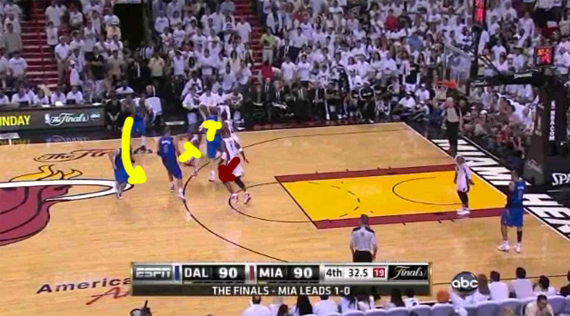
To start the play, Kidd quickly brings the basketball up and gets it into the hands of Jason Terry before clearing out. With Terry and Chandler trailing the play, they get in position to set their staggered screen. Maybe it was because the Mavericks got into the set quickly, but the Heat decided not to trap Terry early, instead defending this set like they did the first time, with Bosh hedging out, preventing dribble penetration to the middle.
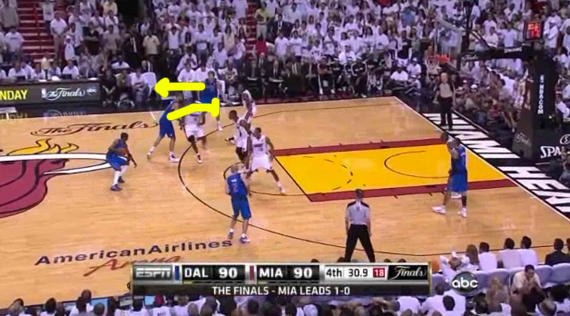
Terry starts towards Jason Kidd, but quickly changes direction, and looks back towards the weakside, where Tyson Chandler is getting in position to set a pindown screen for Dirk Nowitzki. Nowitzki does a good job of using the screen, backing up behind the three point line.
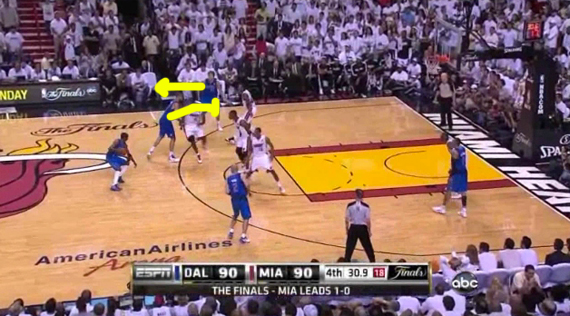
Udonis Haslem (Nowitzki’s defender), runs right into Tyson Chandler, who does a terrific job of holding his ground on the screen. With Bosh hedging out towards the middle to prevent Terry driving off of the staggered screen, he was out of position to help on Nowitzki coming off of the screen. Nowitzki catches, gathers, and knocks down the three point shot. Here is the play in real time:
If you notice one difference between the final staggered ball screen and the first staggered ball screen, Jason Terry doesn’t bring the basketball to Jason Kidd on the strong side. The reason why he didn’t? Because Tyson Chandler knew he could get the screen set and free up Nowitzki (quote from John Schuhmann’s fantastic post on the Mavericks’ comeback):
“I told the guards, ‘Whoever comes off me and Dirk’s screen, before you look to the strong side, look back to the weak side, because I think I can get him open for a good look,’” Chandler said afterward. “And right then, the next play, I was able to get that pick. And I was just holding it, because I knew, I saw Bosh in front of me and I was picking Haslem, so I figured [Nowitzki] would be somewhere behind me getting a good look.”
That’s fantastic recognition by Chandler here, and a great job by Terry to listen to what Chandler was saying.
In my opinion, this staggered ball screen is a play may have won Dallas the series (it definitely helped them win game two, putting themselves in a position to win the series). Rick Carlisle saw his team getting forced into turnover after turnover as his point guards were getting blitzed in pick and roll situations. To come up with a solution like this more or less on the fly, it is a great piece of coaching. As you can see, this staggered ball screen really prevented Miami from getting an effective trap on the ball handler, and when they tried, all of the action and bodies behind the three point line put the Heat at a disadvantage down low (when Nowitzki slipped the screen).
I don’t know if this play is going to work the rest of the series (you know that Spoelstra and his staff are going to rewatch these four possession to try and come up with a way to stop it), but I do expect Dallas to run it once or twice in the fourth quarter of game three, just to see if Miami can stop it or not.
