

The San Antonio Spurs are entering the 2026–27 NBA season with one of the league’s most intriguing tactical experiments. Head coach Mitch Johnson is exploring a three-guard starting lineup featuring De’Aaron Fox, Stephon Castle and Dylan Harper alongside Devin Vassell and Victor Wembanyama.
As the San Antonio Spurs prepare to test their three-guard lineup featuring De’Aaron Fox, Stephon Castle, and Dylan Harper alongside Victor Wembanyama, the team’s evolving offensive identity is generating interest beyond traditional basketball analysis. Fans following preseason developments increasingly turn to NBA statistics, tactical breakdowns, and independent sports platforms to evaluate emerging team strategies. While basketball analysis focuses on lineup efficiency, player chemistry, and defensive matchups, other sports audiences explore resources such as JustBet online sportsbook ratings to research sportsbook services and comparisons. These different approaches reflect the broader digital sports landscape, where audiences seek specialized information while following the same NBA developments.
The approach represents more than a conventional rotation adjustment. It could fundamentally change how San Antonio creates scoring opportunities, distributes offensive responsibilities and uses Wembanyama’s unusual combination of size, mobility and playmaking.
On October 14, 2026, the Spurs finally deployed the complete five-man group against the Phoenix Suns at Frost Bank Center in San Antonio. The result was a 123–103 preseason victory that offered an early look at the lineup’s potential and its limitations.
Fox, Castle and Harper combined for 31 points, 12 rebounds and six assists in the first half, helping San Antonio establish a 60–49 halftime advantage. Although the group struggled during the opening minutes, its offensive execution improved considerably as the players settled into their roles.
si.com
+1
For a team built around Wembanyama’s expanding influence, the experiment introduces an important question: can three perimeter creators make San Antonio more difficult to defend without sacrificing the rebounding, spacing and defensive balance needed to compete against elite NBA opponents?
The answer will depend less on how many guards appear in the starting lineup and more on how effectively they operate when the basketball is in someone else’s hands.
Why Mitch Johnson Is Experimenting With Three Guards
San Antonio’s proposed starting five is built around a different distribution of offensive responsibilities.
Rather than relying on a traditional combination of two guards, two forwards and one center, Johnson is testing a group with three players capable of initiating offense, one perimeter scorer in Vassell and an unusually versatile interior presence in Wembanyama.
The structure gives the Spurs multiple ways to begin possessions.
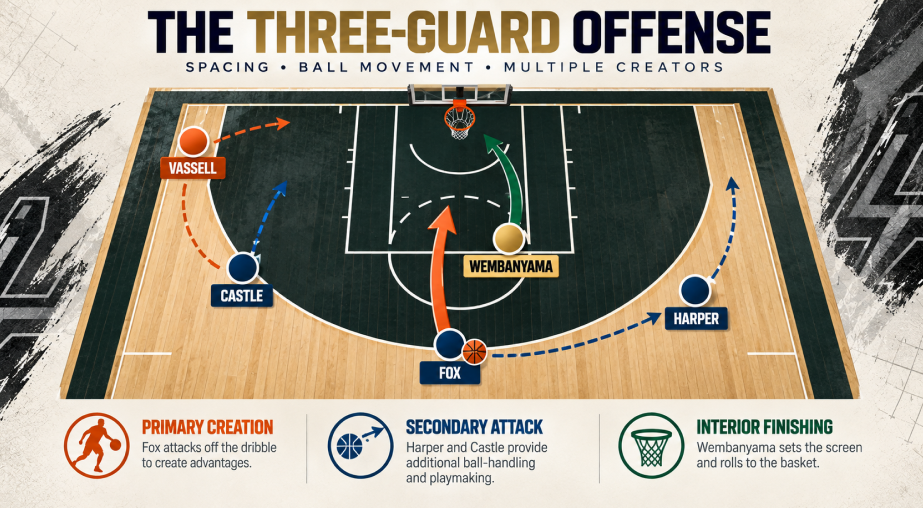
Fox can attack from the top of the floor, Castle can initiate through physical drives and secondary actions, and Harper can operate as another pick-and-roll creator.
Wembanyama provides an additional passing option from the high post, elbow or perimeter.
This flexibility could make San Antonio less predictable against defenses that pressure the primary ball handler.
Before the October 14 game, Johnson emphasized the guards’ shared ability to handle the ball, pass, shoot and defend. He also identified rebounding and running ahead of the ball as important requirements for making the lineup successful.
According to the San Antonio Express-News’ lineup report, Johnson had originally intended to test the combination during the October 8 preseason opener against Atlanta, but Fox’s hip issue delayed its debut.
expressnews.com
That delay made the October 14 meeting with Phoenix especially valuable.
It was the coaching staff’s first substantial opportunity to evaluate how the guards would function together against an NBA opponent rather than exclusively during practice or an internal scrimmage.
The early results suggested that the concept deserves further development, although the limited preseason sample cannot establish whether it will succeed throughout an 82-game schedule.
What The Spurs’ 123–103 Victory Over Phoenix Revealed
San Antonio’s first complete three-guard experiment did not produce immediate offensive fluency.
Castle and Harper missed their first five combined shots, and the Spurs struggled to establish a rhythm during the opening minutes.
Fox, making his preseason debut after missing the team’s previous exhibition games, was substituted midway through the first quarter.
Johnson then experimented with different combinations rather than keeping all three guards together continuously.
The adjustments mattered.
When San Antonio returned to the complete trio during the second quarter, its offense began generating better opportunities through movement, passing and attacks toward the basket.
In the final 3:33 of the first half with all three guards on the floor, the Spurs scored 17 points and outscored Phoenix by 10.
Fox connected with Wembanyama on interior finishes, Castle repeatedly attacked the defense and Harper contributed through offensive rebounding and movement without the ball.
A Sports Illustrated breakdown of the lineup’s debut detailed how Johnson alternated between three-guard, two-guard and single-primary-creator combinations as the first half progressed.
si.com
The individual performances provided useful context.
| Player | October 14 Preseason Performance | Tactical Significance |
|---|---|---|
| Victor Wembanyama | 19 points, 4 blocks | Interior finishing, passing and defensive protection |
| Stephon Castle | 18 points, including 14 free throws | Downhill pressure and physical drives |
| De’Aaron Fox | 9 points, 4 assists | Transition speed and primary creation |
| Dylan Harper | 9 points, 6 rebounds | Secondary ball handling and guard rebounding |
The most encouraging development was not simply San Antonio’s final margin of victory.
It was the improvement in offensive coordination after the lineup’s difficult opening stretch.
The Spurs also outrebounded Phoenix 50–36, providing an encouraging early response to concerns about using three guards simultaneously.
However, the Suns were missing several regular contributors, including Devin Booker. That context limits how much can be concluded from the result.
The preseason victory demonstrated possibilities rather than proving that San Antonio has discovered its ideal starting lineup.
How De’Aaron Fox Changes San Antonio’s Offensive Tempo
Fox’s greatest contribution to the three-guard experiment may be his ability to accelerate possessions before opposing defenses become organized.
His speed makes him particularly dangerous when attacking defensive mismatches, advancing the basketball after rebounds and turning small advantages into scoring opportunities.
With Fox initiating transition offense, San Antonio can force opponents to defend multiple threats simultaneously.
Wembanyama can sprint toward the rim, Castle can fill a lane or cut behind defenders, and Harper can move into open space as a secondary creator.
Vassell provides a perimeter scoring threat that discourages opponents from concentrating entirely on the paint.
This structure is especially interesting because Fox does not need to dominate every possession.
If Castle or Harper secures a defensive rebound, either player can advance the basketball without waiting for a conventional outlet pass to the point guard.
That reduces the time between securing possession and beginning an offensive attack.
It also allows Fox to become a receiver rather than the initiator, creating opportunities for cuts, relocations and quick attacks against unsettled defenses.
The October 14 game offered examples of that flexibility.
Fox finished with nine points and four assists in approximately 19 minutes, including connections with Wembanyama around the basket.
The important development was how quickly the offense improved once San Antonio began coordinating its movement.
For Fox, the next step is developing consistent timing with two other guards who also prefer to attack with the basketball.
If he can remain dangerous as both an initiator and an off-ball threat, the Spurs will have more options when opponents attempt to deny his preferred driving lanes.
Why Stephon Castle Could Be The Key To Making Three Guards Work
Although Fox provides speed and Harper adds another creator, Castle may be the most important player in determining whether the three-guard lineup functions consistently.
His physicality allows him to operate differently from a conventional smaller guard.
Castle can attack defenders through contact, contribute on the glass and handle demanding perimeter defensive assignments.
Those qualities become especially valuable when San Antonio sacrifices some traditional forward size to accommodate another ball handler.
Against Phoenix, Castle scored 18 points, with 14 coming at the free-throw line.
That distribution illustrates an important part of his offensive identity.
Castle does not need to depend entirely on perimeter shooting to create efficient scoring opportunities. His willingness to attack the basket can force defenders into difficult decisions and generate foul pressure.
However, his shooting remains relevant to the lineup’s long-term viability.
If opponents are comfortable helping away from Castle when Fox or Wembanyama has the ball, San Antonio could encounter spacing problems.
The Spurs therefore need Castle to remain active when he is not initiating the offense.
Well-timed cuts, offensive rebounding, screening and quick decisions after receiving passes can prevent defenders from treating him as a stationary perimeter player.
His defensive responsibilities are equally important.
A lineup featuring three guards must be capable of switching assignments, containing penetration and preventing larger opponents from exploiting mismatches.
Castle’s physical tools give Johnson additional flexibility in assigning those matchups.
Rather than defining him exclusively as a point guard or shooting guard, San Antonio can use him as a multipurpose perimeter defender and offensive connector.
That versatility may determine whether the lineup can remain effective against playoff-level competition.
Dylan Harper’s Development Adds Another Layer Of Playmaking
Harper’s potential promotion into the starting lineup is one of the most significant developments in San Antonio’s preseason.
During the October 8 exhibition against the Atlanta Hawks, Harper scored 16 points and recorded four assists while starting in Fox’s absence.
His performance strengthened the argument that he could contribute meaningfully alongside San Antonio’s established starters rather than operating exclusively as a reserve creator.
The NBA’s coverage of Harper’s starting opportunity highlighted his growing readiness for a larger role and Johnson’s willingness to explore a new lineup structure.

cdn-uat.nba.com
Harper’s value comes from his ability to initiate offense while also creating scoring opportunities through movement and positioning.
He is not simply another player competing with Fox and Castle for possession time.
If used effectively, Harper can give San Antonio an additional decision-maker when defenses force the ball away from the initial creator.
Consider a possession in which Fox attacks a high screen involving Wembanyama.
If the defense sends help toward Fox, Harper can receive the ball on the weak side and attack a rotating defender.
That second action is often where effective NBA offenses create their best opportunities.
Rather than restarting the possession, Harper can exploit the defensive movement already generated by Fox and Wembanyama.
His rebounding also matters.
Harper collected six rebounds against Phoenix, demonstrating how a guard can help compensate for the smaller lineup’s potential disadvantages.
The challenge will be consistency.
Harper must continue developing his perimeter shooting, defensive positioning and understanding of when to attack versus when to move the basketball.
San Antonio’s coaching staff also needs to manage his development without overwhelming him with responsibilities.
A successful three-guard structure should allow Harper to contribute as part of a coordinated system rather than requiring him to function as a full-time primary creator.

Victor Wembanyama Could Become The Offensive Centerpiece Without Dominating The Ball
Wembanyama is the central reason the experiment is particularly compelling.
His combination of height, reach, finishing ability and passing vision gives San Antonio offensive options that most NBA teams cannot replicate.
When Wembanyama operates as a screener, defenders must account for his ability to roll toward the basket and finish above the rim.
When he receives the ball near the elbow or high post, he can survey the floor and deliver passes over smaller defenders.
When he moves outside, he can create driving opportunities for teammates by pulling an opposing big man away from the basket.
Those possibilities become more difficult to defend when three guards can attack from different positions.
The Spurs do not need every possession to begin with Wembanyama holding the ball.
Instead, they can use his presence to create advantages before he receives it.
During San Antonio’s October 10 preseason loss to Phoenix, Wembanyama recorded 13 points, seven rebounds and six assists in 22 minutes, despite missing all five of his three-point attempts.
His passing performance was particularly notable because it demonstrated how he can influence offensive possessions even when his outside shooting is ineffective.
The San Antonio Express-News’ analysis of Wembanyama’s playmaking examined his improved decision-making and ability to recognize developing opportunities.
expressnews.com
That skill could become increasingly important in the three-guard system.
If opposing defenses aggressively pressure Fox, Castle or Harper, Wembanyama can serve as a release option.
From there, his size allows him to identify cutters and deliver passes into spaces that smaller playmakers may struggle to access.
The result could be an offense that moves between guard-led penetration and center-led facilitation without requiring major changes in personnel.
The most effective version would combine Wembanyama’s interior gravity with constant movement from San Antonio’s perimeter players.
That approach would make it harder for defenses to load up against one creator while ignoring the others.
The Biggest Concern: Spacing, Rebounding And Defensive Matchups
The three-guard lineup offers considerable offensive flexibility, but it also introduces structural challenges.
The first is spacing.
Playing three capable ball handlers does not automatically produce an effective half-court offense.
Opponents will evaluate which Spurs players are most dangerous as outside shooters and adjust their help-defense assignments accordingly.
If defenders can leave one or more guards unattended beyond the arc, driving lanes may become crowded.
That could reduce the effectiveness of Fox’s penetration and Wembanyama’s interior finishing.
Vassell’s perimeter scoring is therefore an important component of the starting group.
His presence gives San Antonio a player who can operate away from the basketball and punish defensive rotations.
The second concern is rebounding.
Although the Spurs won the rebounding battle against Phoenix, a smaller lineup must demonstrate that it can consistently finish defensive possessions against physically imposing opponents.
Wembanyama cannot be responsible for every contested rebound.
Castle and Harper must contribute, while Fox and Vassell need to maintain disciplined positioning.
The third challenge involves defensive matchups.
Opposing teams may attempt to force switches that leave smaller San Antonio players defending larger forwards near the basket.
Wembanyama’s rim protection can reduce the consequences of some defensive breakdowns, but relying on him to correct every mismatch would place unnecessary pressure on the team’s defensive structure.
The Spurs must also avoid sacrificing defensive rebounding opportunities through excessive help rotations.
These concerns do not necessarily make the lineup impractical.
They mean Johnson will need to adjust defensive assignments and substitution patterns according to the opponent.
A three-guard starting lineup can remain an important part of San Antonio’s identity without being the optimal five-man combination for every situation.
How Mitch Johnson Can Build An Effective Rotation Around The Starting Five
One advantage of San Antonio’s roster construction is that Johnson does not need to keep all three guards on the floor throughout the game.
The October 14 preseason victory demonstrated how different pairings can produce distinct offensive advantages.
Fox and Castle can emphasize speed and physical penetration.
Fox and Harper can create opportunities through quick decision-making and ball-screen actions.
Castle and Harper can provide a different combination of size, rebounding and secondary playmaking.
Johnson can also stagger the guards so that at least one capable creator remains available with the second unit.
This approach would reduce the burden on Wembanyama to initiate every half-court possession when Fox is resting.
The key is maintaining continuity.
If the Spurs change combinations too frequently without establishing clear responsibilities, players may struggle to develop the timing required for effective offensive execution.
Conversely, a carefully planned rotation can preserve the benefits of multiple creators while limiting the defensive disadvantages of using three guards simultaneously.
The following combinations illustrate potential tactical applications rather than confirmed regular-season rotation plans.
| Guard Combination | Potential Offensive Advantage | Main Consideration |
|---|---|---|
| Fox, Castle and Harper | Multiple creators, transition speed and varied driving angles | Perimeter spacing and defensive rebounding |
| Fox and Castle | Fast attacks with physical secondary creation | Consistent off-ball movement |
| Fox and Harper | Two ball-screen creators and quick passing decisions | Defensive matchups against larger opponents |
| Castle and Harper | Physical drives, rebounding and developmental opportunities | Half-court shooting efficiency |

The coaching staff can evaluate these combinations through lineup data, shot quality, turnovers and defensive performance rather than relying exclusively on scoring totals.
An effective offense should create sustainable opportunities even when outside shots are not falling.
That distinction will become especially important when San Antonio faces opponents with stronger defensive personnel than those available to Phoenix during the preseason.
What The October 20 Season Opener Against Oklahoma City Could Reveal
San Antonio’s upcoming regular-season opener against the Oklahoma City Thunder on October 20 presents a much more demanding environment for evaluating the lineup.
The game at Frost Bank Center will provide an early opportunity to observe how the Spurs’ proposed starting group performs against a championship-caliber opponent.
Oklahoma City’s defensive pressure, perimeter activity and ability to disrupt passing lanes create a difficult test for any offense built around multiple ball handlers.
The matchup could reveal whether San Antonio’s guards can maintain their decision-making under pressure.
It will also provide insight into how effectively Wembanyama can function as both a scoring threat and a passing hub against a defense designed to limit easy opportunities.
Before that matchup, the Spurs are scheduled to complete their preseason against Sacramento on October 16.
Those remaining preparations will give Johnson another opportunity to evaluate combinations and determine how much responsibility to assign each guard.
However, the opening game should not be treated as a final verdict on the experiment.
New lineups often require substantial playing time to develop chemistry, particularly when multiple players are adjusting to unfamiliar off-ball responsibilities.
San Antonio’s progress should be evaluated over several weeks, with attention to offensive efficiency, turnover rate, shot distribution and defensive rebounding.
The larger question is whether the three-guard configuration produces advantages that outweigh its structural limitations.
If Fox, Castle and Harper consistently create good shots while Wembanyama remains involved as a scorer, screener and passer, San Antonio could develop one of the NBA’s more difficult offensive systems to prepare for.
If the group struggles to maintain spacing or defend larger opponents, Johnson may need to use it more selectively.
Why The Spurs’ Three-Guard Experiment Matters Beyond The Preseason
San Antonio’s experiment reflects a broader tactical principle in modern basketball: positions are becoming less important than the skills players can provide together.
A lineup does not necessarily need a traditional power forward if its guards can rebound, defend multiple positions and contribute without dominating possession.
Similarly, an offense does not require one permanent point guard when several players can initiate actions and recognize defensive advantages.
The Spurs are attempting to combine those ideas around a uniquely versatile center.
Fox supplies speed and established scoring creation.
Castle provides physicality and defensive flexibility.
Harper adds another developing playmaker capable of creating opportunities when the initial action breaks down.
Vassell contributes perimeter scoring, while Wembanyama connects the structure through his finishing, passing and ability to influence defensive positioning.
The October 14 victory over Phoenix demonstrated that the combination can generate productive offensive stretches, even after an uneven start.
It did not establish that the lineup will consistently outperform more conventional alternatives.
That question requires a larger sample against regular-season opponents.
For Johnson, the most important objective is not proving that three guards should always start together.
It is determining whether their combined abilities can create a more adaptable, efficient and difficult-to-defend offense around Wembanyama.
If San Antonio succeeds, the three-guard experiment could become an important part of its competitive identity throughout the 2026–27 season.
And if the lineup ultimately works best in selected situations rather than as a permanent starting arrangement, the experiment will still have helped the Spurs identify how to maximize the talents of Fox, Castle, Harper and Wembanyama together.
