

Arizona Roster Depth is the central question in a 2026-27 season that opened with national expectations already attached to Tommy Lloyd’s program. The Wildcats entered November with a top-five national profile in major preseason polls, a returning All-Big 12 anchor in Motiejus Krivas, a proven wing in Ivan Kharchenkov, and a heavy group of newcomers asked to replace several key pieces from a Final Four team. That combination gives Arizona real championship upside, but it also leaves a clear evaluation point: how quickly can talent become a dependable rotation?
The first week of the season offered early evidence, not a full answer. Arizona opened on November 2, 2026 against UCLA in Las Vegas as part of the Hall of Fame Series Las Vegas, then beat Cal Poly in its home opener on November 5. In that Cal Poly game, Krivas scored a career-high 30 points on 10-of-13 shooting and added eight rebounds. Caleb Holt scored 21 points with eight boards. Kharchenkov posted 16 points and 10 rebounds, his second double-double in as many games. Those numbers matter because they show Arizona’s core pieces were productive immediately, but early nonconference production does not erase the larger rotation questions created by the offseason reset.
Arizona Roster Depth Starts With Krivas
Why Motiejus Krivas Changes The Floor
Krivas’ decision to return for his senior season gave Arizona a foundation most programs did not have after a deep NCAA Tournament run. In 2025-26, he averaged 10.4 points, 8.2 rebounds, and 1.9 blocks while shooting 56.9 percent from the field, and he earned All-Big 12 First-Team and All-Defensive honors, according to Arizona Athletics. Those are not empty frontcourt numbers. They point to a two-way big who can finish efficiently, protect the rim, and anchor possession structure at both ends.
That matters for a roster with ten newcomers. A returning center with defensive range around the basket can simplify coverages while younger guards learn ball-screen rules and weak-side rotations. Offensively, Krivas gives Arizona a pressure point near the rim, which can create cleaner perimeter looks if opponents send help. He also gives the Wildcats a reliable late-clock option when spacing breaks down. Arizona does not need him to become a completely different player; it needs his presence to stabilize lineups around him.
How Arizona Roster Depth Changes The Frontcourt
Arizona Roster Depth looks stronger because RJ Godfrey arrived from Clemson, but the fit still has to prove itself in live Big 12 play. Godfrey gives the Wildcats another frontcourt body with transfer experience, which should help reduce the physical burden on Krivas. The key is whether Arizona can use those minutes without shrinking the floor or slowing its offensive pace. If the Wildcats can pair size with mobility, the frontcourt becomes more than a safety net. It becomes a matchup problem.
Frontcourt Power And Backcourt Stress
Replacing Creation Without Jaden Bradley
The roster losses were significant. Brayden Burries and Koa Peat declared for the NBA Draft, and senior point guard Jaden Bradley also departed. That removes a large share of proven creation, decision-making, and late-game comfort from last season’s group. Arizona has enough talent to replace minutes. Replacing trust is harder.
Derek Dixon and JJ Mandaquit are part of that answer at point guard. The standard for them is not only assist volume. Arizona needs clean entries into Krivas, timely advances in transition, and ball security against pressure. In college basketball, guard play often decides whether a gifted frontcourt receives touches in useful areas or spends possessions sealing without reward. That is the practical pressure on Arizona’s new lead guards.
Kharchenkov’s Two-Way Value
Kharchenkov’s return helps bridge the gap. After a freshman season in which he averaged roughly 10.4 points and 4.3 rebounds, he gives Arizona a returning perimeter piece with defensive potential and scoring comfort. His early double-double streak in the first two games of 2026-27 also points to a player who can affect games without being limited to spot-up shooting. If his rebounding holds against high-level opponents, Arizona can play more flexible lineups around Krivas and Holt.
Newcomers And Rotation Math
Caleb Holt’s Immediate Role
Caleb Holt arrived as the headliner of Arizona’s recruiting class. The research notes identify him as a five-star shooting guard expected to provide scoring, perimeter defense, and athleticism. His 21-point, eight-rebound performance against Cal Poly was a strong early sign that his athletic tools can translate quickly. The caution is that freshman production often changes once scouting reports sharpen and conference opponents start testing decision-making.
Holt’s development is one of the season’s major swing points. If he can defend without fouling, attack closeouts, and make enough shots to keep defenses honest, Arizona’s perimeter ceiling rises sharply. If he becomes too shot-dependent or turnover-prone, the Wildcats may need to narrow his responsibilities while the older pieces carry more of the offense.
Ten Newcomers And The Cohesion Test
Ten newcomers create opportunity and friction at the same time. Arizona can mix lineups, protect against foul trouble, and push for practice competition. Yet every substitution pattern requires shared language. Defensive coverages, transition spacing, and end-game execution usually lag when so many players are new to each other. Arizona Roster Depth faces the same test that NBA teams often see after major roster movement: playable talent is only useful if roles are clear. A similar principle appears in our analysis of NBA roster depth, where extra bodies matter most when coaches can trust them in defined situations.
- Krivas gives Arizona a proven interior anchor and preseason star profile.
- Kharchenkov supplies returning wing production and defensive flexibility.
- Holt adds freshman scoring punch and athletic upside.
- Dixon, Mandaquit, and Godfrey are central to whether the rotation balances experience and new talent.
For readers interested in exploring other topics within our network, CAD/CAM Net is a related site in the same family.
Polls, Rankings, And Title Pressure
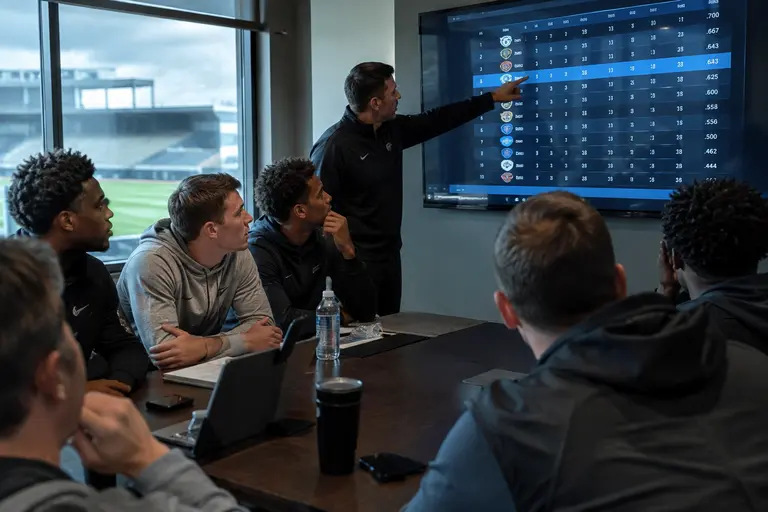
What The Rankings Say
The external expectations were not modest. Arizona entered the season No. 5 in the AP Preseason Poll and No. 4 in the USA Today Coaches Poll, according to the research notes. The Wildcats were also picked to repeat as Big 12 regular season and tournament champions in the preseason media poll. KenPom placed Arizona No. 5 overall and No. 2 in the Big 12, with Sports Illustrated noting the placement in its preseason ranking coverage on Arizona’s KenPom position.
Rankings do not decide title races, but they reveal how the roster is viewed before full results arrive. In Arizona’s case, the market of basketball evaluators appears to be balancing turnover against elite returning talent and a strong talent influx. That is a fair framing. The Wildcats can be a national contender without being a finished product in early November.
The Big 12 Standard
The Big 12 context raises the bar. A deep league punishes thin guard play, uncertain bench units, and defensive miscommunication. Arizona’s preseason status as a favorite carries weight, but conference play will test whether the Wildcats can win games that are slower, more physical, and less forgiving than early-season matchups. If Arizona Roster Depth is real beyond the top six or seven players, the Wildcats should withstand foul trouble and uneven shooting nights. If the bench is not ready, the margin narrows quickly.
Arizona Wildcats Championship Aspirations
A Contender With Real Questions
Arizona has a credible title profile because it combines a high-level returning big, a returning wing, a major freshman guard, and transfer help. Krivas’ preseason recognition as Big 12 Preseason Player of the Year and Kharchenkov’s selection to the preseason all-conference team reinforce the idea that Arizona’s core is not built only on projection. There is proven production in place.
The cautious read is that Arizona’s championship case depends on depth turning into cohesion. Holt has to grow without being overloaded. Godfrey must fit alongside or behind Krivas. Dixon or Mandaquit must give the offense steady point guard minutes. The reserves and redshirts must provide enough functional play to protect the main rotation over a long schedule. Arizona Roster Depth is not simply a phrase for preseason optimism; it is the mechanism that will decide whether the Wildcats’ talent holds up against the top end of college basketball.
Through November 8, 2026, the early signs were positive, especially from Krivas, Holt, and Kharchenkov. The evidence still calls for restraint. Arizona looked capable of matching its ranking, but the season’s hardest tests had not yet answered the biggest question: whether a reworked roster can play with late-March precision when the opponent has the same level of size, guards, and preparation.
