
Imagine 33 championship banners in two cities 3,000 miles apart. Twelve Finals battles that changed the game. This rivalry is the closest thing basketball has to a mythology.
Boston’s old-school leaders and L.A.’s star-studded sidelines clashed. Red Auerbach’s strategy met Magic Johnson’s incredible passes. It was like a Cold War with jump shots.
The third-quarter shifts in momentum? That was ideological warfare.
What keeps these NBA rivalries alive? They reflect our differences: East Coast grit vs. West Coast glamour. Teamwork vs. star power. The color clash of green-and-gold vs. purple-and-gold. These games didn’t just crown champions—they scripted a national conversation.
We’re not just looking at box scores. We’re exploring why this rivalry gives us chills. Larry Bird’s steal or Kobe’s fadeaway on classic sports networks? The hardwood was a Rorschach test. Tell me which team you support, and I’ll tell you who you are.
Introduction: Setting the Foundation
Imagine a smoky Boston Garden in 1957. Sweat and ambition mixed to create a legendary rivalry. The smell of stale popcorn and floor wax filled the air. Chuck Taylors squeaked, adding to the atmosphere.
This was more than basketball. It was a mix of industrial grit and post-war swagger. On the other side of the country, the Minneapolis Lakers were heading to California. They traded snow for sunshine and paparazzi.
The DNA of these NBA team legacies is fascinating. Boston was all about Red Auerbach’s victory cigars. Minneapolis had George Mikan’s goggles, turning him into a basketball hero.
Their stories are like comic book tales. Boston was cold and serious, while Minneapolis was flashy and bold.
| Celtics (1946) | Lakers (1947) | |
|---|---|---|
| Founding Philosophy | Blue-collar teamwork | Star-driven spectacle |
| Signature Quirk | Auerbach’s cigar rituals | Mikan’s prescription goggles |
| Home Court Aroma | Locker room musk | Orange groves & hair grease |
| Early Marketing | “Win or walk home” | “See the giants soar!” |
Boston’s “we not me” approach clashed with LA’s star focus. The Celtics built dynasties through teamwork and hard work. Bill Russell’s 11 rings showed the power of teamwork over individual stats.
The Lakers, on the other hand, made basketball a show. They turned halftime into a spectacle and players into stars.
This rivalry did more than fill trophy cases. It set the stage for modern sports stories. It’s a battle between workhorses and show ponies, rust belt and sun belt, substance and style.
Every LeBron team or Warriors dynasty owes a debt to these stories. The real magic is making us debate for 70 years.
1960s Dominance and Wilt vs Russell
Imagine a chess match where one player hoards pawns while the other sacrifices queens for checkmate. That’s Bill Russell vs Wilt Chamberlain in the 1960s—a decade where Boston’s green machine devoured championships like Pac-Man gulping pellets. The Celtics won 11 titles in 13 years, a feat so absurd it makes modern dynasties look like participation trophy collectors.
Russell’s defensive wizardry redefined basketball’s soul. He blocked shots with the urgency of Kafka scribbling nightmares, turning defense into existential art. Chamberlain? The man scored 100 points in a game like it was a grocery list—efficient, gluttonous, and utterly devoid of poetry. Their clash wasn’t just talent vs teamwork; it was ideology in high-tops.
The 1969 Finals Game 7 remains the Zapruder film of Celtics-Lakers rivalry lore. With seconds left and Boston up 103-102, Don Nelson’s desperation shot ricocheted off the rim… then the backboard… then through the net. Lakers owner Jack Kent Cooke had already inflated victory balloons. They stayed deflated—a metaphor wrapped in schadenfreude.
| Bill Russell | Wilt Chamberlain | |
|---|---|---|
| Philosophy | Collective sacrifice | Statistical supremacy |
| Signature Move | Timed blocks ➔ fast breaks | Dunking over 3 defenders |
| Legacy | 11 rings (no fingerprints) | 100-pt game (no rings) |
| Effect on Teammates | Made role players legendary | Made stars feel redundant |
Russell’s Celtics didn’t just win—they weaponized context. His teams held opponents under 100 points in 90% of historic NBA playoff games, a stat that’d give today’s score-first coaches hives. Wilt’s 50.4 PPG season average stares at modern stars like a unimpressed parent at a participation trophy ceremony.
This era’s lesson? Championships aren’t collected—they’re curated. Boston’s dynasty was a Swiss watch; Philly and LA had flashier gears but weaker springs. The 60s proved that in NBA championship rivalries, the best defense against a meteor is building a better bunker.
The 1980s: Bird vs Magic and the NBA’s Golden Age
If Springsteen’s blue-collar anthems battled Madonna’s Material Girl in a Game 7 overtime, you’d get the Larry Bird vs Magic Johnson saga. The 1980s rivalry wasn’t just basketball – it was Reagan-era America arguing with itself through sweatbands and short shorts. Boston’s hickory-stained grit clashed with LA’s disco-era sparkle, turning every Finals into a cultural Rorschach test.
The 1984 Finals – dubbed the “Series of the Decade” by Sports Illustrated – was Shakespeare with jump shots. Game 4’s moment came when Kevin McHale’s WWE-worthy clothesline on Kurt Rambis shifted the series’ momentum. Celtics fans called it “playoff physicality.” Lakers loyalists, on the other hand, mutter “felony assault” at brunch.
This clash birthed three iconic elements of modern basketball:
- Trash talk as art form: Bird telling defenders exactly where he’d shoot
- Clutch gene mythology: Magic’s junior skyhook in ’87
- Positionless basketball: 6’9″ Magic playing point guard decades before it was cool
While the Celtics-Lakers duel dominated, the ’80s also delivered some of the Greatest Upsets in NBA Playoff History. Consider this table of basketball David vs Goliath moments:
| Year | Matchup | Why It Shocked |
|---|---|---|
| 1981 | Rockets over Lakers | Moses Malone outrebounded Kareem’s entire team |
| 1984 | Celtics over Lakers | Bird’s 27/14/4 avg in 7-game war |
| 1995 | Rockets over Spurs | 6th-seed champs defying 53-win MVP Robinson |
| 2011 | Mavericks over Heat | Dirk’s flu game vs LeBron’s superteam |
The ’84 Finals’ legacy? It made the NBA must-see TV during MTV’s peak. Bird’s “overrated” smirk and Magic’s no-look passes turned casual viewers into addicts. We weren’t just watching basketball – we were choosing sides in America’s culture wars, one fast break at a time.
By decade’s end, the league’s TV revenue had tripled. Coincidence? Please. This rivalry didn’t just use the spotlight – it became the spotlight. The ’80s proved sports could be both high art and popcorn entertainment, provided you had two superstars willing to hate each other beautifully.
Magic Johnson vs Larry Bird: Out of College, Into NBA
Before TikTok trends, basketball’s greatest show starred two Midwestern kids. They turned handshake deals into hardwood drama. The 1979 NCAA Championship was more than a game—it was the start of a 12-season drama that saved the NBA.
Their first pro meeting on December 28, 1979, was like a Coen brothers script. Bird scored 23 points and grabbed 19 rebounds. Magic countered with a triple-double, full of jazz and no-look passes. The box score looked like a duel:
| Category | Larry Bird | Magic Johnson |
|---|---|---|
| Points | 23 | 26 |
| Rebounds | 19 | 10 |
| Assists | 5 | 10 |
| Steals | 3 | 4 |
| Turnovers | 4 | 6 |
Pat Riley said it best: “They turned the NBA into a 24-second soap opera.” Bird’s trash talk versus Magic’s charm made TV must-see. Their battles in the 1980s were cultural moments hidden in basketball.
What made their games unforgettable? The contrast. Bird’s game versus Magic’s flair. The Celtics’ strategy versus the Lakers’ speed. Their fans divided America, like a partisan election.
This rivalry didn’t just fill arenas—it built them. Ticket sales soared 22% in their rookie seasons. CBS moved NBA games to weekends, chasing their magic. Basketball became a must-watch, with better stories than Dallas.
Shaq & Kobe vs Pierce & Garnett: 2000s Rebirth
The 2000s rivalry was like a Marvel crossover event. It had alpha personalities, big trades, and Game 7 dramatics. On one side, Kobe and Shaq were unstoppable. On the other, Boston’s “Big Three” – Pierce, Garnett, and Allen – brought their own magic.
The 2008 Finals were like The Avengers vs The Dark Knight. Boston’s trio, formed through trades, faced the Lakers. Then, Pierce’s dramatic return in Game 1 sparked debate. Was it heroism or showmanship? The internet is divided.
- Iron Man (Kobe): Ruthless self-made hero with a redemption arc
- Hulk (Shaq): Unstoppable force when not battling inner demons
- Captain America (Pierce): Blue-collar leader with sudden super-soldier stamina
Boston’s 131-92 win in Game 6 was a cultural reset. Garnett’s “ANYTHING IS POSSIBLE!” scream was a turning point. But the Lakers came back strong in 2009. Kobe’s 30 points in Game 5 were a stunning comeback.
This era showed rivalries can be impactful without constant meetings. Two Finals series created more iconic moments than many franchises have in decades. The 2000s “reboot” was full of twists, like a Netflix series.
2010 Finals: Kobe’s Revenge
Imagine Kobe Bryant moving like a panther, his eyes fixed on the Celtics. The 2010 NBA Finals was more than a game. It was hoops noir, a gritty battle where legends were made or forgotten. This was Kobe’s Rocky III moment, his chance to beat the Celtics.
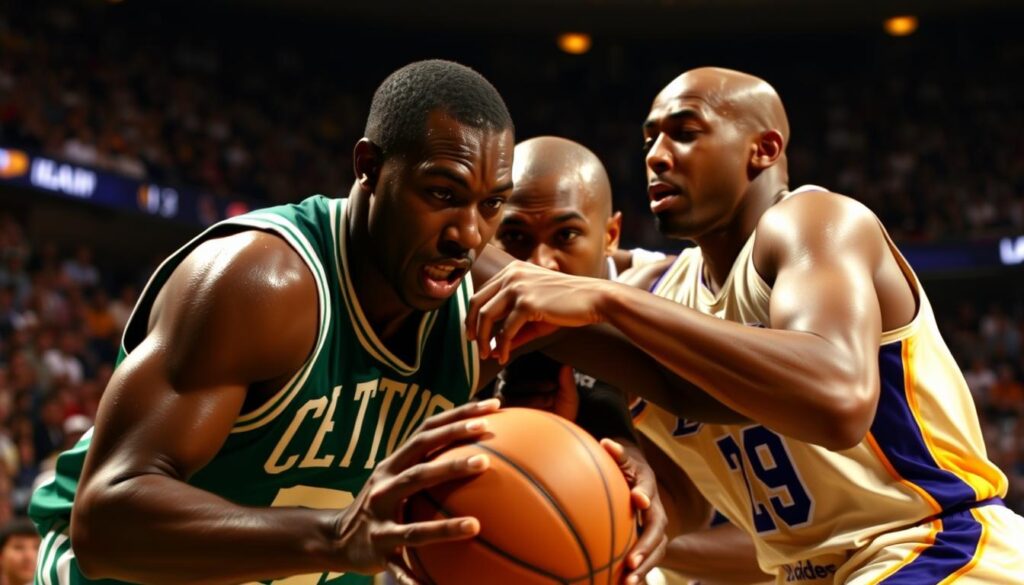
The final minutes were filled with tension. Ron Artest missed a three-pointer, but Pau Gasol dunked it back in. Rajon Rondo’s last-second shot almost changed history. It was like a game of existential theater.
Coaches Phil Jackson and Doc Rivers had different styles. Jackson was calm, like a Zen master. Rivers was frantic, like he was searching for his car in a storm. Their contrast added to the drama.
| Stat | Lakers | Celtics |
|---|---|---|
| Fourth Quarter FG% | 25.7% | 21.1% |
| Rebounds | 53 | 40 |
| Free Throws Made | 37 | 17 |
| Turnovers | 15 | 10 |
When the buzzer sounded, Kobe stood tall. His 23 points were just part of the story. This was a game of psychological warfare, a masterclass in spite.
This classic game stands out because of its raw rivalry. It was a battle without modern distractions, just pure basketball. The game seemed to say: “This is why we watch.”
Off-Court Drama and Coast-to-Coast Tension
While Larry and Magic battled on the court, a different battle raged off it. The Celtics vs Lakers rivalry was more than just basketball. It was a clash of cultures, with each side using its own language and symbols.
Chick Hearn’s smooth voice for the Lakers contrasted with Johnny Most’s sharp Boston accent. Their words painted vivid pictures of the game, with Hearn’s descriptions of Magic’s passes evoking the Pacific Coast Highway. Most, on the other hand, likened Bird’s moves to clearing Route 128.
The owners added fuel to the fire. Jerry Buss hosted lavish parties, while Red Auerbach plotted in smoke-filled rooms. Their styles were as different as night and day, reflecting the excess of the Sun Belt versus the work ethic of New England.
But beneath the surface, there were deeper issues. Magic’s comments in 1987 highlighted the racial undertones of the rivalry. Boston fans saw Bird as a hero, while LA fans admired Magic’s flair. The rivalry was as much about race and culture as it was about basketball.
| Aspect | Celtics | Lakers | Cultural Symbolism |
|---|---|---|---|
| Leadership Style | Auerbach’s cigar-choked war rooms | Buss’ Hollywood pool parties | Factory smoke vs Sunset Strip neon |
| Broadcast Voice | Johnny Most’s raspy intensity | Chick Hearn’s smooth play-by-play | Stevedore vs Surf Report |
| Fan Identity | Blue-collar Bird devotees | Magic’s multicultural coalition | Lunch pails vs Palm Pilots |
| Media Narrative | “Celtic Pride” work ethic | “Showtime” entertainment | Hardhats vs Headliners |
The rivalry spilled over into the media. Most’s dislike for the Lakers was legendary, with him once calling Kareem’s skyhook a UFO. Hearn countered with his own insults, painting Boston Garden as a unique place. Their words turned games into national debates, with fans choosing sides.
The Celtics vs Lakers rivalry was a cultural phenomenon. It allowed America to discuss important issues through basketball. We were not just watching games; we were participating in a national conversation, one fast break at a time.
How the Rivalry Changed NBA Broadcasting and Popularity
The Celtics-Lakers rivalry didn’t just dominate the court. It also took over TV screens, changing sports media forever. From black-and-white broadcasts to ESPN’s 30 for 30 documentaries, every game became a must-see event. This rivalry didn’t just elevate basketball. It made games into events that glued people to their TVs.
Magic Johnson’s smile and Larry Bird’s serious face became marketing gold. Before Nike ads, they were already stars. Networks saw them as characters in a national drama. Bird’s serious interviews and Magic’s no-look passes were TV hits.
Marshall McLuhan said it best: “The medium became the rivalry’s message.” Think about it:
- CBS used 7 camera angles in the 1980s to show Bird’s behind-the-back dishes
- ABC in 2010 framed Kobe Bryant as a Shakespearean hero in the Finals
- ESPN’s 30 for 30: Celtics/Lakers turned old highlights into drama
This change made NBA games into bingeable content. Fans tuned in for history or to see Magic’s winks. Today’s NBA games owe their style to this rivalry. Even the statistical overlays during timeouts? Thanks to Red Auerbach’s drama.
The result? The NBA went from tape-delayed games to prime-time shows. Every dribble now carries 60 years of history. You’re not just watching basketball. You’re experiencing cultural mythology through your TV.
Greatest Individual Games in the Rivalry
Imagine Greek tragedies and hoops Shakespeare mixed together. These games didn’t just define careers; they rewrote basketball mythology. Let’s look at four Historic NBA Playoff Games where legends rose or fell.
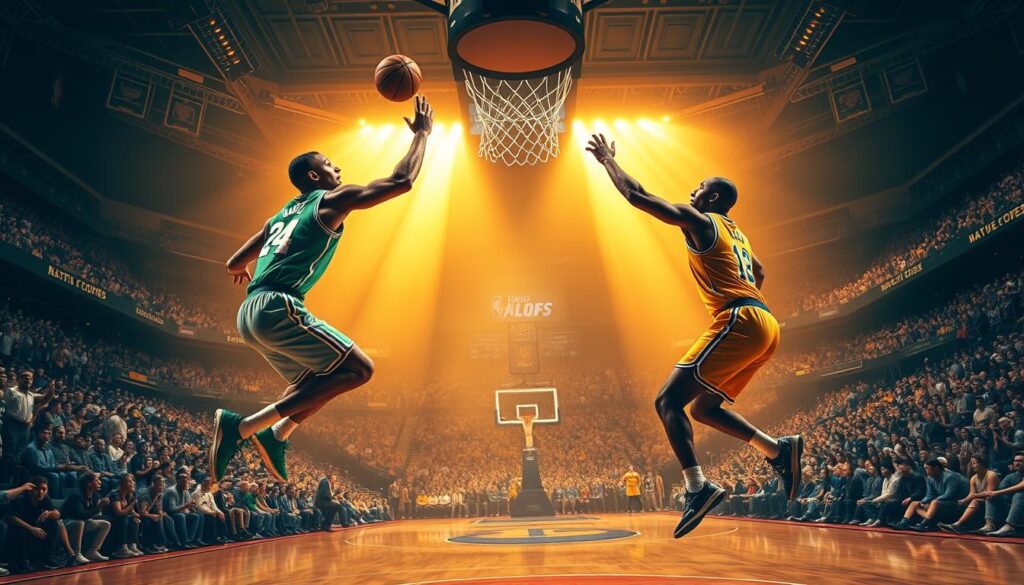
1962: The Overtime Opera
Imagine Bob Cousy dribbling like a jazz pianist and Jerry West shooting from afar like it’s easy. Game 7 of the Finals was a 6OT battle. Boston’s Cousy outlasted LA’s West, despite West’s 42 points.
1984: Memorial Day Massacre
Larry Bird scored 34 points, turning the Forum into a Boston party. The Lakers’ “Showtime” offense was a mess, losing 148-114. Kareem’s scowl was priceless. It was more like a public execution than a game.
1987: Magic’s Baby Hook Heist
Magic Johnson made a skyhook from his non-dominant hand with 2 seconds left. It broke Boston’s heart and made Pat Riley’s hair gel freeze. It’s the most cinematic moment in Historic NBA Playoff Games.
- 1969 Finals: Jerry West’s Sisyphus Moment
- 2010 Game 7: Kobe’s Revenge Tour Finale
West’s 1969 performance is like a tragedy – he averaged 38/7/5 for the losing team. He won Finals MVP by sheer will, like Achilles dragging Hector. In 2010, Kobe Bryant dominated Boston, out-grinding them with 23 rebounds and a smirk.
These games are more than just scores. They’re cultural reset buttons. Every airball, every fist pump, every tear added to America’s greatest sports feud. The real winner? Anyone who saw this epic theater of sweat and swollen ankles.
Legacy and Modern Influence
Today’s NBA teams follow the 1980s Celtics-Lakers playbook. The historic rivalry games shaped the league’s DNA. Jeanie Buss’ Lakers act like a Hollywood agency, while Wyc Grousbeck’s Celtics are like a Silicon Valley startup.
The Larry Bird vs Magic Johnson rivalry set a model for player power. Their battles made teams choose between loyalty (Boston) or star power (LA). Now, the Lakers use influencer marketing, and Boston focuses on analytics.
But can Jayson Tatum vs Devin Booker match the 1980s’ passion? Today’s teams change like playlists. Yet, every Finals matchup is compared to the Celtics-Lakers era.
The rivalry’s lasting impact? It turned basketball into a boardroom sport. Owners strategize like generals, using TikTok and private equity. Boston trades smartly, while LA bets on big names. Both aim for that championship high.
Conclusion: The Saga’s Ongoing Impact
The Celtics-Lakers feud is like the Oxford comma in basketball. It’s not needed, but it’s key to understanding the sport. This rivalry is more than just NBA games; it’s a reflection of American culture.
Boston’s tough, old-school style meets LA’s flashy, modern vibe. This contrast is seen in both game results and online debates. Ask someone in Boston about Larry Bird’s 1984 trash talk, and you’ll get a long story. In LA, you might hear about the future of basketball.
Today’s NBA rivalries, like Warriors-Cavs and Heat-Spurs, are fun but not as deep. They don’t match the mix of grit and glamour seen in Celtics-Lakers games. The league’s shift to three-point shooting comes from both Boston’s defense and LA’s showmanship.
When these teams meet in the Finals again, it will be more than just a game. Boston fans will share stories of Bill Russell. LA fans will post about Kobe Bryant. We’ll all feel like we’re watching old games for a few minutes.
The game’s outcome will decide more than just a winner. It will show if tradition or new ideas will shape basketball’s future. So, who do you think will win?
