
After the Boston Celtics scored two points with the help of two Paul Pierce free throws, tying the score at 80, Boston scored just 11 points in the final 7:10 of the fourth quarter including a stretch where the Celtics didn’t score for three minutes and fifty seconds. This stretch is what turned a close game into a blowout, with Miami pulling away.
Even though there was some strange playcalling, the Miami Heat deserve a lot of credit for digging in and playing fantastic defense. This defense involved strong help defense and a unique strategy to prevent Rajon Rondo’s dribble penetration.
Curious Playcalling
While Miami’s defense stole the show, Boston did contribute to their drought with some odd playcalling choices early in this stretch:
After Pierce’s two free throws, Glen Davis wound up taking the next two shots. Now, the fact that he was taking wasn’t the problem. The problem was that these weren’t typical Glen Davis shots where he was the third option on a set, got an offensive rebound, or was playing off of the Big three. These were designed plays where Davis was the primary option.
The first play, Boston dumps the ball into Davis and clears out, running an ISO for him, and he eventually misses the shot. The second play is an off ball screen ran for Davis, allowing him to cut to the block, get the ball, and go up with the shot that is blocked.
Strong Help Defense
In addition to the curious playcall, the second play where Glen Davis gets blocked at the rim was a good example of the Heat and their help defense. Bosh is originally on Davis, but when the off ball screen gets set, instead of Bosh fighting through, Joel Anthony steps up and gets the block.
This wasn’t a fluke. Miami’s help defense was strong all night and it shined during the final 7 minutes of the game against Boston.
Paul Pierce gets a ball screen and Joel Anthony is late with the hedge, allowing Pierce to split the screen. However, instead of allowing Pierce get to the rim, Chris Bosh steps up and forces Pierce to give up the ball. What makes this play is the rotation back after the help. Because Bosh steps up, it looks like Jermaine O’Neal is open for the easy finish. However, Anthony was always working, rotating back, and able to block the shot.
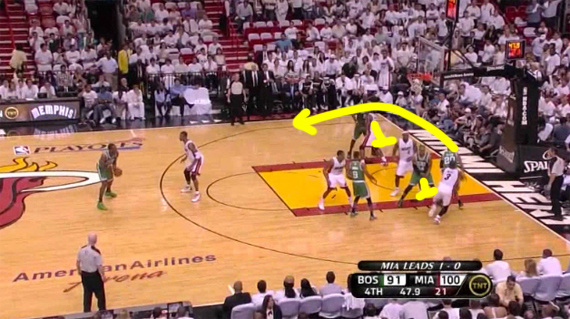
On this play, the Boston Celtics are looking to run Ray Allen off of a couple screens away from the basketball, sending Allen off of a staggered screen that lets him curl to the basketball.
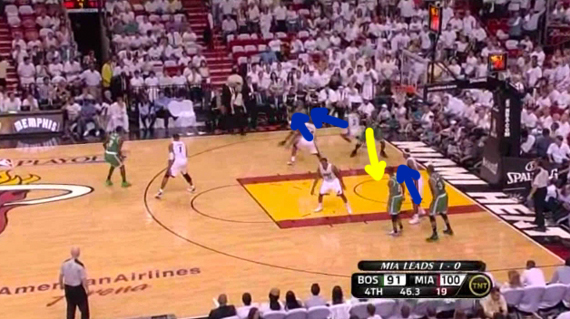
As Allen makes the catch, Anthony (covering Kevin Garnett – the screener) shows with Dwyane Wade closing out on Allen as well. Noticing his man leaving him, Kevin Garnett slips the screen and waits for the pass from Allen (Allen might be the best player in the league when it comes to this type of pass). However, as soon as Allen makes the catch and Anthony leaves Garnett, LeBron James is rotating over to the middle of the paint.
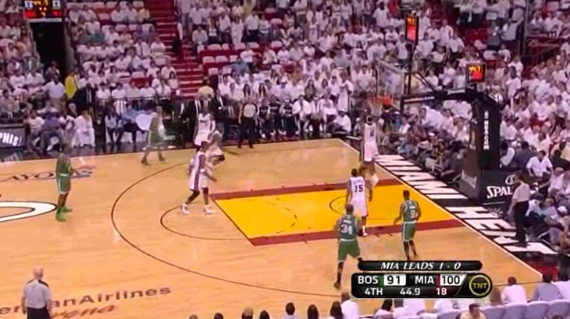
So when Garnett makes the catch, LeBron James is right there ready to deny the shot, which is what he does, meeting Garnett in the air and getting the block.
If LeBron James is making the correct reads and willing to trust his teammate and leave his man, he is a dangerous help defender because he is so athletic. He gets where he wants to go quickly and gets himself in position to get the block.
Defending Rajon Rondo
The final aspect of the Heat’s defense during this stretch (and for the entire game) was how the Heat chose to defend Rajon Rondo. In one situation, the Heat went to a conventional strategy, in another, they went to with a unique gameplan that seems to be working out.
Pick And Rolls
Looking at the conventional strategy, the Heat were able to neutralize Rajon Rondo coming off of screens by simply going under screens and forcing Rondo to make a play on the outside.
In the game, Rondo actually runs off of two ball screens and his defenders goes underneath each one, and eventually Rondo is forced to take a jumper, one that he misses.
On the play, when Rondo’s defender goes under the screen, he actually draws the offensive foul, getting in Kevin Garnett’s way and taking the shove that he gives.
On Dribble Penetration
While going under Rajon Rondo screens is a pretty common site when watching teams defend the Celtics, the way they handled Rondo’s dribble penetration when not in a pick and roll situation was a little more unique. Instead of playing off of him or anything like that, they played him straight up and when Rondo attacked the lane, they helped.
What made this unique is who came and helped. Instead of sending help from a certain spot (the weakside block), they had Joel Anthony leaving Kevin Garnett and dropping into the paint, basically funneling the action back to Garnett and giving up a Garnett jumper from the elbow/top of the key.
This is strange considering that Garnett was 10th in FG% among power forwards with at least 20 games played and 20+ minutes per game, shooting 47% during the regular season. The Heat must have seen something in Garnett (maybe it was because he was 0-2 and looked uncomfortable from that spot in game one, or maybe it just looked like he was lagging in game two), made them comfortable leaving Garnett. For what it’s worth, it is working so far as Garnett is 2-11 (18.2%) from 16-23 feet.
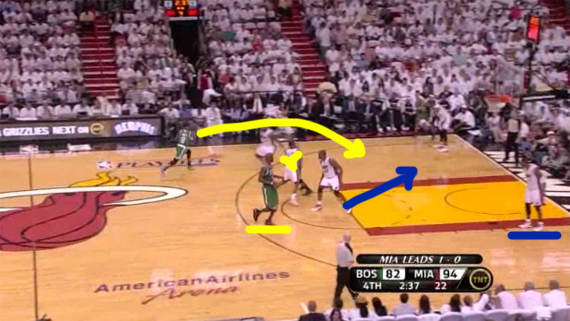
As Rondo sprints the basketball up the court, he gets an impromptu screen from Paul Pierce, freeing up a path allowing Rajon Rondo to get himself to the rim. Instead of sending Chris Bosh from the weakside block to help, Joel Anthony leaves Garnett and sinks into the middle of the lane.
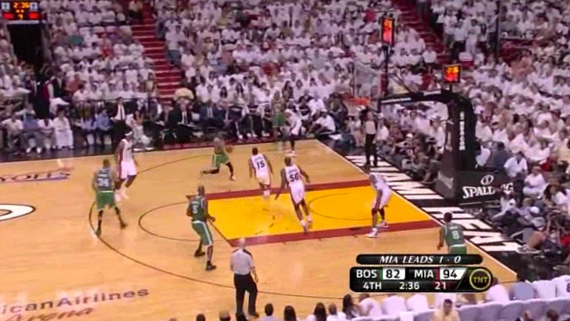
With Anthony in the paint, this allows Chris Bosh to stay in the passing lane and take away the kick out pass to Jeff Green. Essentially what they are doing here is funneling the action back to Garnett.
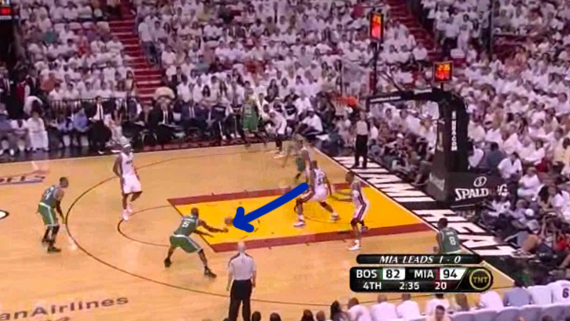
When the pass gets made, Joel Anthony is deep in the paint so when the ball gets kicked out he goes ahead and closes out on him.
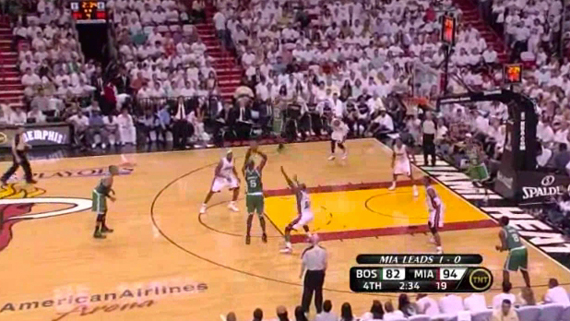
Anthony is mobile/athletic enough to at least bother Garnett with the closeout, even if he doesn’t get a strong closeout.
The Heat are taking away just about everything. The drive to the rim is taken away by Anthony. The pass to the corner is taking away with Bosh sitting in the lane. The only option that Rajon Rondo has here is to kick the ball out to Garnett, who misses the jumper.
On the play Mario Chalmers is pressing Rajon Rondo way up top in the backcourt, allowing Rondo to simply blow by him. Again, Anthony leaves Garnett and provides the help, keeping Rondo out of the lane. This is important because with the help coming from Anthony, it allows Dwyane Wade to stay with Ray Allen in the corner. Here, he is face guarding him, not even worried about what is taking place behind him. His only concern (as it should be) is Ray Allen on the outside.
The Heat are actually able to force a turnover on this possession using their strategy to send help from Garnett’s man. Again, the Heat are playing Rondo very high, allowing him to get a running start and attacking the lane. Once he gets into the paint, he is met by Joel Anthony, who leaves Garnett. It is worth repeating that with Anthony helping off of the paint, it allows the rest of the defense to stick with their men on the outside. Here, with James not worried about helping, he is able to return to his man easily and get the steal on Rondo’s pass.
While this worked for the Heat in game two, it is going to be interesting to see if they do it in game three and if they do, will it work? Garnett is shooting nearly 50% from 16-23 feet, so it is worth wondering if the Heat noticed Garnett’s early struggles (on mostly open jumpers) and just started leaving him or if the Heat see something in Garnett’s shot/health and that is why they are leaving him. The tell will be if the Heat try this again early in game three and stick with it despite Garnett hitting a few open jumpers.
