

Every time Oklahoma City loses (and sometimes when they win), the first thing that you need to look at is the Thunder’s offense, because more than likely, that is what is responsible for the loss. That was the case once again during game three of the Western Conference Finals, a game they loss due in large part to their inability to score (both early in the game and late).
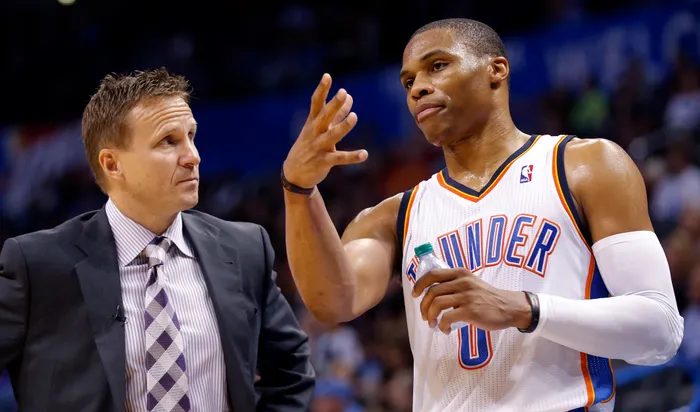
And while there are those who are trying to blame the usual suspect (Russell Westbrook), the blame needs to be put on Thunder coach Scott Brooks. Game after game, the Thunder always seem to hit stretches where they just can’t score and those stretches usually coincide with the times they don’t really run an offense.
Plenty of times in game three, the Thunder had trips where they just didn’t have a set ready to run, player, or ball movement, often forcing players to try and create on their own, where they would fail to do so.
This time down the court, you have Russell Westbrook bringing the basketball up and attempt to try and call something while dribbling the basketball to the wing. Then nobody moves. After waiting for a while, Kendrick Perkins finally comes over and sets a screen, and Westbrook uses it. After coming off the screen, he tries to kick it out to James Harden, but Shawn Marion is able to get his hand on it and create the turnover. Now, the lack of movement is what allows Marion to get the turnover. He knows that James Harden isn’t a threat to cut off of his help, so he is able to dive in, stop penetration, and then shoot back out to get his hand on the ball.
Far too often, the Thunder run one action and think that is enough to get the job done. Here, Durant sets a screen for Westbrook in an attempt to run a pick and pop and then gets a screen on the backside from Kendrick Perkins. Durant kind of jogs through the motions, and since Perkins isn’t a threat on the offensive end, Chandler is able to play the passing lane and take the over the top pass away from Westbrook. Now once this action finishes, it is stand around time as everyone stands and watches Westbrook dribble the basketball. Westbrook is forced to try and create, missing the jumper out of isolation.
Here is another example of just one action (setting a screen up top) with everyone standing and watching. This time, we at least get to see a pass, but it goes to Kevin Durant who is stepping back to about 30 feet away from the basket. Durant makes the catch, but because he is so far out, his dribble penetration takes him just to the elbow, where he misses the jumper.
So as we can see, the lack of sets and an offensive gameplan leads to a lack of movement. This lack of direction/movement creates confusion among the players, and this confusion creates poor spacing. Poor spacing makes it even tougher to try and create something from nothing.
Here, Kevin Durant gets the basketball on the block and it looks like he is going to go to work. At the last second, Thabo Sefolosha flashes through the paint, looking for a pass, but he also takes away Durant’s option to attack the middle. So instead of Durant working one-on-one, he is now forced to kick it out to Westbrook, who gets blocked (not by his man – also due to poor spacing) as he attacks the rim.
The thing about Sefolosha’s cut is that this is the kind of thing that happens when there is no direction on the offensive end. Nobody knows that is getting run, so everyone is going to do their own thing, not really knowing what their teammates are doing.
Here is another example of confusion leading to poor spacing, leading to a turnover. Everyone is just standing around as Russell Westbrook gets a ball screen from Kendrick Perkins. Again, the team has no direction and no movement, so James Harden tries to do something and set a backscreen off the ball for Durant. This isn’t anything designed though, so Durant isn’t expecting the backscreen, so he just doesn’t know to use it. The result is Harden and Durant standing right next to each other, so when Westbrook tries to make the pass, it gets stolen.
Almost as frustrating as their lack of sets, ball movement, and spacing on offense, is coach Brooks’ stubbornness when it comes to running sets that don’t work over and over. There is one action in particular that the Thunder like to run that hasn’t really worked all season, but that hasn’t stopped them from running it over and over (including three times in a row during game three).
The action that they like to run is a staggered ball screen up top, and then running another screen off of that (whether it be a staggered off ball screen or a dribble handoff).
The reason why this set never seems to work is because the double screen up top never gets the job done, as if the two bigs are just going through the motion. This kind of action works when one of the two defenders covering the screener is forced to react to Westbrook, but because that screen is never effective that never happens. In fact, the only time this action worked in game three is when Russell Westbrook just broke off the play and attacked the rim, drawing a foul.
What really makes this frustrating is that when the Thunder are actually spaced properly and are moving, they look great (as they should with two of the better players in the league).
On this possession, you know that the Thunder are running a set from the start. Russell Westbrook quickly gets the basketball out of his hands and cuts through as the Thunder start a set. Eventually, Westbrook attacks, but with good spacing, he has a teammate making himself available, kicks the ball out, and then the ball quickly shoots around the outside, forcing Dallas to recover. Eventually, Sefolosha gets it, pump fakes, and gets the easy lay-in.
Here is that staggered ball screen yet again, but this time, the set isn’t predicated on whether or not a big gets a good screen. Instead, that staggered screen is a decoy as Durant is involved and then he quickly gets a screen from Nick Collison. This gives Durant the space to make the catch and get a jumper off at the foul line.
When I am talking about ball movement and spacing, it doesn’t have to be these intricate sets. Here, Durant gives Westbrook a screen, but instead of popping out, Durant rolls to the rim hard, getting open. With the rest of the offense on the other side of the court, there is no help in time to stop Durant.
Again, nothing crazy here, but when Russell Westbrook attacks, Kevin Durant trails him and gets the basketball in the lane, drawing a foul. If Durant just stands around on the outside, that is a tough shot by Westbrook. Durant doesn’t stand there, makes himself available, and Westbrook makes the right decision.
Small Lineup
The fourth quarter saw Scott Brooks finally go to their small lineup, playing Westbrook, Cook, Harden, Durant, and Collison all for the entire fourth quarter. This was very successful as we saw the Thunder get back in the game and make things interesting. Even with this success, it wasn’t because the Thunder were running offense, quite the opposite. With shooters all around him, Brooks just put everything on Westbrook’s shoulders, expecting him to create, and he responded by having success early in the quarter:
Look at all of these plays Westbrook scores on. It is the same problems with the Thunder offense, no direction and no movement. However, because shooters spread the floor and Westbrook made some shots, it tricks everyone into believing the Thunder are running a real offense.
Eventually, the Westbrook stopped making shots, and that is exactly when the Thunder’s offense sputtered yet again.
Watching these plays it is hard to convince me that the Thunder (and Russell Westbrook specifically) are doing anything different when they had success early in the quarter. In my opinion, the lack of direction finally caught up with them.
While Russell Westbrook made a few mistakes (that transition three late was a terrible shot), it is hard to say that he is the man to blame here, both for shooting the ball too much and for not getting the basketball to Durant. Their is just a lack of direction, and too often that means Westbrook trying to create late in the clock.
For those who say that Westbrook needs to learn how to create for his teammates better, even when the plays break down, they need to understand Westbrook is still a 22 year old learning the position. If the Thunder are running a set, Westbrook makes good decisions and get the basketball where it needs to be.
It’s when things breakdown that he goes a little crazy and the ball sticks in his hands. As the coach, it is Scott Brooks’ job to put his players in the best position to succeed. Anytime that Brooks allows the Thunder to have a possession with no direction, he is doing a disservice to his young point guard.
