

For those of you following the Thunder this postseason, there will be a familiar site at the start of every second quarter. It is during this time that Scott Brooks employs a bench unit led by supersub James Harden and, well, not much else. Because of the dearth of gamechangers around him, Brooks will consistently use a specific set early in the quarter to try and generate a good look for his primary playmaker.
The play starts with Harden always in the right corner (so he can drive middle with his dominant left hand) and the ball in the hands of the Thunder’s backup point guard, currently Derek Fisher. Dirk-stopper Nick Collison begins the action by sprinting to set a ball screen for Fisher at the top of the key. This screen, commonly referred to as false action (because it’s used to set up the real threat of the play), forces a quick hedge by Collison’s defender freeing him for a catch on a pass back from Fisher.
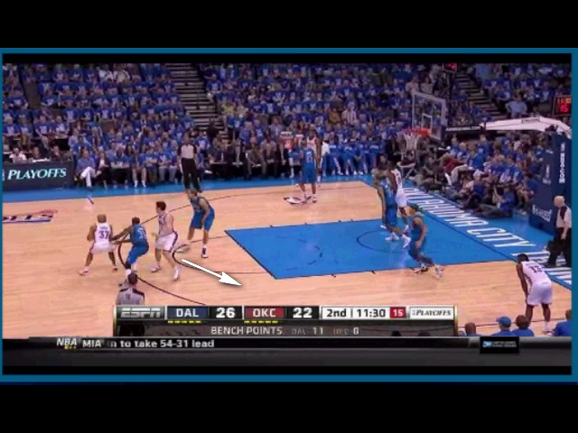
This false action now sets up the real design of the play; to get Harden into a dribble hand-off (DHO) while sprinting up from the deep corner.
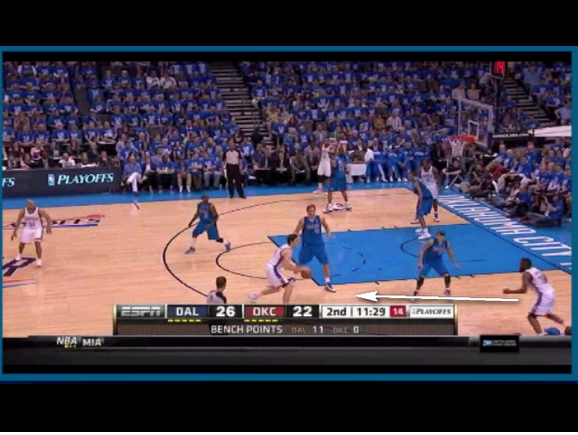
Harden’s read are simple:
– Backcut if denied getting to the screen
– Curl if the screener’s defender offers no hedge protection
– Straight cut (usually for a 3pt shot) if both defenders sag under or Harden’s man gets caught in the screen
And if no initial opening appears after the DHO, Harden and Collison can re-engage in screening action (Either a step-up or traditionally side pick and roll).
The key to all this is the weakside spacing. The other two perimeter players and second post form what is referred to as a “Triangle Away”. The alignment that allows for gaps to be open both on the baseline and for any middle attack Harden chooses to make off the bounce.
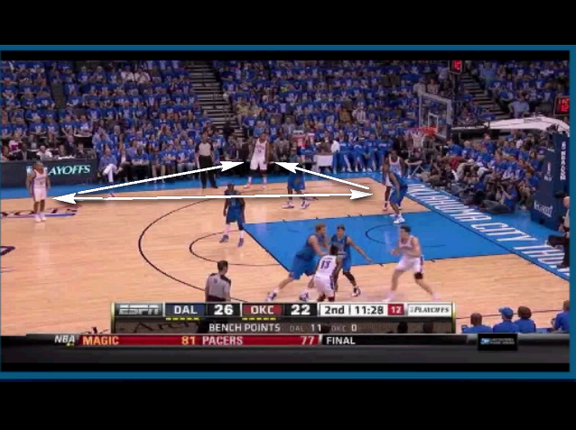
In Game 1 against Dallas, Harden finds the space for 3-point shot thanks largely to Dirk Nowitzki cutting in front of his defender (Delonte West) while trying to recover to Collison’s roll to open space after the DHO.
This set is used so frequently by the Thunder because it is a read-based play. Harden essentially just has to react to both his defender and the screener’s to make the cut that puts the most pressure on the defense. So the result in Game 1 maybe nothing like the results you see the rest of the series. The only certainty about this play is that you will see it.
