

When Boston unveiled Bill Russell’s statue last fall, it was more than a tribute to a man. It was a snapshot of basketball’s greatest paradox. Here stood a player-coach who won 11 rings in 13 seasons. His stone gaze seemed to mock today’s “superteam” experiments, like a chess grandmaster watching toddlers play checkers.
Today, teams often rely on free agency to win. But the real secret? The 1965 Celtics roster was so strong, Kareem Abdul-Jabbar joked they could’ve “won championships knee-walking through Cape Cod sand.” This team was not just a group of players. It was basketball’s original Avengers, eight Hall of Famers moving in perfect sync under Red Auerbach’s guidance.
Russell’s record of 21-0 in elimination games is unmatched. But the real magic was turning role players into legends. The Celtics treated assists like money and defense like air. Their priorities have aged better than their short-short uniforms.
The Boston Celtics dynasty didn’t just win. They changed basketball. They introduced concepts like switching defenses and tempo control. Their secret? A center who valued rebounds over fame, and a front office focused on building rosters, not social media followers.
Team Formation
Bill Russell and Steph Curry have something in common. They were both franchise-altering draft steals. This made expansion teams look like kids playing chess.
The Celtics’ 1956 roster change was more than smart. It was sporting larceny hidden in paperwork.
Drafting Dynasty DNA
Before Moneyball became famous, Red Auerbach used territorial picks like a Wall Street expert. He traded two All-Stars for the #2 pick, getting Russell. This was not just team-building. It was organizational gene-splicing.
Red’s Chess Moves
The 1956 draft was Auerbach’s Kasparov moment:
- He tricked Rochester into passing on Russell with a “he’ll want Olympic money” bluff
- He traded St. Louis’ need for local stars (Macauley was a hometown hero)
- He got future Hall of Famer Tommy Heinsohn in the same draft
The Warriors getting Curry at #7 in 2009 seems amateur compared to Red’s heist. While expansion teams focused on filling seats, Boston was engineering championship algorithms.
The Original Sixth Man
Frank Ramsey’s 1954 debut introduced the NBA to strategic substitution. This idea was so new it made hockey line changes seem simple. Ramsey didn’t just come off the bench. He brought:
- Positionless scoring before it was cool
- Defensive versatility that broke opposing gameplans
- The blueprint for every legendary sixth man from Havlicek to Ginóbili
Ramsey’s role showed championships aren’t won by starting fives. They’re claimed by eight-man systems with interchangeable parts. Today’s superteams are learning this lesson the hard way.
Defensive Dominance
In the 1960s, the Celtics showed that defense can win championships. They didn’t focus on flashy plays. Instead, they systematically crushed their opponents’ dreams.
Imagine basketball as a version of “The Art of War”, but with Chuck Taylors.
The Block Heard ‘Round the World
Russell’s blocks were more than just stops. They were strategic plays that turned defense into offense quickly. The NBA didn’t track blocks until 1973-74. So, Russell’s 4.3 blocks per game in playoffs was a game-changer.
Today, we call this “transition offense mining”. It’s about turning defense into offense fast. Warriors fans might see a similar strategy in their three-point game.
Rotation Revolution
The Celtics’ secret was in their bench strategy. Red Auerbach used substitutions like chess moves. He anticipated modern load management by 50 years, but with less rest.
Bench Science 101
- Energy arbitrage: Rotating fresh defenders to maintain peak intensity
- Positionless prototypes: Players like K.C. Jones switching roles before “switch everything” became a coaching cliché
- Psychological warfare: Depth that made opponents feel outnumbered before tip-off
This approach led to today’s “two-way player” focus. Teams now look for players like Draymond Green. They want players who can dominate in all aspects of the game.
Russell and Auerbach Partnership
Imagine Steve Jobs and Wozniak, but instead of tech, they were in basketball. The Russell-Auerbach team didn’t just win games; they rewrote basketball’s operating system. The ABA started in 1967, causing a stir, but Boston’s duo focused on stable innovation. This was as rare as a quiet night in Madison Square Garden.
Coach-Player Calculus
Russell’s court vision and Auerbach’s coaching skills made a perfect team. They worked together like a well-oiled machine. Auerbach called plays like a jazz composer, and Russell executed them like a quantum computer. This was competitive telepathy, not just coaching.
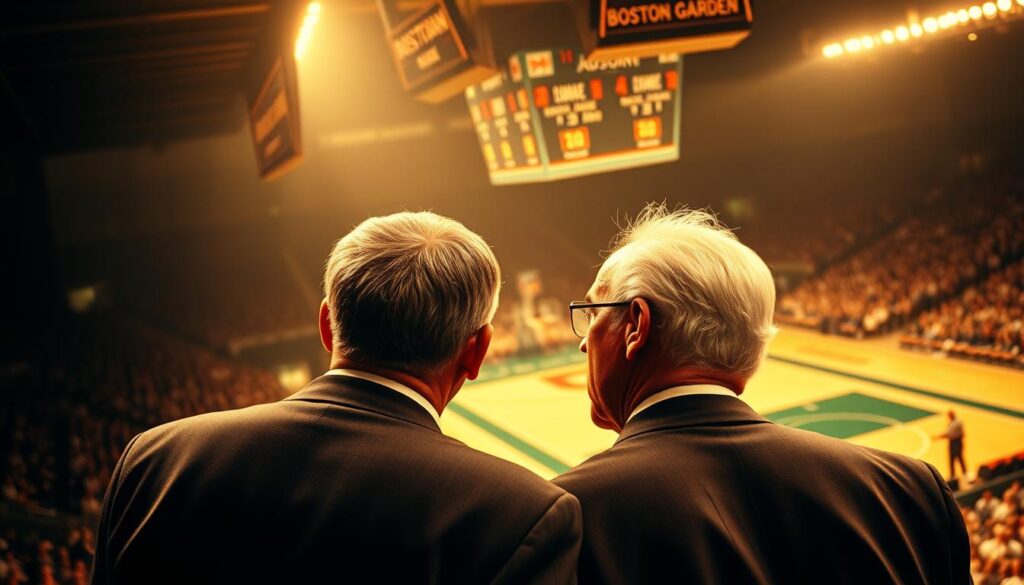
The victory cigar was more than a symbol. Auerbach’s cigar was a tactical middle finger wrapped in tobacco. When he lit up, players knew they were on the right track. Rival coaches, on the other hand, were stressed out.
In 1966, Russell became player-coach, breaking racial barriers while keeping the dynasty alive. As ABA teams focused on flashy gimmicks, Boston’s symphonic basketball stood out. This showed that culture beats chaos every time.
Title Runs
The Celtics’ 1959-1966 championship streak is basketball’s ultimate flex. They won eight straight titles. Eight. In today’s era, that’s like finding a working VHS tape – rare but possible.
Banner Years Breakdown
The Celtics didn’t just win rings; they used them as weapons. In 1962’s Game 7 against the Lakers, Russell was unstoppable. He grabbed 30 rebounds and led the defense like a conductor on caffeine.
Today, we’d call this a “triple-double precursor.” Back then, it was art.
| Dynasty | Years | Titles | Secret Sauce |
|---|---|---|---|
| 60s Celtics | 1959-1966 | 8 | Russell’s rebounding clinic |
| 90s Bulls | 1991-1998 | 6 | Jordan’s scoring psychosis |
| 2010s Warriors | 2015-2018 | 3 | Three-point alchemy |
Playoff Pressure Cooker
Russell’s 1962 Finals performance was unmatched. His 30-rebound, 4-block night was legendary. MJ once joked about Russell having “59 rings” – we’re counting.
The Celtics’ secret? Sacrifice as strategy. The ’90s Bulls had their “Last Dance,” but Boston’s players made championships look easy. No reality TV crews, just cold efficiency – the original greatest team lineup that made dynastic success routine.
Evolution of Basketball Strategy
What do disco, dial-up internet, and post-up centers have in common? They all crashed hard when the world moved faster. The Celtics’ 1960s blueprint didn’t just win titles – it rewrote basketball’s equivalent of Newton’s laws. This left forgotten franchises like the Waterloo Hawks (RIP) as cautionary tales in evolution of NBA team building.
From Mikan to Small Ball
George Mikan’s 1950s dominance – think Shaq with better free throws – created a slow-motion chess match. Then Russell’s Celtics turbocharged the game. Their average pace jumped 12% from 1954 to 1964 – basketball’s first caffeine buzz.
Those outlet passes? They were the beta version of Showtime Lakers’ fast breaks, decades before Magic’s rookie card.
| Era | PPG | Pace (Possessions/Gm) | Championship Teams |
|---|---|---|---|
| 1950s | 93.4 | 89 | Minneapolis Lakers |
| 1960s | 115.2 | 107 | Boston Celtics |
Fast-forward to today’s warriors three point revolution. Steph Curry’s 30-footers are just Russell’s outlet passes with better PR. Both strategies exploited rule changes – hand-check bans then, defensive three seconds now.
Ego vs Ecosystem
The 1969 Celtics (average age: 31) vs 2023 Nuggets (27) is hoops Darwinism in action. Russell’s crew sacrificed stats like monks sacrificing worldly goods. Compare that to Denver’s Jokić – a walking ecosystem who makes teammates 23% more efficient just by existing.
- 1969 Celtics: 6 HOFers, 1 ball
- 2023 Nuggets: 1 MVP, 4 specialists
- Waterloo Hawks: 0 adaptation skills
Teams that failed this test? Let’s pour one out for the Waterloo Hawks – the Blockbuster Video of basketball franchises. Their 1949 roster had three guys named “Bud”, which tells you everything about their forgotten NBA franchises energy.
Key Rivalries
Every great sports story needs a villain. The Celtics-Lakers saga is the ultimate example. It’s like Godfather Part II meets Space Jam, but with better uniforms and worse haircuts.
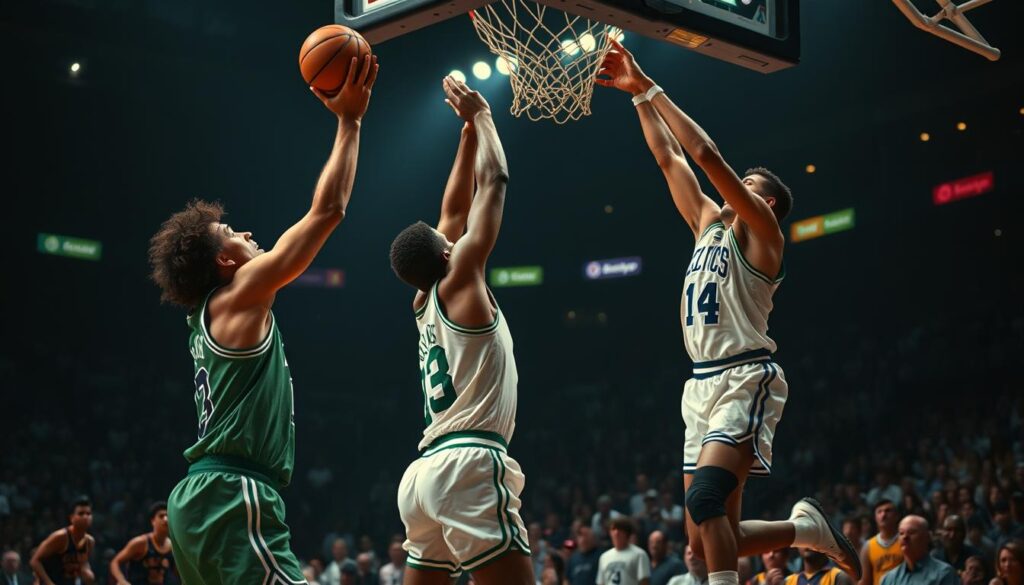
Celtics vs Lakers: Round 1
Before Magic vs Bird became famous, there was Russell vs Baylor. They faced off six times in the Finals from 1959-1969. This rivalry set the stage for all future NBA rivalries.
Boston won all six series. The Forum became their trophy case.
Wilt’s White Whale
Chamberlain’s career against Russell was like Moby Dick with a jump shot. The stats king chased Boston’s whale. Their playoff battles were unmatched:
| Player | PPG | RPG | Finals Wins |
|---|---|---|---|
| Bill Russell | 16.2 | 24.9 | 11 |
| Wilt Chamberlain | 25.7 | 28.0 | 2 |
The 1969 Finals MVP vote was a controversy. Russell’s Celtics won Game 7 by two points. But the trophy went to Jerry West of the Lakers. Imagine the Twitter outrage if LeBron lost but won MVP.
West’s silhouette is the NBA logo. But his expression? It shows the trauma of facing the Celtics.
This rivalry was more than basketball. It was Cold War politics in high-tops. It was civil rights era tension played out through pick-and-rolls. Russell’s teams didn’t just beat opponents – they broke spirits. Chamberlain’s stats were consolation prizes in a championship arms race.
Social Impact
Modern athletes are praised for their activism, but back then, it was risky. Russell’s Celtics faced social minefields and could be blacklisted. They didn’t just win games; they used sports to speak out.
Civil Rights Court
Russell boycotted a game in 1961, showing courage before Colin Kaepernick. He refused to play where Black guests were barred. In 1963, he hosted camps in Mississippi, weeks after Medgar Evers’ death.
Today, the NFL has a “Rooney Rule” but lacks real change. The Celtics didn’t just talk about justice; they lived it on the court.
Beyond the Parquet
The Celtics faced challenges in the 1970s, but their legacy lives on. When teams like the Royals moved, they avoided these issues. In 2020, Jayson Tatum and Jaylen Brown led marches in Boston.
The connection is clear: Team geography shapes social impact as much as their play.
| Team Relocation | Social Climate | Activism Response |
|---|---|---|
| Royals→Cincinnati (1957) | Avoided Northern segregation debates | Silent on civil rights |
| Celtics (1960s) | Boston’s racial tensions | Russell’s frontline advocacy |
| 2020 Celtics | National BLM protests | Team-organized marches |
Today, NBA teams tout their social justice efforts. But when relocation talks start, it’s different. The 2014 Hawks scandal showed a team might suppress Black fans to attract buyers.
Are today’s “woke rebrands” truly different from the past? Or are they just hiding behind a mask?
Lessons Learned
What do championship DNA and expired milk have in common? Both turn sour when egos outpace expiration dates. The Celtics’ 11-title avalanche wasn’t built on highlight reels. It was forged through collective humility that modern superteams keep misplacing like car keys at a frat party.
Ego Death for Life
The Spurs’ five-title run under Popovich perfected what Red Auerbach scribbled on locker room chalkboards: “The rock pounds back.” Tim Duncan’s career reads like a Zen koan – 19 seasons of silent dominance. His max contract demanded less spotlight than a Walmart greeter.
Compare that to Phoenix’s 2023 “superteam” that made less noise than a whoopee cushion at a funeral. Three alpha scorers fighting over one basketball like seagulls attacking a french fry.
Golden State’s death lineup only worked because Draymond Green embraced Russell’s thankless calculus: 15 rebounds > 15 tweets. Brooklyn’s Big Three experiment crashed faster than a Tesla on Autopilot. Proof that talent stacking without sacrifice is just basketball crypto.
Blueprint to Banner
The 2008 Celtics didn’t just revive Boston’s legacy – they bottled Auerbach’s cigar smoke. KG’s defensive intensity turned Rondo into a 6’1″ traffic cop directing championship traffic. Their playbook? Simple:
- Defensive switches sharper than a Brooklyn bartender’s comeback
- Role players treated like VIPs, not NPCs
- Shot distribution smoother than a jazz quartet’s setlist
| Dynasty | Secret Sauce | Modern Counterpart |
|---|---|---|
| 1960s Celtics | Ego-free defense | 2022 Warriors |
| 2000s Spurs | System > stars | 2023 Heat |
| 2023 Pretenders | Instagram followers | Phoenix Suns |
San Antonio’s “pounding the rock” mantra echoes Auerbach’s practice sessions. Players ran drills until cigar ash piles resembled miniature Alps. Today’s GMs chase shiny objects like raccoons with credit cards. They forget that sustainable success requires building cathedrals, not fireworks stands.
Conclusion
Jeannine Russell held a private ceremony at City Hall Plaza last summer. It felt like a big help. She scattered her husband’s ashes where the Boston Celtics’ dynasty started.
This marked the end of an era. The Celtics won 11 titles in 13 years. The NBA retired #6 league-wide, making it a cultural icon.
Today, people talk about “load management” and “peak performance windows.” But the 60s Celtics legacy shows them wrong. Imagine telling Russell his team needed rest days to chase Wilt Chamberlain and fight for civil rights.
Their secret was simple: (talent) × (sacrifice) = banners. Boston Celtics teams winning #18 this June would prove it.
Today’s players face a different world. The shot clock and Twitter timelines are part of the game. But when Jayson Tatum watches old footage, the 60s Celtics’ magic comes alive.
Their greatest play was choosing to be remembered together, not for individual highlights. City Hall Plaza now holds more than ashes. It holds a challenge to build something lasting.
The 2024 squad’s playoff push is about more than breaking ties. It’s about showing dynasty DNA can be replicated. Every defensive rotation and unselfish pass honors the 1965 Celtics. Basketball remembers what truly matters.
