

ESPN’s The Last Dance took over our screens in 2020. It didn’t just bring back memories—it made us rethink sports legacies. The series sparked debate: was it a tribute to greatness or a warning about ego and time limits? With 5.6 million viewers tuning in, it made us face a harsh reality: even the greatest dynasties have dark sides.
Jerry Krause, the GM, was at the heart of Chicago’s success and downfall. He was like Walter White in a sports coat—a genius at building teams but also at tearing them apart. He picked Scottie Pippen for $5 million and hired Phil Jackson when others doubted him. His famous quote, “organizations win championships,” is a haunting reminder of his flaws.
The Bulls of the ’90s were unlike any other team. They were basketball’s first viral meme. Their six titles were a mix of killer instinct, marketing, and Jordan’s unique style. Their success was short but explosive, changing what we think of sports empires.
So, why do we remember the Bulls so much? Maybe it’s because they made dominance look dangerous. Each championship felt like a daring heist. Jordan was the master thief, Pippen the getaway driver, and Krause… well, he was the architect with a wrecking ball.
Introduction: Building a Powerhouse
Building an NBA dynasty isn’t about finding superheroes. It’s about playing chess while others play checkers. The Chicago Bulls’ front office in the late ’80s was like a mad scientist’s lab. GM Jerry Krause made moves that changed the game.
The Krause Gambit
Krause’s strategy was to sacrifice pawns to protect the king. Trading Charles Oakley for Bill Cartwright in 1988 was like swapping a flamethrower for a scalpel. Critics were loud, but Cartwright became Jordan’s defensive rock.
His 1987 draft night was pure magic:
- Snagging Scottie Pippen (5th pick) via Seattle in a pre-arranged trade
- Grabbing Horace Grant (10th pick) to complete the twin-tower defense
This wasn’t just drafting—it was Moneyball-level roster math a decade before Billy Beane made it cool. Krause’s 1993 move for Luc Longley was a smart counter to Shaq. If Jordan was Axel Foley, Krause was the greenlighting genius.
These moves created a legendary defensive dynasty. Jordan’s fire met Krause’s cool calculations. The result? A winning formula for turning trades into championships.
Key Players
The ’90s Bulls didn’t just pick players; they mixed magic. This team was like Citizen Kane and Ocean’s Eleven combined. Let’s explore what made their lineup so special.
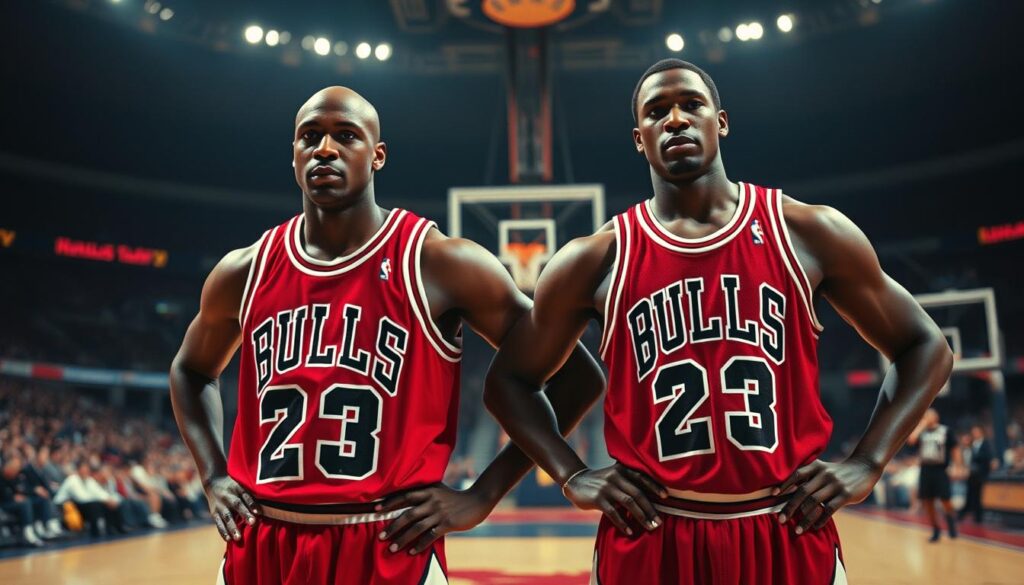
Jordan’s Obsession Engine
Michael Jordan was more than just competitive. He turned his doubts into fuel. His 63-point game against Bird’s Celtics was not just skill. It was his psychotic determination.
His $33 million salary in 1997-98 was not just payment. It was a way to keep him from causing a storm on the court.
Pippen – The Underpaid Architect
Scottie Pippen made just $2.9 million in 1997-98. It was a huge underpayment. Imagine Picasso working for free while Michelangelo got all the money. Pippen’s skills opened up space for Jordan, but his salary was a joke.
| Player | 1997-98 Salary | Key Role | Advanced Stat (PER) |
|---|---|---|---|
| Michael Jordan | $33.1M | Alpha Scorer | 28.7 |
| Scottie Pippen | $2.9M | Defensive Anchor | 20.9 |
| Toni Kukoc | $4.56M | Playmaking Sixth Man | 18.3 |
The supporting cast was incredible:
- Toni Kukoc: The Croatian Sensation – a 6’11″ point forward who predated Jokic by two decades
- Steve Kerr: Three-point specialist who turned clutch shooting into performance art
- Dennis Rodman: Rebounding savant who treated backboards like ATMs
This team was not just smart; it was evolutionary. The Bulls showed how to mix a superstar, an underpaid hero, and great sixth men. Today’s teams are trying to follow their lead.
Coaching: Phil Jackson’s Influence
While other coaches focused on plays, Phil Jackson created experiences. He was like Socrates in sweatpants, using basketball to teach life lessons. His approach mixed Lakota Sioux wisdom with Princeton tactics, turning the game into a spiritual battle.
Red Auerbach’s cigar smoke was iconic. Jackson’s use of incense defined the ’90s.
Zen and the Art of Championship Maintenance
The triangle offense was like jazz, with players improvising. Jackson turned Jordan’s scoring into orchestrated destruction. He followed three simple rules:
- Ball movement over hero ball
- Spacing as psychological warfare
- Fourth-quarter gas reserves (thanks to his Buddhist-level load management)
In 1990, Jackson sought Toni Kukoc, not just a Croatian player. He saw “Pippen’s future yoga partner”, a key player for the triangle. This led to six titles, with opponents looking confused.
Modern analytics fans might find Jackson’s film sessions odd. He studied Sun Tzu more than basketball. Yet, his players’ interviews show they were living parables, not just running plays.
Among most influential NBA coaches, Jackson is unique. Popovich loves Malbec, Riley has slicked-back hair. Jackson turned locker rooms into ashrams and parades into mindfulness retreats. The proof is in the banners and Jordan’s smile during meditation.
Best Playoff Runs
What makes a team a dynasty? It’s the playoffs, where teams become legends. Let’s look at two NBA Finals classics that changed the game. They gave us moments that are now part of pop culture.

The 1992 Finals: Basketball’s Citizen Kane
Michael Jordan’s shrug in Game 1 against Portland was more than a reaction. It was a Mona Lisa of trash talk. That series set the standard for modern championships, combining Jordan’s brilliance with strategic depth.
- The Bulls’ defense held Drexler to 40% shooting – basketball’s version of a restraining order
- Pippen’s evolution into a two-way nightmare, foreshadowing the evolution of NBA team building
- Phil Jackson’s triangle offense creating mismatches like a chess grandmaster on Adderall
This wasn’t just a title. It was a masterclass in psychological warfare, all in red and black.
1998 Utah Jazz: Last Shot Symphony
Game 6 against Utah was more than a basketball game. It was Jordan’s retirement tour, with a basketball as his baton. Here’s why it stands out:
- The Flu Game Sequel: 45 points on 48% shooting while visibly hungover from food poisoning
- Strategic Simplicity: No three-point barrage, just 14 mid-range daggers in the fourth quarter
- The Steal: Striping Malone with the subtlety of a pickpocket at Times Square
While today’s Warriors might dominate with math, Jordan’s Bulls used mythology. The 1998 Finals drew 29 million viewers, making Jordan’s performance art.
These series didn’t just win titles. They set the standard for championship DNA. A mix of individual obsession and collective precision that shapes the evolution of NBA team building. The question is, when will we see another NBA Finals classic that makes advanced stats irrelevant and mythology mandatory?
Rivalries and Adversaries
In the NBA, the Bulls didn’t just win games; they changed the game. They fought against the Celtics-Lakers rivalry in the 1980s. But in the 1990s, their battles with the Pistons and Knicks were the main event.
These games were more than just sports. They were battles of wills between two teams with different dreams.
Pistons: Bad Boys to Whipping Boys
The Detroit Pistons were like a wall for Jordan to break through. For three years, the “Jordan Rules” defense made him look frustrated. But in 1991, the Bulls swept the Pistons in four games, like a wall crumbling.
Here’s what made this rivalry special:
- Detroit’s “Dobermans” (Laimbeer, Rodman) were silenced
- Scottie Pippen grew from sidekick to key player
- Jordan scored 29.8 points per game, outsmarting his foes
Knicks – The Manhattan Melee
The Knicks were like Cuba, small but loud. Their fights with the Bulls were like the Ali-Frazier rivalry. They had:
- Pat Riley’s “no blood, no foul” coaching style
- Charles Oakley’s elbows as weapons
- Ewing’s long playoff struggles (0-6 vs Jordan’s Bulls)
New York won in 1994, but it was like a Miracle on Ice nobody wanted. It was a win that came after Jordan left for baseball.
Cultural Impact
The Chicago Bulls didn’t just win games; they changed the game. They were more than a team; they were a cultural phenomenon. By 1996, kids in Tokyo knew “Air Jordan” better than their own leaders.
Space Jam and Global Domination
In 1996, Michael Jordan and Bugs Bunny teamed up in Space Jam. It was a huge marketing move, not just a movie. The film was released worldwide, making the Bulls’ logo as famous as Coca-Cola’s.
Think about this:
- By 1998, 83 countries showed Bulls games.
- Space Jam merchandise sold more than Bulls championship gear in Europe.
- The “Be Like Mike” campaign led to a 300% increase in youth league sign-ups.
The Jordan Effect on Sneaker Economics
Air Jordans didn’t just sell shoes; they changed the game. Today, Jordan’s sneaker brand is worth $3.1 billion. The shoes were more than just footwear; they were a symbol of status.
Here’s the amazing part:
More teens in the 90s knew Jordan’s “Bred” colorway than the First Amendment. The shoes created a new economy. They showed that the Bulls’ influence went far beyond basketball.
Dynasty’s End and Lasting Influence
The Chicago Bulls’ sixth championship win was followed by a harsh end. It was like the Red Wedding in Westeros, efficient but heart-wrenching. The ’98 title win felt like a funeral, with Jerry Krause’s words haunting the greatest team ever.
The Last Dance Before the Lockout
The 1999 NBA lockout ended Chicago’s golden era. Fans stayed away, with United Center attendance dropping 42%. Krause’s rebuild plan was a lesson in how not to rebuild a team:
| Krause’s Plan (1998) | Modern “Process” |
|---|---|
| Sign aging veterans | Stockpile draft picks |
| Trade franchise icons | Develop young talent |
| Deny reality of roster decay | Embrace strategic losing |
Sam Hinkie’s 76ers made tanking an art, but Krause’s plan was like trying to fix a Ferrari with tractor parts. The Bulls suffered seven straight losing seasons, making fans miss the Jordan-era rivalry.
The 1999 lockout led to the Charlotte Bobcats, while Chicago’s value dropped. The Bulls’ struggles became a lesson for the league. Championship DNA can’t be copied.
Today, every superteam breakup reminds fans of Jordan and Pippen. Each rebuild failure brings back Krause’s name. And when GMs talk about success, Chicago fans remember the Malört.
Conclusion
The 90s Bulls dynasty is like basketball’s Mona Lisa. It’s technically brilliant and emotionally raw. No team can recreate their magic. They won six championships in eight years, marking a cultural shift.
Today, teams aim for championships with advanced strategies and careful planning. But the Bulls won with Jordan’s fierce drive, Pippen’s talent, and Jackson’s smart plays. They used a unique triangle offense, inspired by ancient wisdom.
Now, teams often change players like they’re dating. The Bulls kept their core strong, thanks to smart moves and Rodman’s adventures. Their 1996 season, with 72 wins, was fueled by media rivalries and TV’s power.
Modern dynasties, like LeBron’s Heat and Durant’s Warriors, needed special circumstances. The Bulls thrived without today’s social media hype. Their legendary games, like Jordan’s flu game, were unforgettable without tweets.
The Bulls’ story is unique because they were legends in a digital world. Their drama, like the Last Dance documentary, was fueled by old-school rivalries. Imagine Draymond Green settling disputes like they did back then.
The Bulls’ success is hard to understand. They had three Hall of Famers, a wise coach, and no leaks about trades. Their secret was Jordan’s passion, Pippen’s dedication, and Jackson’s strategy. Modern GMs might have broken them up for more wins.
Can we see that kind of greatness again? Not without a time machine in Jordans. The 90s Bulls showed greatness goes beyond numbers. It needs passion, strategy, and a player who rebounds like his hair’s on fire.
