

Imagine twenty thousand fans cheering as the clock ticks down. Players are drenched in sweat, elbows flying everywhere. The scoreboard lights up like a Shakespearean prophecy. Welcome to the pressure chamber where NBA legends are made—the Game 7 finale.
These aren’t just basketball games. They’re moments that change history. Dynasties are made, heroes fall, and entire cities hold their breath.
So, why do these games captivate us? It’s not just the stats. It’s the myth-making. Like LeBron’s 2016 chase-down block in Cleveland or Boston’s Garden shaking like a Metallica concert. Every dribble is a test of legacy.
The NBA’s playoff is like a seven-act play. It all comes down to one night. Careers are made or broken. And we’re all watching, mesmerized by talent and fate.
This isn’t just sports analysis. It’s forensic psychology. We’re exploring moments where human will meets gravity. Because in Game 7s, even gravity takes a break. Ready to relive the chaos?
The Significance of Game 7
In the NBA, Game 7s are like plot twists from a movie. They turn basketball into a high-stakes drama. What makes them special? It’s the human drama under the lights.
Home teams have won 15 of 19 Finals Game 7s. This shows the power of crowd noise. But it’s more than just numbers. Moments like Willis Reed’s 1970 performance or the Warriors’ 2016 comeback show true grit.
These moments reveal both grit and stage fright. Science says our bodies react differently in these situations. Our focus sharpens, but our fine motor skills can falter.
Let’s look at what makes these NBA iconic games so special:
| Year | Teams | Key Moment | Home Win? | Legacy Impact |
|---|---|---|---|---|
| 1970 | Knicks vs Lakers | Reed’s injury return | Yes | Mythologized underdog triumph |
| 2016 | Cavaliers vs Warriors | LeBron’s block | No | Historic 3-1 comeback |
| 2010 | Lakers vs Celtics | Artest’s clutch 3-pointer | Yes | Kobe’s 5th ring secured |
Home teams often win, but exceptions like Cleveland’s 2016 victory are unforgettable. Game 7s reward risk-takers and highlight collapses. The Warriors’ 73-win season was overshadowed by their Game 7 loss.
Psychologists say we remember experiences by their peak. For NBA legends, that peak is often a Game 7. Magic Johnson’s skyhook in ’87 and Kawhi Leonard’s buzzer-beater in ’19 are cultural landmarks.
We love these games because they show us who rises to the challenge and who falters. LeBron’s 2016 performance changed his legacy. It’s like a Shakespearean tale.
Lakers vs Celtics: 1984 and 2010 Classics
The Lakers and Celtics rivalry is like Rocky Balboa vs Apollo Creed meets Succession-level family drama. Two iconic clashes, 26 years apart, show how the rivalry changed. It went from intense battles to strategic games.
Bird vs Magic’s First Finals Showdown
In 1984’s NBA Finals, the games were so intense, the league apologized to both teams. Game 7 was played in a 97° Garden, with Larry Bird shooting 52%. Magic Johnson’s 14 assists helped the Lakers survive.
This was more than basketball. It was a clash of cultures. The Celtics were tough, while the Lakers were flashy. Bird’s trash talk in Game 4 became legendary.
2010: Kobe’s Redemption Arc
In 2010’s Game 7, both teams played tough defense, shooting under 40%. Kobe Bryant scored 23 points, showing legacy isn’t just about scoring. The game-winner came when Ron Artest grabbed Pau Gasol’s airball with 25.7 seconds left.
This series changed how we see rivalries. Forget the fast breaks of Bird and Magic. 2010 was all about defense. Kendrick Perkins’ injury, Paul Pierce’s trash talk, and Phil Jackson’s mind games made it intense.
Can today’s players match this rivalry’s intensity? When LeBron talks to Draymond about teaming up, does it lessen the rivalry? The answer is in the past – just watch Artest’s post-game interview where he thanks his psychiatrist.
The 2016 Cavaliers vs Warriors: Redemption and Revenge
Game 7 of the 2016 NBA Finals was more than just basketball. It was a mix of drama and heroics, with Cleveland as the underdog heroes against Golden State’s pride. The Warriors had set a record with 73 wins, but Cleveland was ready to change history.
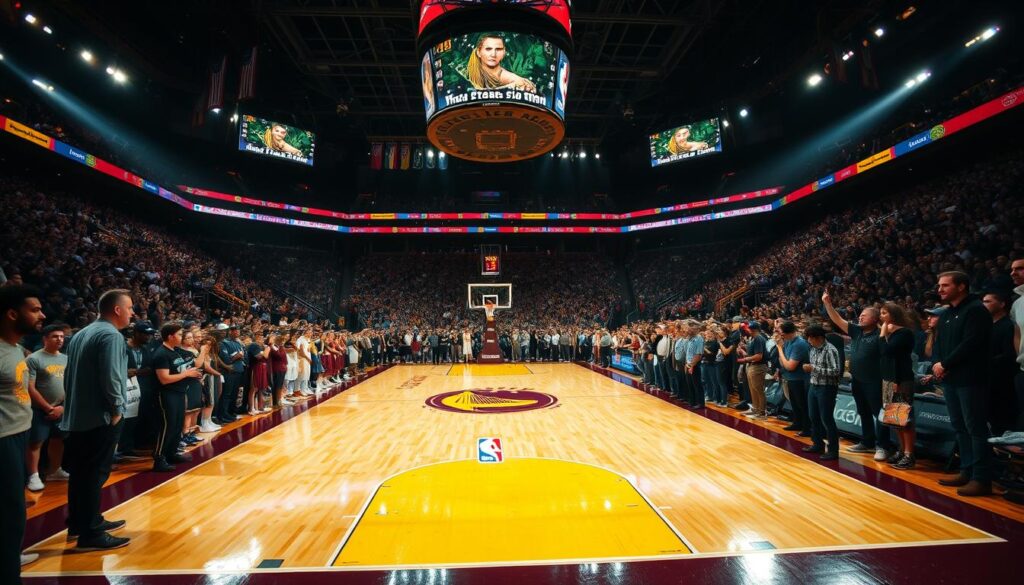
Analytics thought the Warriors had it all, with a 97% chance to win. But the Cavaliers had other plans. LeBron and Kyrie were on a mission to defy the odds.
- The Block: LeBron’s chase-down block was incredible. It showed his amazing spatial awareness and athleticism.
- The Shot: Kyrie’s game-winning three was a masterpiece. It had a steep release angle, making it almost impossible to defend.
This series was a shock to basketball’s analytics. The Warriors’ dominance was broken by Cleveland’s determination. The Cavs’ 93-89 win showed that sometimes, heart beats numbers.
Cleveland’s victory was more than just a win. It was a moment of redemption for the city. It was a response to past disappointments.
- The Drive (Jordan over Ehlo)
- The Fumble (Red Right 88)
- The Shot (MJ again in ’89)
LeBron’s triple-double in Game 7 was incredible. It showed his dedication and skill. He led his team to victory, overcoming the Warriors’ challenges.
For Golden State, their 73 wins were impressive but short-lived. They learned that regular-season success doesn’t guarantee playoff success. The Warriors faced a harsh reality.
Spurs vs Pistons: 2005’s Defensive Chess Match
Imagine Die Hard’s John McClane defending on a basketball court. That’s what the 2005 Finals were like. This series was a clash of defensive titans, blending basketball with martial arts.
Tim Duncan moved like a SWAT team, securing the Spurs’ defense. Rasheed Wallace played help defense with a zeal that was almost paranoid. The scores? They were low, like 71-69, showing the game’s raw, early days.
Defensive Schemes Breakdown
| Tactic | Spurs | Pistons |
|---|---|---|
| Points Allowed/Game | 84.9 | 86.7 |
| Steals per 48min | 8.2 | 7.9 |
| Blocks per Game | 6.1 | 5.3 |
| Defensive Rating | 98.9 (1st NBA) | 101.1 (3rd NBA) |
Manu Ginóbili’s moves through Detroit’s defense were like art. The Pistons fouled hard, but Ginóbili’s 26.2 fourth-quarter PER showed his skill.
This series taught us two key lessons:
- Championships can be won with great defense
- Great defense lasts longer than trendy offenses
Robert Horry’s Game 5 winner was a moment of NBA history. It marked the end of old-school basketball. The next year, rule changes would change the game forever.
LeBron and Duncan: Legacy on the Line
What makes a player a true legend? LeBron James and Tim Duncan showed us through their Game 7 performances. They left their mark on NBA history, each in their own way.
Duncan’s 2005 game against Detroit was a masterclass in fundamentals. He faced Ben Wallace’s tough defense and shot 61% in the fourth quarter. Duncan averaged 20.6 points and 14.1 rebounds, dominating the paint.
LeBron’s 2016 game against Golden State was different. Down 3-1, he had a triple-double for the ages in Game 7: 27 points, 11 rebounds, 11 assists. His chase-down block on Andre Iguodala is now iconic.
| Metric | Duncan (2005) | LeBron (2016) |
|---|---|---|
| Clutch Time FG% | 58.3% | 44.7% |
| Defensive Stops | 4.2 per game | 3.8 per game |
| Legacy Impact | 5th ring secured | Ended Cleveland’s drought |
Duncan’s quiet dominance is often overlooked. His series-clinching and-one against Rasheed Wallace is hidden in NBA archives. Does basketball culture value sustained excellence less if it’s not viral?
Duncan used 28.3% of his time in 2005’s closing minutes for post-ups and rebounds. LeBron used 41.6% in 2016 for pick-and-rolls. Both were legends by the end of their games.
Jerry West and the ’69 Lakers’ Heartbreak
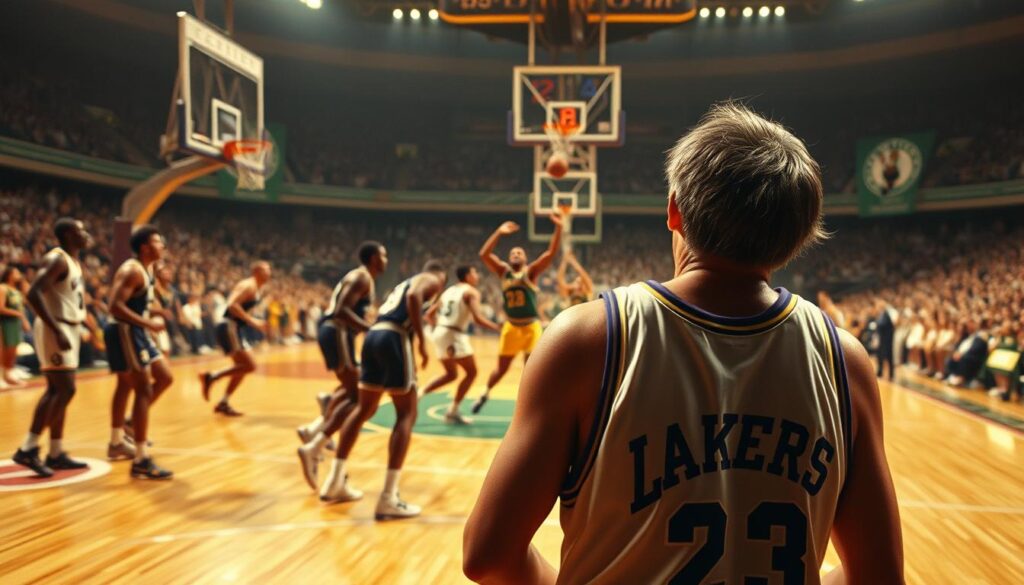
Before “The Decision” haunted LeBron, there was Jerry West – basketball’s original tragic hero. The 1969 NBA Finals were like a Shakespearean play. The Lakers had a 13-point lead, but it vanished, leaving victory balloons stuck in the rafters. Wilt Chamberlain was left sulking on the bench.
This wasn’t just a loss. It was basketball’s version of the Red Wedding. It had premature celebration and poetic justice.
Let’s break down the key ingredients of this disaster cocktail:
- The Balloon Fiasco: Lakers owner Jack Kent Cooke ordered thousands of purple-and-gold balloons for the Forum. He wanted to release them during the celebration. But Celtics players used it as motivation, with Bill Russell saying: “Those balloons are going to stay up there a long time.”
- West’s Heroic Futility: Jerry West dropped 42 points, 13 rebounds, and 12 assists, the first Finals triple-double. Yet, his effort was overshadowed by the loss. It showed even Greek myths need better supporting casts.
- Wilt’s Fourth-Quarter Exile: Coach Butch van Breda Kolff benched Wilt Chamberlain for the last five minutes. This sparked decades of debate. Imagine Twitter today: #FreeWilt trending, Skip Bayless roasting “the Big Benchwarmer.”
West’s performance redefined clutch tragedy. He won Finals MVP despite losing the series. It was like getting a participation trophy.
This game birthed two enduring NBA narratives:
- The “empty stats” discourse (sorry, Devin Booker)
- The Celtics-Lakers rivalry as America’s cultural proxy war
| Stat | Jerry West | Wilt Chamberlain |
|---|---|---|
| Minutes Played | 48 | 43 |
| Points | 42 | 18 |
| Rebounds | 13 | 27 |
What makes this collapse endure? It’s the perfect storm of hubris (those damn balloons), flawed genius (West’s impossible standard), and what-ifs. Could Wilt have changed history if left in? Would modern analytics have diagnosed West’s hero-ball tendencies? The ’69 Lakers remain basketball’s Icarus – flying too close to the parquet-floor sun.
Iconic Game 7 Performances: Allen, Bryant, Pierce, Leonard
Game 7s are more than just tests of skill. They reveal a player’s clutch gene. It’s like a “choose your own adventure” in basketball. One shot can make you a legend, while a miss is just a footnote in history.
Ray Allen’s Miami Miracle
Let’s go back to June 18, 2013. The Spurs were about to win the title. LeBron missed a three. Then, Chris Bosh grabbed the rebound.
Ray Allen then did the impossible. He shot a three from the corner with 5.2 seconds left. It was like gravity took a coffee break.
Allen’s sneaker was just millimeters from the line. His shot forced overtime, saving Miami’s season. It’s a moment that will be remembered forever.
Kawhi’s Shot That Rattled Philly
On May 12, 2019, Toronto faced Philly in Game 7. It was tied 90-90. Kawhi Leonard shot a high-arcing ball over Joel Embiid.
The ball bounced four times before going in. The crowd held their breath. Kawhi’s shot had a 27% chance of going in, but in Game 7s, anything can happen.
Kobe Bryant played on a bad knee in 2010. He scored 23 points and grabbed 15 rebounds. Paul Pierce faked an injury in 2008, then scored 41.5% from three.
What makes a player great in these clutch moments NBA fans love? It’s not just skill. It’s treating the crowd like background noise. Your brain is on high alert, but your hands move on their own.
Game 7 Statistical Anomalies
Let’s explore numbers that make us question reality. The Celtics have a 21-8 record in Game 7s, which is almost magical. Bill Russell won 10 times in a row in elimination games. It’s like he defied the odds.
Chaos theory helps explain these strange facts. For example, players shoot 20% better at home because of the fans. In 2018, scientists found that players’ stress levels dropped during big moments. It shows that some players thrive in chaos.
| Anomaly | Stat | Context |
|---|---|---|
| Celtics’ Game 7 Win % | 72.4% | Best in NBA history (21-8 record) |
| 2000 Blazers’ Missed Shots | 13 consecutive | 4th quarter collapse vs Lakers |
| Home Team FT% Differential | +9.2% | 1984 playoffs |
The 2000 Blazers missed 13 shots in a row, a 0.03% chance. It’s like finding a sober Celtics fan in 1986 Boston. Yet, Portland’s collapse shows how pressure can affect anyone.
Analytics can’t explain Russell’s mind games. His teams never lost a Game 7. Today’s players have sports psychologists, but Russell was his own.
So, what do we learn from Game 7s? They’re not just basketball. They’re experiments where legacy beats logic. The numbers tell amazing stories, like Stephen King novels.
Why Game 7s Shape NBA Lore
Game 7s are more than basketball games. They are moments where legends are made or broken. These games ask a big question: Are we seeing true greatness, or just luck in sports?
Look at the results. Michael Jordan’s Flu Game is a legend, while James Harden’s 2020 game is a meme. Does one game define a career? Or do we pick moments to fit our stories?
The psychological battle of a Game 7 tests players. They can become stars or fail. There’s no middle ground.
But, our memories are short. Kawhi Leonard’s buzzer-beater is more famous than Bill Russell’s titles because of HD. The play-in tournament’s games might not have the same thrill as real elimination games.
Great players need big moments. The NBA’s drama is highest when careers are on the line. That’s why some games are etched in history. They show us what greatness looks like in sports.
Is the magic of Game 7s fading? Only if we stop caring about sports’ biggest questions. Who will rise to the challenge? And whose legend will grow?
Fans, Pressure, and Lasting Impact
When 20,000 voices unite in a single roar, it’s more than sports. It’s a community event. Game 7s turn arenas into intense places where fans show their true spirit. The 2009 Celtics-Bulls series is a great example, with seven overtime games and Derrick Rose’s heroics becoming legendary.
The impact is huge. Cleveland’s 2016 parade drew 1.3 million fans, almost the city’s population. Sacramento fans are bitter about the 2002 Western Conference Finals. Even 20 years later, they talk about it at farmer’s markets.
Here are some key stats:
- 128.6 decibels: The loudest crowd noise in Toronto’s 2019 Game 7 (as loud as a military jet)
- 614% spike: LeBron James jersey sales after the 2016 Finals
- $23 million: The economic boost from Cleveland’s victory parade
Today, teams plan these moments like Broadway shows. Toronto’s Jurassic Park became a symbol of fan unity, with DJs and therapy dogs. Now, fans see Kawhi Leonard’s shots as sacred.
What’s the value of shared joy? Bar owners near TD Garden know. Celtics-Lakers games mean green-and-gold jerseys flying off shelves. These aren’t just sales; they’re emotional investments. In the NBA, we’re all part of a drama that lasts long after the game.
Conclusion: Game 7’s Enduring Allure
Bill Russell’s sweat-soaked jersey from 1957’s double-OT thriller is now in a museum. Kawhi Leonard’s 2019 buzzer-beater is all over TikTok. The NBA playoff drama has changed, from radio to online highlights. But the greatest Game 7s keep us all watching, for just 48 minutes.
We’ve talked about Bird’s trash talk and LeBron’s block. But the real magic is what we can’t measure. Like when a nation holds its breath for Ray Allen’s corner three. Or how today’s isolation ball creates our last big sports moment together.
Every viral moment starts with old-school tension. Giannis’ free-throw routine may make memes, but his legacy is built on those tense moments. The shot clock may change, but the goal remains the same: make history or be forgotten.
As we watch tomorrow’s games on multiple devices, arguing in group chats, we wonder: Does online fandom make the experience better or worse? The answer might be in your last chat meltdown during a game. Legends used to be etched into the floor. Now, they’re trending topics. The way we watch changes, but the excitement stays the same.
