

Imagine Boston Garden in 1976. The air was thick with sweat and the smell of stale popcorn. Game 5 of the Finals turned into a triple overtime battle. It was more than just a game; it was a moment of pure basketball magic.
John Havlicek and Gar Heard created a moment that will never be forgotten. It was like a mix of Warhol’s art and Ali’s boxing. It was a cultural event disguised as a sports game.
So, why does this game stick in our minds? It showed that sports can change culture. The Celtics and Suns didn’t just play hard; they changed the way we see sports stories.
When Heard’s shot went in with just one second left, it was more than a point. It started the era of highlights we love today.
Think about the stats: 3 overtimes, 33 lead changes, 15 ties. But there’s more to it. This game helped the NBA gain respect. It made basketball a big part of American culture.
Next time you see a player make an incredible shot, remember 1976. That’s when basketball became a place for miracles. And we all love watching those moments with our snacks.
Defining a “Classic” Playoff Game
What makes a playoff game unforgettable? It’s not just about stats or awards. It’s the mix of high stakes, drama, and survival. Imagine basketball as a stage where every play is a moment of truth.
Karl Malone’s 1990 season was impressive, but does it compare to Robert Horry’s seven championships? Regular-season wins are one thing. But playoff heroics are something else entirely.
| Player | Regular Season PPG | Playoff PPG | Clutch Moments |
|---|---|---|---|
| Karl Malone | 36.0 | 27.1 | 3 game-winners |
| Robert Horry | 7.0 | 9.7 | 17 game-winners |
Analytics love efficiency, but playoff classics are about urgency. James Harden’s threes and Kawhi Leonard’s 2019 dagger are unforgettable. They’re not just highlights; they change the game.
We celebrate these games because they show what’s truly important. 82 games show you’re good. But 48 playoff minutes show you’re essential. This is why Butler’s 2020 bubble run is more memorable than Harden’s titles.
So, what makes a game classic? It needs three things:
- Stakes (elimination games > Tuesday night in Detroit)
- Narrative (rivalries, revenge arcs, redemption tours)
- Legacy Cement (does it alter how we remember the athlete?)
The greatest playoff series do more than entertain. They redefine what we think of athletes. They turn role players into heroes and MVPs into warriors. Every play is a chance to make history.
Bill Russell vs Wilt: 1962 Game 7 Eastern Finals
Imagine two giants crashing into each other on Boston Garden’s floor. That’s what happened in 1962 between Russell and Chamberlain. It was more than a game; it was a clash of titans, with Red Auerbach’s cigar smoke adding to the drama. This game set the stage for all future historic rivalry games.
Wilt scored 50 points, as if it was nothing. Russell countered with 30 rebounds and a lesson in defense. He showed that defense is not just about blocking shots. It’s about making opponents feel like they’re being watched.
The game’s score was 109-107 in favor of Boston. But its legacy is even bigger. It taught us three important lessons:
- Championship DNA beats stat-padding pyrotechnics
- Rebounding is chess with elbows
- Every modern center owes these titans royalties
Russell’s Celtics didn’t just win; they showed the power of teamwork. They proved that teamwork can beat a single superstar. Today’s NBA values “two-way players” and “switchable defenders” because of this game.
When we talk about the Celtics vs Lakers rivalry, we’re really talking about this game’s impact. It changed how centers play, making them more defensive-minded. It also set the stage for clutch playoff performances and the debate over “superteams.” Sixty years later, Russell’s question remains: “Why celebrate scoring when you can prevent it?”
Magic Johnson’s Versatility: 1980 NBA Finals
When Kareem Abdul-Jabbar’s ankle buckled, the Lakers’ hopes seemed lost. But a 20-year-old rookie, Magic Johnson, stepped up. He played like a jazz master in Game 6, scoring 42 points.
Let’s dive into Magic’s incredible performance. He didn’t just fill roles; he redefined them. With 15 rebounds and 7 assists, he was like a Swiss Army knife.
He played all five positions with the energy of a disco ball. It was more than a basketball game; it was a cultural shift. And it happened in short shorts.
His rookie card became priceless overnight. It’s now worth six figures, like a Basquiat painting. eBay prices soar after every 30-for-30 documentary.
What box scores miss is Magic’s boldness. He turned the game into an improv show. The Celtics-Lakers rivalry is legendary, but this moment was pure swagger.
Reggie Miller vs Knicks: The Choke Game
New Yorkers are divided on May 7, 1994. Was it a basketball tragedy or a Greek drama at Madison Square Garden? Reggie Miller made it a solo show, with Spike Lee watching from the front row.
Miller didn’t just win; he showed the Knicks psychological warfare. His 25 points in the fourth quarter were a lesson in mind games. Here’s how he did it:
| Play Type | Execution | Psychological Impact |
|---|---|---|
| Three-Point Barrage | 5/5 from deep | Destroyed defensive confidence |
| Free Throw Mind Games | Taunted Spike Lee pre-shot | Rattled entire arena |
| Steal & Layup Combo | 8 points in 9 seconds | Induced team-wide panic |
Miller’s last move – 8 points in 9 seconds – is a basketball horror story. Knicks fans relive Greg Anthony’s pass and John Starks’ free throws. For a visual reminder, the game tape is as fresh as ever.
Why do we remember this unforgettable Game 7? It’s a mix of:
- A trash-talking villain (Miller’s bow to the crowd)
- Hapless victims (Knicks’ championship aspirations)
- Captive audience (Lee’s reactive close-ups)
Sports psychologists study this collapse like the Zapruder film. They wonder how a team can fall apart so dramatically. The Pacers’ 93-86 win is etched in history like Shakespearean verse.
The Allen Iverson Step Over—2001 Finals Game 1
In 2001, Allen Iverson made the NBA Finals unforgettable with a bold step. The Philadelphia 76ers beat the Lakers 107-101 in overtime. It was more than basketball—it was cultural trespassing.
Here was a 5’11” guard with cornrows and tattoos, leading a team of role players. They had beaten Vince Carter’s Raptors and Ray Allen’s Bucks. Now, they faced the Shaq-Kobe dynasty. The odds were against them, but Iverson’s confidence was unwavering.
- The step heard ’round the league: Iverson’s crossover-turned-stomp over Tyronn Lue was more than disrespect. It was a message to the NBA: “We’re here, we’re loud, deal with it.”
- 48 points of defiance: Iverson played 52 minutes against Kobe and Shaq, scoring more than their starting backcourt. It was art brut basketball.
- The birth of the anti-hero: Iverson’s mock-step over Lue was a challenge to the clean-cut Jordan-era. Baggy shorts, chains, and authenticity became the new norm.
This game shook the league’s cultural infrastructure. The 2005 dress code was a response to Iverson’s 2001 statement. The NBA wanted choirboys, but Philly gave them a poet with a killer crossover.
What makes this moment legendary isn’t just the stats. It’s the context. This was hip-hop’s full arrival in sports, with its own language and middle fingers to respectability. When Iverson stepped over Lue, a whole generation followed.
Ray Allen’s Corner Three: 2013 Finals Game 6
In a moment where analytics met agony, Ray Allen’s corner three became basketball’s version of a mic drop. The Spurs had already rolled out the virtual red carpet for their fifth championship trophy. Miami’s “Big Three” era hung by a thread thinner than Popovich’s post-game press conference patience. Then physics intervened.
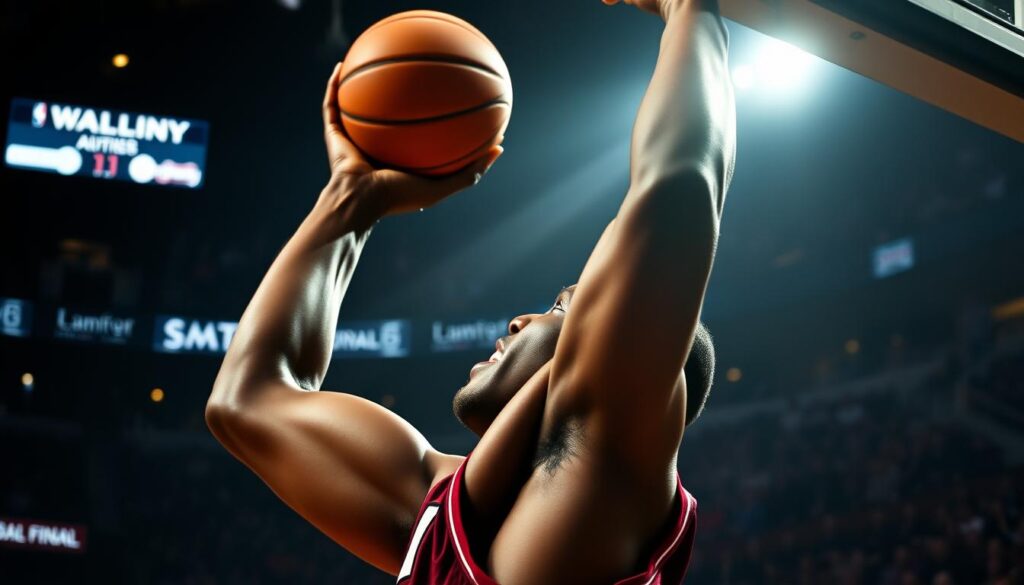
Let’s break down the shot that broke advanced metrics like a bull in a data center. Allen’s feet hovered 25.3 inches behind the arc—a distance NASA would classify as “lunar landing territory” for most shooters. Kawhi Leonard’s contest? A mere 2.4 feet away, which in NBA closing-speed terms is roughly equivalent to a polite handshake.
| Factor | Measurement | Historical Context |
|---|---|---|
| Distance from Arc | 25.3 feet | Longest Finals clutch 3 in 16 years |
| Defender Proximity | 2.4 feet | Closer than Duncan’s bank shot range |
| Time Remaining | 5.2 seconds | Enough for 1.3 LeBron chase-down blocks |
| Shot Difficulty Rating | 9.8/10 | Higher than Pop’s post-game wine selection |
The true magic? This NBA Finals classic exposed basketball’s Schrödinger’s cat paradox. Until Allen released the ball, LeBron simultaneously had and hadn’t failed to cement his legacy. The shot didn’t just save Miami’s season—it vaporized a thousand hot takes mid-air.
Advanced stat nerds debate whether Popovich should’ve kept Duncan in for rebounding. But here’s the rub: San Antonio’s 95% win probability models didn’t account for Ray Allen having the spatial awareness of a GPS satellite. Sometimes, clutch transcends analytics.
This Game 7 dramatic precursor rewrote the rules of legacy math. LeBron’s 32-point night became a footnote. Bosh’s offensive rebound? A parenthetical. Allen’s shot became the Oxford comma of NBA history—technically optional, but civilization collapses without it.
Most Clutch Individual Performances
What makes playoff heroes stand out? It’s the moments when time seems to slow down. The crowd holds its breath, and legends are born. Let’s look at two performances that changed the game.
Michael Jordan’s 1997 Flu Game was more than a game. It was a mix of drama and magic. MJ played with food poisoning, scoring 38 points. His iconic shrug after a game-winning three-pointer is unforgettable.
In 2016, LeBron James made a block that changed history. It saved Cleveland’s championship hopes. His 27-11-11 triple-double is impressive, but his quick thinking is what fans remember.
| Player | Moment | Key Stat | Cultural Impact |
|---|---|---|---|
| Michael Jordan | 1997 Flu Game | 38 points on 48% shooting | Redefined “playing through adversity” |
| LeBron James | 2016 The Block | 92.9% defensive win probability | Shifted legacy narrative permanently |
| Larry Bird | 1987 Steal vs Pistons | Game-winning assist in 2 seconds | Perfected psychological warfare |
The clutch gene is a myth, like Bigfoot. Great players prepare and show courage. Jordan practiced game-winners, and LeBron studies fourth-quarter strategies.
These moments don’t just win games. They change careers, spark debates, and give broadcasters new words. True playoff heroes don’t just meet the challenge. They take it to their level.
Fan Experiences and Changing Playoff Atmosphere
Remember when fans were surrounded by cigar smoke and wealthy owners? Now, courtside is like a cryptocurrency convention and a hypebeast market. The change from old scorebooks to NFTs didn’t happen fast. It took Sheed-level skills and chaos to change how we watch basketball.
Take the $1.38 million sneakers. Not just any shoes, but Kawhi Leonard’s 2019 New Balances. They were sold like art. This shows how much fans value these moments, turning them into cultural collateral.
Fans are now part of NBA history. Rasheed Wallace’s rant started a T-shirt empire. Drake’s hoodie collection made a Toronto parking lot famous. Even referee conspiracies are discussed online, like Tim Donaghy would have been.
Modern playoff games are all about fan participation:
- Courtside seats are now Instagram studios (filter: championship vibes)
- Fourth-quarter runs cause Light Mode phone flashes
- “Wardell with the Dagger!” chants inspire viral SoundCloud tracks
But there’s more to it. Classic NBA games are now forever in digital form. Allen Iverson’s step-over and Ray Allen’s three-pointer are both career highlights and memes. The playoffs are not just watched; they’re mined, remixed, and used in culture wars.
The NBA’s fan evolution shows greatness is not just in rings. It’s in how a moment infects culture. Ball don’t lie – but the internet does.
Lasting Narratives & How Games are Remembered
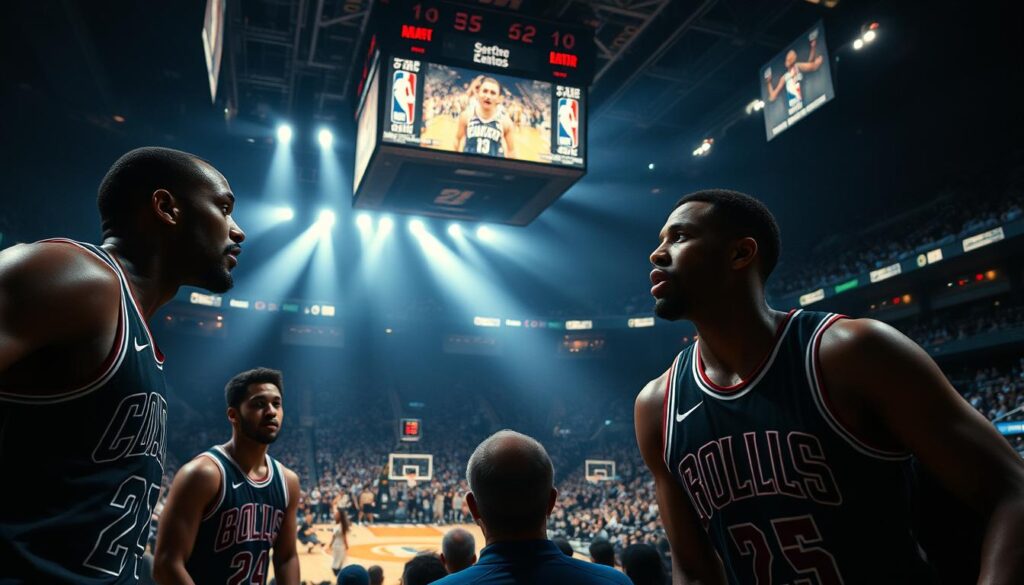
Wilt Chamberlain scored 100 points in a single game. Bill Russell won 11 championships. Guess which stat gets bronzed in NBA mythology? History belongs to the winners—and their publicists. The league’s greatest Historic Rivalry Games aren’t just decided by box scores. They’re shaped by storytellers who turn sweat into scripture.
Take the 1976 Finals Game 5—the “triple-overtime bloodbath” between Boston and Phoenix. The Celtics’ eventual win became a cultural reset. But how many remember Phoenix’s Paul Westphal intentionally calling a timeout he didn’t have to manipulate the clock? That detail gets lost beneath Larry O’Brien trophies and duck boat parades.
Legends vs Ledgers: Why Stats Lie
Jordan’s 1997 “Flu Game” proves narrative alchemy at work. The truth? It was food poisoning from bad pizza. But “I conquered a pepperoni purge” doesn’t sell shoes. We prefer the myth of a feverish demigod dropping 38 points on Utah. Championships let you control the script—just ask LeBron’s 2016 “block heard ’round the world” editors.
| Legend | Reality | Cultural Impact |
|---|---|---|
| Jordan’s “Flu Game” | Food poisoning in Utah | Iconic Nike marketing |
| Russell’s 11 Rings | Wilt’s 100-pt game same season | Defines “winning” legacy |
| 1976 Game 5 Brawl | Strategic timeout exploitation | NBA’s physicality benchmark |
| Magic’s 1980 Rookie Finals | Kareem’s 40 pts ignored | Birth of “Showtime” lore |
Modern NBA Iconic Games face instant mythmaking through social media. Kawhi’s 2019 buzzer-beater against Philly? The shot itself was miraculous. But the six bounces on the rim? That’s Shakespearean tension no screenwriter could pitch. Memes and TNT replays now co-author history before players hit the locker room.
Yet some truths persist. Russell’s Celtics overshadow Wilt’s stats because rings win over spreadsheets. As Charles Barkley quipped: “Nobody retires saying, ‘I averaged 25 points.’ They say, ‘I got three chips.’” The lesson? In basketball’s museum of memories, victory plaques hang highest—even if the descriptions get…embellished.
Conclusion: Playoff Games as Cultural Touchstones
We measure Historic NBA Playoff Games in more than points. They’re time capsules, like Magic Johnson’s no-look pass or Reggie Miller’s eight points in nine seconds. These moments rewrite what’s possible.
Robert Horry’s 2005 dagger against Detroit didn’t just win a title. It made a role player a folk hero. It showed that clutch has no salary cap.
NBA Finals Classics thrive where numbers fail. Ray Allen’s 2013 corner three is more than a plus-minus rating. It’s geometry meeting destiny, a shot that changed Miami’s championship odds.
We don’t recall the box score from Jordan’s Flu Game. We remember the sweat-drenched jersey hanging like a battle standard.
When games become folklore, they escape arenas. The Choke Game isn’t just about New York’s fourth-quarter collapse. It’s Spike Lee’s courtside disbelief immortalized in GIFs.
Allen Iverson stepping over Tyronn Lue isn’t just a crossover. It’s hip-hop defiance captured in sneaker commercials and TikTok edits.
So does the score matter when legends take over? Maybe we’ve been asking wrong. These games aren’t statistics – they’re campfire stories. The real question: What cultural myth gets whispered next time the lights dim and 20 seconds light the shot clock?
