

If you’ve watched modern basketball, you’ve seen coaches acting like they’re solving a Rubik’s cube fast. Today’s game is all about quick, smooth plays that leave defenders confused. Why stick to a slow half-court game when you can attack early?
The pistol action is the go-to for early offense in the US. It’s a smart strategy that gives teams an edge before the defense can react. It’s not just about being fast; it’s about getting a mental jump on the opponent through better spacing.
From the NBA to local leagues, the pistol 21 series is everywhere. It’s as flexible as a yoga move. By using these entries and options, teams can turn a simple play into a big scoring chance.
Key Takeaways:
- This approach shows that quick offense is key at all levels of play.
- Success comes from smooth entries and options that leave defenses struggling to keep up.
Intro: Flow from transition to advantage before defense is set
The Pistol/21 Series is more than just passing the ball. It’s about creating a flow that keeps the defense off balance. This flow is key to gaining an advantage before the defense can react.
The game starts with a dribble or a pass, often by the point guard. This move tests the defense’s speed and reaction. The goal is to get an early lead by catching the defense off guard.
Understanding the Initial Flow
The initial flow in the Pistol/21 Series is simple yet powerful. It starts with a clear and decisive action. This could be a dribble handoff or a pass to a specific player. The aim is to be precise and keep the defense guessing.
As the play progresses, the 21 series kicks in. It might include a drag screen to confuse the defense further. This series is known for its flexibility and ability to adjust to the defense’s moves, making it a valuable strategy in basketball today.
Core entries: 21 (pitch ahead → handoff), 21 Chase, 21 Keep, 21 Drag; when to call each
The Pistol/21 Series is known for its flexibility. It has many core entries that can be used based on the defense’s setup. This makes it hard for defenses to guess and get ready for.
Breaking Down the Core Entries
The Pistol/21 Series has several core entries. Each one is made to take advantage of different defensive weaknesses. These are: 21 Pitch Ahead, 21 Chase, 21 Keep, and 21 Drag.
Pitch Ahead and Handoff
The pitch ahead is a key action that can lead to quick scores or draw defenders. It involves throwing the ball forward to a player, who can then run or pass. The handoff is also important, as it can give the offense a numbers advantage or free up a shooter.
Here are the main features of each core entry:
- 21 Pitch Ahead: Creates a scoring chance or draws defenders.
- 21 Chase: Targets an aggressive defense.
- 21 Keep: Keeps the ball with the quarterback, allowing for a read-based choice.
- 21 Drag: Uses a mismatch by dragging a defender away from the ball handler.
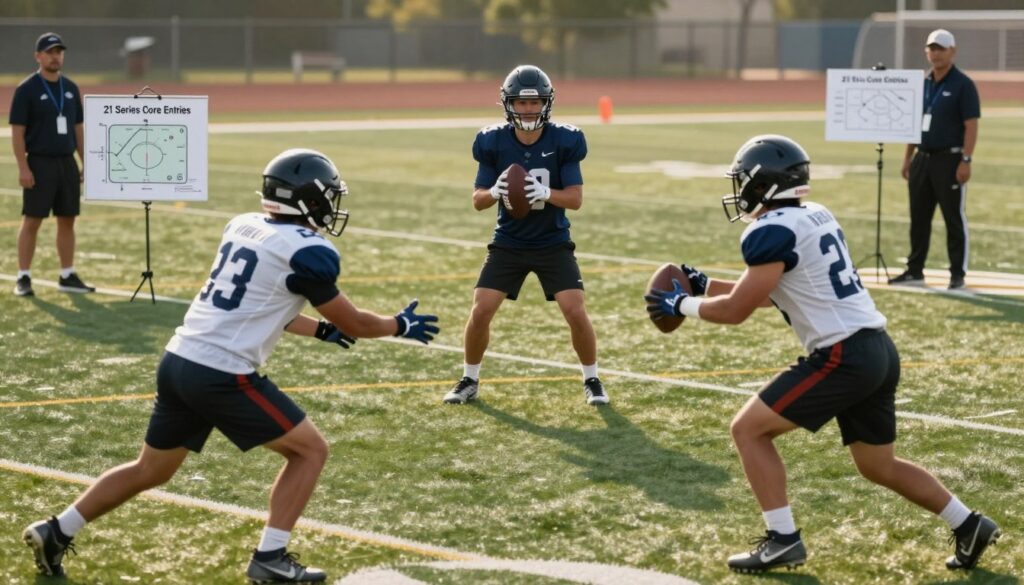
Knowing when to use each entry is key for the offense’s success. Coaches and players need to read the defense and make fast decisions. These decisions should be based on the defense’s alignment and movement.
Reads & progressions: Keeper lane, reject, hit ahead, drag into middle PnR, throwback 3
Reading the defense is key in the Pistol/21 Series. It lets players use the defense’s weaknesses to their advantage. Players need to spot chances like the keeper lane, rejecting screens, or hitting ahead to teammates.
This offense is powerful because it lets players read the defense well. For example, if the X2 defender tries to stop O1’s drive, O1 can pass to O2. O2 is open after moving off O5’s screen, ready for a 3-point shot.
Reading the Defense
To read the defense well, players must know the defensive setup. They need to adjust quickly based on how the defenders move.
Key Reads and Progressions:
- Keeper Lane: Knowing when to keep dribbling and attack the lane.
- Reject: Spotting when to reject a screen and get space.
- Hit Ahead: Passing to a teammate cutting to the basket or popping out for a shot.
- Drag into Middle PnR: Creating a pick-and-roll situation by dragging a defender.
- Throwback 3: Finding chances for a throwback three-point shot.
A drag screen is great when the defense expects something else. It lets the offense use the defense’s rotation. A step-up screen can also help, freeing up a shooter or opening a lane for a drive.
By getting good at these reads and progressions, teams can boost their offense. The Pistol/21 Series becomes a strong strategy against different defenses.
Options vs Coverages: Switch (Slip/Seal), ICE (Flip Angle), Drop (Pace to Pull-up/Roll)
The Pistol/21 Series is like a Swiss Army knife for outsmarting defenses. It offers many tools to find and use defensive weaknesses. The offense can change its plan to fit different defensive strategies.
Knowing how to beat different defenses is key. Against a switch, the offense can use a slip or seal to find a way to score.
Countering Defensive Strategies
Against an ICE defense, the offense can use a flip angle to get an advantage. This means changing the attack angle to match the defense’s setup. If the defense drops back, the offense can pace to a pull-up or roll for another scoring chance.

Dribbling through the defense can lead to an inside-out pass for a 3-point shot. Screeners might also slip screens and cut inside for a quick pass. These moves make it hard for the defense to keep up.
The ability to chase down defensive movements and use them to your advantage is vital. It needs a good understanding of the offense and how to read the defense well.
Spacing rules with 5‑out lanes and corner discipline
Spacing is key in the 21 Series, making the offense work smoothly. It’s all about moving the ball and players. The right spacing can turn a good play into a great one.
Keeping 5-out lanes is essential. It lets players spread out and find ways to score. This also makes the defense work harder, leading to mistakes.
Maintaining Proper Spacing
The post player is important in spacing. They set flare-screens or ball-screens for guards. This opens up the court and creates chances to score.
For example, a ball-screen for O1 can lead to a scoring chance or a better matchup.
Corner discipline is also key. Players in the corners must stay in the right spot. This keeps the 5-out formation strong and the offense moving.
Following these spacing rules and corner discipline helps teams use the 21 Series well. It’s about making an offense that can change with the defense and find its weaknesses.
Blending with sets: Pistol into Spain, into Chicago, into wedge post-up
Adding the Pistol/21 Series to other sets boosts a team’s offense. This mix makes the offense hard to predict, keeping defenses on their toes. It’s a smart move for any coach wanting to shake things up.
The Pistol/21 Series works at all levels, from pro to high school. It’s great for mixing with sets like Spain, Chicago, or a wedge post-up. This makes it a key asset for any team looking to vary their attack.
Integrating the Pistol/21 Series with Other Sets
Blending the Pistol/21 Series with other sets opens up many scoring chances. For example, combining it with the Spain set can really mess with defenders. The pistol action starts the play, then the Spain set’s ball and player movement follow.
Using the Pistol/21 Series with the Chicago set is also effective. The pitch play attacks the defense, while the Chicago set’s screens and cuts open up scoring chances.
Adding a wedge post-up to the Pistol/21 Series brings a new twist. It draws the defense’s focus, freeing up the outside players to shoot.
- The Pistol/21 Series can be blended with various sets to create a complex offense.
- Integrating with sets like Spain or Chicago can create unique scoring opportunities.
- The use of pistol action and pitch plays can confuse defenders and create openings.
Drills: 5‑on‑0 flow, 3v3 pistol constraints, 5v5 “7‑second pistol” segment
Mastering the Pistol/21 Series requires dedicated practice. Teams need to work on their skills and chemistry through specific drills. This is key to executing the offense well.
Drills like 5-on-0 flow, 3v3 pistol constraints, and 5v5 “7-second pistol” segments are essential. They help players understand their roles and improve decision-making. This leads to smoother execution of the offense.
Practicing Key Components
To excel in the Pistol/21 Series, focus on its core parts. The 5-on-0 flow drill is great for learning the initial flow and read-based options. It’s done without defenders, making it easier to practice.
This drill enhances player movements, timing, and decision-making. Repeating it helps players grasp the offense better and improve their skills.
The 3v3 pistol constraints drill introduces defenders, adding complexity. It’s perfect for learning to read the defense and adjust quickly.
The 5v5 “7-second pistol” segment simulates game conditions. It forces players to execute the offense fast. This drill is great for quick scoring opportunities.
Drill Benefits
| Drill | Benefits |
|---|---|
| 5-on-0 flow | Improves player movement, timing, and decision-making |
| 3v3 pistol constraints | Develops ability to read defense and make adjustments |
| 5v5 “7-second pistol” | Simulates game conditions, improves quick execution |
By adding these drills to practice, teams can master the Pistol/21 Series. This leads to early advantages for ball handlers and shooters. It also creates clear lanes for rollers in a fast-paced offense.
Good practice isn’t just about doing the same thing over and over. It’s about deliberate practice. Teams should focus on using the drag screen and step-up screen correctly. These are key parts of the Pistol/21 Series.
Analytics: Early-clock PPP, rim attempts %, corner 3 rate
Analytics are key in making the Pistol/21 Series a strong offense. By focusing on important metrics, coaches can boost their team’s strategy.
Teams should look at early-clock points per possession (PPP), rim attempts percentage, and corner 3-point rate. These numbers show how well the offense is doing and where it can get better.
Analyzing Performance Metrics
Let’s explore these important metrics. Early-clock PPP shows how well the offense does when they have the ball early. A high number means the Pistol/21 Series is good at scoring before the defense is ready.
Rim attempts percentage is also key. It shows how often the offense gets to the basket. A higher percentage means the offense is aggressive and effective, putting pressure on the defense.
The corner 3-point rate is important too. It shows how well the offense stretches the defense and creates space. By looking at these metrics together, coaches can understand their team’s strengths and weaknesses.
| Metric | Description | Importance |
|---|---|---|
| Early-Clock PPP | Points per possession early in the shot clock | Indicates early offense efficiency |
| Rim Attempts % | Percentage of attempts at the rim | Reflects aggressiveness and effectiveness |
| Corner 3-Point Rate | Frequency of 3-point attempts from the corner | Measures ability to stretch the defense |
Get the Pistol 21 Offense Playbook today. It will help you add a fast, organized, and adaptable early offense to your team. This way, you can better analyze and improve your team’s performance using these key analytics.
Common errors and cue words
Mastering the Pistol/21 Series is not just about knowing the moves. It’s about being precise and clear with your teammates. Small mistakes can really mess up the team’s flow.
Forcing defenders to act can help the offense. The “illusion of attacking” in the Roll Twist action is a great example. Using cue words like “slip out” or “threat to shoot” keeps the team together and ready for changes.
Effective Communication
The difference between Horns and Pistol plays is key. Horns end in a side ball screen with the corner filled. Pistol ends with the corner empty. Knowing this and using the right pitch for the pistol action can open up scoring chances.
Good communication and using defensive mistakes to your advantage can boost your team’s offense. This way, you can stay ahead of your opponents.
