

Up by one with 16.9 seconds left, Team USA needed to get one final stop to secure their win against Spain. With Spain inbounding from the sideline at halfcourt, Team USA decided to use a zone against Spain. It is no surprise that Jim Boeheim, Syracuse’s head coach, was involved in that decisions (from Chris Sheridan):
“In the timeout, Jim Boeheim said ‘Let’s go orange.’ We call it ‘Orange’ out of respect for Jim. He said he doesn’t have any buildings named after him in Syracuse, so we named the zone after him. And I agreed with him, but it was his suggestion,” Krzyzewski said.
Now, this was a bold call because if it doesn’t work, Coach K finds him subject to some criticism (yes, I realize this is just a friendly, but the criticism will still be there). However, because it was smartly run and caught Spain off-guard, the zone worked well:
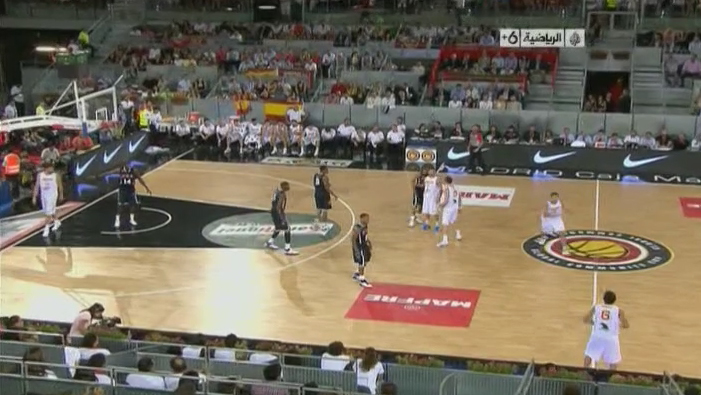
Team USA ran zone one possession, so it is safe to say that Spain wasn’t really expecting it. More importantly, Team USA did a very good job of disguising their zone. They opened up showing man to man as the ball was getting ready to be inbounded. You have Odom covering Marc Gasol, and the 4 other members on Team USA on the perimeter as if they were waiting to match up in a man to man defense.
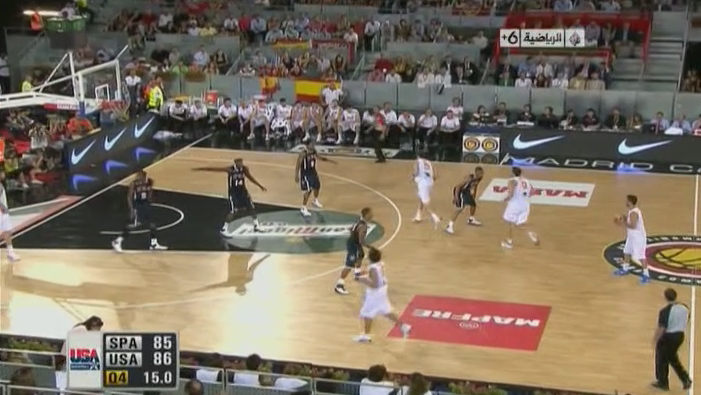
By the time Juan Carlos Navarro makes the catch and picks his head up, he is now facing a 2-3 zone instead of the man to man defense he was anticipating. This is important because if Team USA showed their zone right away, it would have given Spain time to adjust. They could have called another timeout (not sure if they had any), or their coach could have simply made called a zone offense from the sideline. Disguising the zone forced Spain to adjust on the fly.
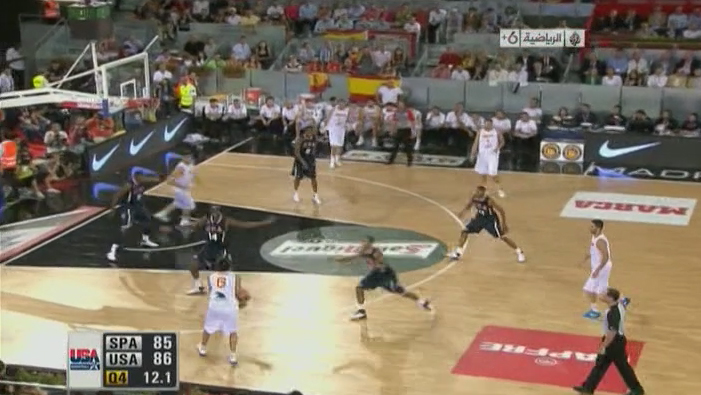
As Navarro enters the ball to Rubio on the wing, the Spanish side looks a little discombobulated. You have 4 guys standing on the perimeter doesn’t really look like he is sure where he should be going as well.
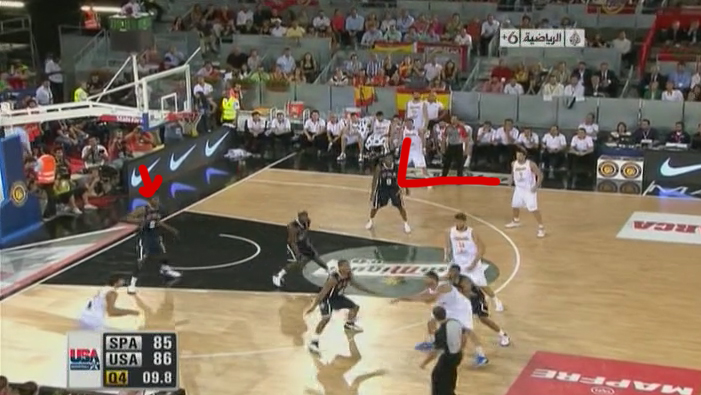
Rubio gets the ball back to Navarro who takes one dribble to his side and gets it back to Rubio, despite Gasol coming up to set a screen for him. Two things happen here that benefit Team USA, and it all has to do with catching Spain off guard. On the weakside, you have poor floor spacing, and the two wings are too close together. The result is that Andre Iguodala can cover both players on the weakside instead of having to choose one. This takes away any chance of a skip pass (something that beats the zone).
The second thing that helped Team USA is that in their confusion, Spain kept the ball on one side. Rubio and Navarro were passing the ball back and forth on the same side of the court rather than swinging it around the perimeter. When the ball gets passed around quickly, it forces the zone to rotate faster than it wants to and eventually a hole opens up. However, here Team USA’s zone doesn’t have to rotate much, and that means that Kevin Durant is in terrific position to close out.
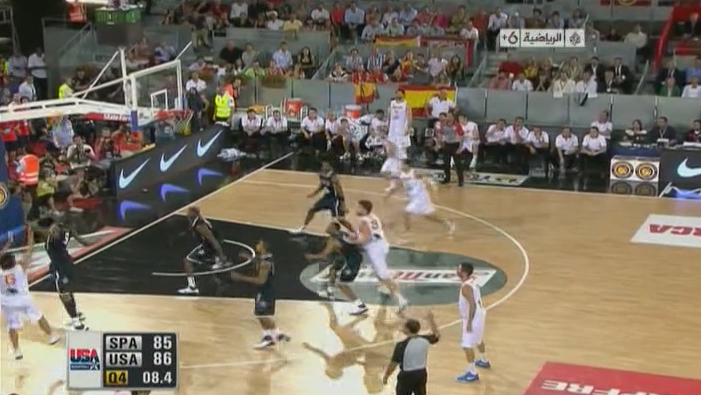
Which is what he does very well to get the block. After Durant’s block, Spain is able to gather the ball once again (rebounding is the one weakness against the zone), but Durant is able to get a second block to secure the win.
Here is the play in real time. What I want you guys to pay attention to is something that you can’t see in the images. Notice how the Spanish players are pointing and waving around trying to get each other on the same page. This is proof that the zone caught Spain off guard.
In my opinion this is how Team USA can be effective running the zone. It isn’t something they can do effectively quarters at a time (and with the guards on their roster, I am sure they don’t want to do it). But if Team USA can work in the zone a possession here, a possession there, and catch opponents off guard (especially late in games), they can get stops when playing zone.
