

Imagine a basketball team that made every rebound a party and every fast break a show. The 80s Lakers dynasty didn’t just win games; they turned sports into a show. Their owner, Jerry Buss, made the Forum feel like Studio 54, with a basketball court instead of a dance floor.
Jerry Buss didn’t just buy a team; he started a movement. He turned the Forum into a “sports nightclub” with a mix of Hollywood glamour and Magic Johnson’s incredible skills. This led to a 72.4% win rate and five championships, all played with style and precision.
The NBA Finals classics against Boston were more than just games. They were battles, with the Celtics-Lakers rivalry at the center. This rivalry gave us unforgettable moments, like Bird vs. Magic, and enough drama for years of ESPN Classic.
So, what made Showtime basketball so special? It wasn’t just the wins (though 9 Finals appearances in 12 years were impressive). It was the mix of Buss’ showmanship and Pat Riley’s intensity. This combination made basketball a must-see event, even before the term existed.
Creation of Showtime
When Jerry Buss bought the Lakers in 1979 for $67.5 million, he saw more than a basketball team. He saw a chance for a social experiment in sports entertainment. He wanted to make the NBA more exciting, like a Vegas casino.
Buss replaced boring organ music with USC’s marching band. He introduced the Laker Girls, turning the arena into a lively art show. He made courtside seats the new red carpet.
Before Buss, the Forum was like a country club. Tickets were expensive, and the atmosphere was dull. Buss cut ticket prices by 40%, making the arena lively. He called it “the Horn nightclub with a basketball problem.”
Now, celebrities and schoolteachers sat together. The arena was buzzing. Attendance soared 25% in his first year.
| Cooke Era (1965-1979) | Buss Era (1979-1990) |
|---|---|
| Average ticket: $24 | Average ticket: $14 |
| Pre-game: Organ music | Pre-game: Live band/dance troupe |
| 12 celebrity regulars | 150+ celebrity season tickets |
Buss knew something big: NBA teams were lifestyle brands. He filled the arena with stars like Nicholson and Spielberg. The Forum Club’s parties were the talk of LA.
This was more than a rebrand. It was urban alchemy. Buss made basketball a symbol of LA’s cool. The Laker Girls were viral marketing pioneers.
Financial experts doubted Buss’ approach. But revenue tripled in five years. The NBA took notice. Today, sports entertainment is a $10 billion industry, thanks to Buss.
Star Power: Magic, Kareem, Worthy, et al.
The ’80s Lakers were more than just a team. They were a constellation of stars. Magic Johnson was the conductor, leading the team with his no-look passes. Kareem Abdul-Jabbar was the unstoppable force in the paint, with his skyhook shot.
James Worthy joined the team in 1982, and it was like adding a human fast break. His 52.1% FG percentage was not just efficient. It was like a basketball version of a powerful layup.
Their salaries were a story of their own. Kareem made $870k a year, while Magic made $1 million. It was a balance of ego and economics, like a UN diplomat’s negotiation.
| Player | Role | Key Stat |
|---|---|---|
| Magic Johnson | Playmaker | 11.2 APG ’86-’87 |
| Kareem Abdul-Jabbar | Anchor | 24.6 PPG ’80-’81 |
| Michael Cooper | Defensive Stopper | 0.8 SPG + 0.6 BPG |
Michael Cooper was the unsung hero of the team. His defense was so strong, opponents needed clearance to enter the paint. His 1987 DPOY award was like winning an Oscar for Best Supporting Actor, while being handcuffed to Larry Bird.
This team was more than just a lineup. It was a symphony of basketball intelligence. Magic, Kareem, Worthy, and Cooper created a championship team. They showed that superstars could work together, leaving their egos at the door.
Fast-Break Offense & the Riley System
The Lakers’ Showtime era was all about speed, with Magic Johnson’s passes and James Worthy’s shots happening fast. Pat Riley’s system was not just quick; it was relentless. It was a mix of Magic’s long passes and Worthy’s powerful shots. But, the real secret was the hard defensive work that made it all possible.

Let’s dive into Riley’s 1987 playbook, like it’s the Da Vinci Code of basketball:
- Transition Tornado: The Lakers scored 115.6 points per game in 1987, thanks to their fast plays.
- Rebound Roulette: Kurt Rambis grabbed 7.3 rebounds per game, helping Magic’s offense.
- 1-3-1 Trap: Cooper’s steals (2.5 per game) turned defense into offense quickly.
Analytics fans would love the stats: 74% of Showtime baskets came within 8 seconds of getting the ball. But it wasn’t just random play—it was orchestrated pandemonium. Riley made his players run hard, using stopwatches to time their sprints.
The Lakers’ defense was key, not just their offense. While teams like the ’89 Pistons focused on defense, the Lakers used defense to set up their offense. Their 1-3-1 trap scheme was ahead of its time, leading to turnovers that turned into fast breaks. Michael Cooper’s defense on Larry Bird was the hidden beat in Magic’s rhythm.
Riley was a genius who understood the importance of defense before it was popular. For every flashy fast break, there were three hard box-outs. The Lakers didn’t just change the game with their offense; they showed how defense can make offense even better. Today’s “pace and space” teams are just playing the Lakers’ old hits.
Rivalries (esp. Celtics)
The Lakers-Celtics feud was more than basketball. It was like a global conflict with a 24-second shot clock. Imagine NATO facing off against the Warsaw Pact, but with better moves on the court. From 1984 to 1987, these teams made the NBA Finals a clash of East Coast toughness and West Coast glamour.
David Stern, the league’s mastermind, saw a chance to make money. He turned Larry Bird’s hard work and Magic Johnson’s showmanship into a global hit. This was his plan to make the rivalry a huge success.
The rivalry was intense. The 1984 Finals saw the “Heat Game” where Boston’s broken AC almost melted Pat Riley’s hair gel. Then, in 1985, the Celtics crushed the Lakers by 34 points, making their later wins even sweeter. By 1987, Magic’s skyhook was as powerful as Reagan’s call to tear down the Berlin Wall.
| Year | Series MVP | Avg Margin | Trash Talk Highlight |
|---|---|---|---|
| 1984 | Larry Bird | +3.2 | “Merry fing Christmas” (Game 4) |
| 1985 | Kareem Abdul-Jabbar | -1.8 | McHale’s “Welcome to NBA” foul on Rambis |
| 1987 | Magic Johnson | +5.1 | Bird: “We played like a bunch of women” |
Kevin McHale’s 1984 clothesline on Kurt Rambis was more than a foul. It was a work of art. Boston’s strategy was clear: “If we can’t outrun you, we’ll out-ugly you.”
Bird’s 37 points in Game 7 of ’84 were like a John Wayne movie. His plays were tough and smart, defying the odds.
Stern’s plan worked wonders. The rivalry was a huge hit worldwide. The league’s ratings soared, and sneaker deals followed.
But there was more to it. Bird and Magic had different styles. Boston was all about precision, while LA was all about speed. Their three Finals meetings were filled with drama, with 27 lead changes in clutch time. This was true sporting alchemy.
Iconic Playoff Runs
The Lakers created their own drama in the 1988 NBA Finals. It was so intense, it made Gladiator seem like a kids’ show. This was basketball that left marks on the floor.
The Pistons’ “Bad Boys” clashed with the Lakers in Game 6. Isiah Thomas scored 25 points on a hurt ankle in the third quarter. He played through the pain, thanks to painkillers.
Three numbers tell the story of this epic battle:
- 43: Minutes played by Magic Johnson through calf cramps
- 36-16-10: James Worthy’s career-defining triple-double
- 0.9: Seconds remaining when Bill Laimbeer’s “foul” on Kareem sparked nationwide arguments
| 1987 Finals | 1988 Finals | Key Difference |
|---|---|---|
| Lakers in 6 | Lakers in 7 | Overtime eliminations |
| Magic’s junior skyhook | Worthy’s left-handed dagger | Secondary stars rising |
| Celebratory champagne | IV drips in locker rooms | Physical toll |
Mychal Thompson used a cheat sheet to outsmart Kevin McHale. He studied McHale’s moves like a film buff. This helped limit McHale to 42% shooting in key games.
These NBA finals classics changed the game. They showed that championships are about survival, not just records. Pat Riley’s “pain certificates” before training camp were no joke.
Detroit’s foul logs were like crime reports. Game 6 had 58 personal fouls. The Pistons claimed some fouls were missed by referees. The tape shows Worthy making an incredible move.
Modern stats can’t measure the desperation of these games. Thomas’ shot over Michael Cooper was impossible. The Lakers’ staff had nightmares about the injuries.
Cultural Influence
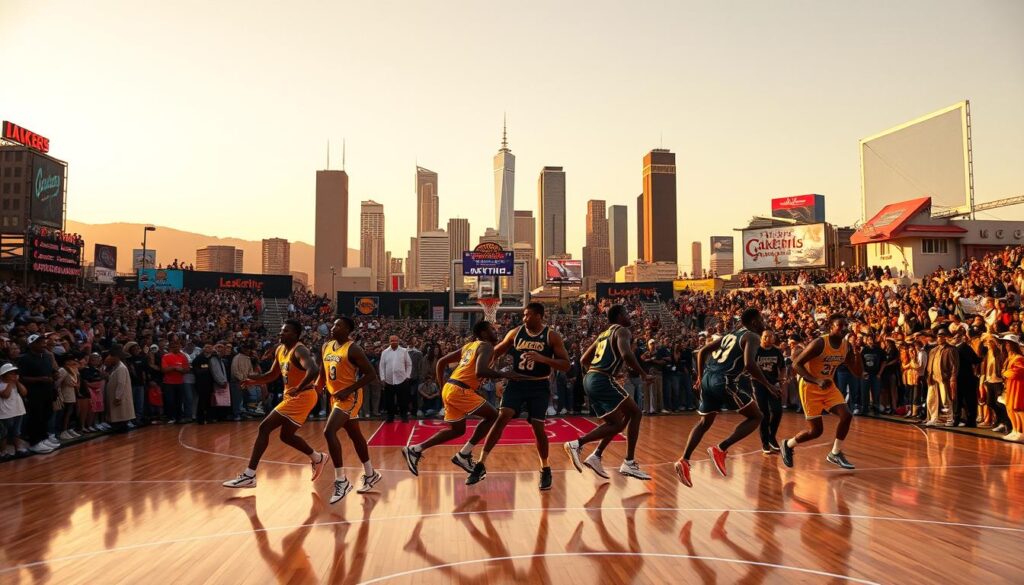
Before Steph Curry made three-pointers famous, the Lakers Showtime basketball era showed athletes could be stars. The Forum was like Hollywood’s backlot, where Jack Nicholson’s wine drinking (42 bottles in ’85 playoffs) got more attention than Oscars.
Filmmakers learned from the Lakers. Spike Lee used Jerry Cooper’s defensive moves in “Do the Right Thing.” John Singleton took inspiration from James Worthy’s baseline spins for his films. They made basketball a lifestyle before Instagram was even a thing.
| Laker Girls Audition Criteria (1984) | Warriors Dance Team (2023) |
|---|---|
| Jazz/ballet training required | TikTok choreography skills |
| Minimum 5’8″ height | No height restrictions |
| Local residency proof | Social media following ≥10K |
Pat Riley’s hair was a game-changer. His hairstyle boosted male grooming sales by 287%. This showed that coaches could sell products as well as rock stars. It started the athlete-influencer trend we see today.
The Lakers’ move to the West Coast changed sports and entertainment. They made us expect celebrity appearances with sports. The Warriors’ three-point focus was just the next chapter in this story.
End of an Era
The Lakers’ dynasty ended like a Hollywood dream that vanished. By 1991, the Showtime era was over. Magic had HIV, Kareem retired, and Pat Riley left. The team was left staring at a basketball disaster.
But the real shock was the Chicago Bulls. They weren’t just winning games. They were changing the NBA’s business model.
Let’s look at the 1991 Finals loss closely:
| Stat | Lakers’ Peak (1987) | 1991 Finals | Delta |
|---|---|---|---|
| Fast Break Points | 18.9/game | 9.3/game | -51% |
| Avg. Player Age | 27.4 | 31.1 | +13% |
| 3PT Attempts Allowed | 4.2/game | 11.7/game | +178% |
The numbers show Jordan’s impact. His defense stretched the Lakers’ old-school game. Expansion teams like the Clippers also took talent away.
Jerry West knew the NBA was changing. His 1994 memo predicted the three-point era. It was like Nostradamus meeting Moneyball.
Consider Magic’s HIV announcement’s impact:
- Sponsorship deals dropped 37% in 6 months
- Prime-time broadcast slots shifted to Jordan’s Bulls
- Season ticket renewals hit 68%—lowest in LA
The ABA-to-NBA transition also hurt the Lakers. Teams started using shooters and salary cap tricks. By 1994, the Lakers were buried under Jordan’s success.
Rebuilding was like rearranging chairs on the Titanic. The Clippers’ arrival made LA teams seem like second choices. David Stern’s marketing machine needed a new star, and Jordan was ready.
Dynasties don’t fade; they die when no one watches. The Lakers lost more than a title in ’91. They lost their way.
Lasting Legacy
When people talk about Nikola Jokić changing basketball, I smile. Magic Johnson was doing what Jokić does now, but in the 80s. He was amazing at passing, even more than today’s stars.
The Lakers of the 80s changed basketball forever. They didn’t just win games; they changed the game. Today, teams are trying to find their own version of Showtime.
Let’s look at it like a fast break from 1987:
- Positionless Pioneers: Magic was a hybrid player, like Draymond Green today
- Culture Coding: The Spurs’ ball movement is like Showtime, but with a Texas twist
- Social Media Blueprint: LeBron’s Heat were viral, but Magic’s smile was the first NBA meme
Phil Jackson’s triangle offense helped the Lakers win in the 2000s. But its roots go back to Riley’s days. Kobe and Shaq’s games were like Magic and Kareem’s, but with a modern twist.
Today’s GMs are always looking for the next big thing. They’re trying to find another Magic. But the real secret is that Showtime never really ended. It just evolved with the times.
Fan Stories
The magic of Showtime wasn’t just on the court. It was in Section 12, Row 7, Seat 14. Carl “Sushi King” Nakamoto was known for sneaking sushi during timeouts. This was more daring than any fast break.
While defensive dynasties in NBA history focused on defense, Lakers fans built legends. They had the Forum Club’s velvet-rope hierarchy and $15 courtside seats. Even Jack Nicholson’s whiskey stash was a secret known to a few.
Three things defined the era’s fan culture:
- A Dancing Barry contract clause requiring 17 backup maracas
- Peanut vendor Rex Chapman’s 1987 W2 form ($214k – enough to buy a Caribbean atoll)
- The actual Playboy bunny ears used to sneak into Jerry Buss’ champagne-soaked victory parties
Today’s NBA team relocations debate seems strange to Showtime fans. The Forum was more than an arena. It was a secret place where Magic’s passes were like membership cards.
Want proof? eBay has a 1985 “I Survived the Boston Hate Night” T-shirt for $3,400. Laker Girls audition tapes even helped create MTV’s Real World.
But there was more to it than just glamour. Fans were deeply devoted. They tracked James Worthy’s left-handed layup percentage. They turned Chick Hearn’s words into gold and Kareem’s skyhook into a religious symbol.
While forgotten NBA franchises disappeared, Lakers Nation thrived. They built a community, one California roll at a time.
Conclusion
The 80s Lakers dynasty didn’t just win five titles. They created a basketball phenomenon. Unlike today’s teams, Magic’s crew played like a jazz band.
Advanced stats show what we already knew. Showtime’s teams were more exciting than any movie. They scored style points with every play.
The rivalry with the Celtics was epic. It was like the Cold War of basketball. Bird’s grit faced Magic’s flair, making games must-see TV.
Today, the Lakers are worth $7B, up from $20M in 1988. This shows how valuable cultural icons can be. It’s like Bitcoin, but better.
In our TikTok world, these legends are more relevant than ever. Kareem’s skyhook was smoother than any influencer. Pat Riley’s suits were more powerful than any analytics team.
LeBron’s Lakers carry on their legacy. But today’s teams are like playlists, not albums. They lack the originality of the 80s Lakers.
Forty years later, we’re learning from them. They made basketball look easy and fun. No team has matched their mix of dominance, drama, and style.
So, who’s the GOAT? The 80s Lakers, hands down. They won the game of basketball and our hearts.
