

In 2016, a young shooter from Oakland changed basketball forever. Steph Curry started hitting threes from places no one thought possible. His 45.4% shooting from deep was like a new language in basketball.
Before, the paint was the most important area on the court. The San Antonio Spurs ruled with their post play. But the Golden State Warriors changed the game with their three-point shots.
This wasn’t just about shooting. It was about changing the game’s strategy. Coaches began planning plays like they were coding. Curry’s long-range shots were like the game’s version of new technology.
Old-school fans held onto their rebounding stats. But stats lovers were thrilled. And in Texas, Gregg Popovich might have been saying, “These kids have turbo buttons.” The change was big, and it was all about the three-point shot.
Pre-Warriors League Style
Imagine walking through a basketball museum where every exhibit screams “NO TRESPASSING” beyond 15 feet. That was the NBA before the splash brothers era. The 90s Bulls dynasty didn’t just dominate – they codified religion around Jordan’s midrange fadeaways and Pippen’s elbow-jumper orthodoxy.
Let’s look at the playbook of giants. The 80s Lakers dynasty ran their offense through Kareem’s skyhook ZIP code. Magic orchestrated fast breaks like a maestro conducting Beethoven with a perm. Fast forward to Shaq’s era: defenses weren’t schemes – they were emergency evacuation plans for anyone caught between the Diesel and the rim.
Three relics from basketball’s Mesozoic era:
- Shot charts resembling overwatered houseplants – all roots (paint points) no branches (three-pointers)
- Coaches diagramming plays on chalkboards like medieval cartographers
- The phrase “analytics department” meaning the guy who kept stats in a Trapper Keeper
Traditional shot selection wasn’t just strategy – it was theological doctrine. Why settle for three when two could be earned through blood sacrifice in the post? The math made sense…if you ignored geometry, physics, and the concept of efficiency. Goldsberry-style heat maps from that era show vast “dead zones” beyond the arc – frontiers the Warriors would later colonize like digital-age pioneers.
Defensive dynasties built entire identities around this scarcity mindset. The Bad Boy Pistons and Riley’s Knicks treated the paint like sacred ground – cross this line, and prepare for tribal warfare. It was glorious, brutal, and about as subtle as a sledgehammer to the sternum.
Rise of Steph Curry & Klay Thompson
Imagine two elements that shouldn’t mix, but together, they create something amazing. The Steph Curry revolution began with a skinny kid from Davidson College. He was like David facing Goliath’s family.

From Mid-Major to Major Problem
Curry’s 2008 NCAA tournament run was like a student outsmarting professors. His 128 three-pointers sent messages about basketball’s future. In Washington State, Klay Thompson was working on his shot like a watchmaker.
When they teamed up in Golden State in 2011, it was explosive. Klay’s 37-point quarter was like art with a shot clock. The Warriors had created a radioactive backcourt.
The Particle Physics of Partnership
What makes the Splash Brothers the NBA’s ultimate pair?
- Curry’s pull on defenders (2.3 per off-ball screen in 2015 playoffs)
- Thompson’s catch-and-shoot efficiency (42% on contested threes 2014-2019)
- Shared spatial awareness like NASA engineers
And don’t forget the legendary sixth men – Andre Iguodala and Shaun Livingston. They added chaos with a touch of jazz, like musicians in a symphony.
Coaching and System Changes
Every tech revolution needs its dream team. The San Antonio Spurs dynasty was like open-source software, sharing their “code” in basketball. The Warriors, led by Steve Kerr and Mike D’Antoni, were like Apple disruptors. They changed NBA strategy with Silicon Valley speed.
Kerr’s Spacing Revolution
Kerr didn’t invent motion offense, but he made it his own. He learned from Gregg Popovich, one of the most influential NBA coaches. Kerr’s system used spacing to outsmart defenses.
Three key parts made up Kerr’s system:
- Elevator Doors: Dual screens that collapsed like a startup’s runway
- Draymond at Point Center: A 6’6” middle manager distributing assignments
- Splash Brother Relocation: Curry/Thompson constantly resetting defensive firewalls
D’Antoni’s Influence
D’Antoni’s “7 Seconds or Less” Suns offense was the blueprint. The Warriors took his pace-and-space ideas and made them better. They added venture capital-level improvements.
| Philosophy | D’Antoni (2004 Suns) | Kerr (2015 Warriors) |
|---|---|---|
| Primary Weapon | Nash-Stoudemire pick-and-roll | Curry-Green dribble handoff |
| 3PA Per Game | 24.7 (1st in NBA) | 31.6 (Revolutionized NBA) |
| Secret Sauce | Speed kills | Spacing creates kill zones |
This wasn’t just about Xs and Os. It was a full-stack rebuild of NBA offense. The Spurs’ beautiful game met Silicon Valley’s growth hacking. The result? A system so efficient, Adam Silver thought about nerfing it through updates (see: 2017 NBA rule changes).
Impact on Opponents
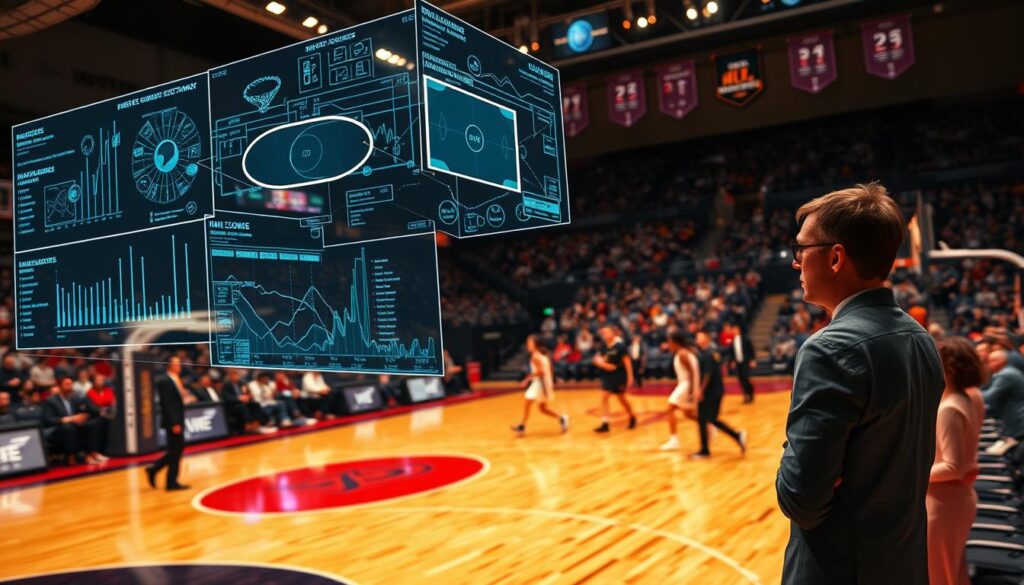
The Warriors’ focus on three-pointers changed the game. It made teams choose between letting Curry shoot or changing their defense. They picked chaos.
Defensive Adjustments
Coaches became like mad scientists. The 2016 Thunder tried to stop Curry by always having Andre Roberson on him. But Klay Thompson scored 41 points in a big game.
The Cavaliers even tried hockey-style changes to keep defenders fresh. Even the great Gregg Popovich said they were just guessing.
The league’s response went through three stages:
- Denial: “It’s just a hot streak” (2013-2015)
- Desperation: Double-teaming at halfcourt (2016-2018)
- Surrender: “Fine, we’ll shoot threes too” (2019-present)
The Analytics Arms Race
Front offices became like War Rooms. The evolution of NBA team building sped up as teams tried to:
- Hire math experts to improve defense
- Make players who can shoot and defend
- Trade big men for players who can switch
| Era | Defensive Strategy | Teams | 3PT% Allowed |
|---|---|---|---|
| Pre-Warriors | Protect the paint | Spurs, Grizzlies | 34.1% |
| 2015-2018 | Switch everything | Rockets, Celtics | 36.7% |
| Post-2019 | Run shooters off line | Bucks, Raptors | 33.9% |
This led to strange NBA team rebuilding stories. The Rockets traded Clint Capela for five shooters. The Bucks made Brook Lopez a three-point shooter. The Knicks, well, they didn’t do so well.
Three-point attempts have gone up 72% league-wide. Defenses are struggling to keep up. This has changed rosters, salaries, and the game itself.
Analytics and Shot Selection
Basketball’s Pythagorean theorem came from Golden State’s scoring strategy. The Warriors three-point revolution changed NBA tactics fast. It showed that math is useful in real life, like in basketball.
Redefining Court Geometry
Old-school coaches saw a simple rectangle. But Steve Kerr’s team saw a vast playground. They used data to show how gravity and Curry’s moves changed the game.
Data from Kirk Goldsberry revealed key insights:
- The “short corner” was a trap – too close for a block, too far for a shot
- Three-pointers from the top of the arc were 17% more valuable than long twos
- Defenders’ rotations left “dark matter” zones open for shots
The Efficiency Equation
The Warriors’ secret was simple: more Curry threes meant more points. Here’s how it worked:
| Shot Type | League Avg % | Warriors % | Points Per Attempt |
|---|---|---|---|
| Corner 3 | 38.1 | 43.6 | 1.31 |
| Long 2 | 40.3 | 41.9 | 0.84 |
| Above Break 3 | 35.4 | 39.8 | 1.19 |
Draymond Green preferred any shot over a long two. A 35% three-point shooter only needs 23.3% accuracy from deep to match a 50% mid-range shooter. This made Klay Thompson’s deep shots in NBA Finals classics seem like smart investments.
How Other Teams Tried to Copy
NBA teams were like tech fans chasing the next big thing. They all wanted to be like Golden State. But, they didn’t have a solid plan. They tried desperate three-point binges and half-baked small-ball experiments. But, as we know, past success doesn’t mean future wins.
Houston’s Moreyball Experiment
Daryl Morey’s Rockets were like Bitcoin fans. They took analytics to an extreme in 2018:
- 47% of shots from deep (league average: 31%)
- Zero mid-range attempts in 27 games
- James Harden’s stepback three as the ultimate shitcoin – volatile but occasionally brilliant
This all-threes-or-layups dogma led to amazing offense… until the Warriors showed its flaws in the playoffs. It’s clear that ignoring human judgment doesn’t work in real games.
The Spread Offense Epidemic
By 2020, the three-point trend had spread everywhere. Teams followed Golden State’s spacing like Zoom meetings. The signs were clear:
- 7-foot centers suddenly “discovering” three-point range
- Point guards averaging more threes than Steve Nash’s entire career
- Defensive schemes resembling confused TikTok dance trends
This chase led to interesting NBA team rebuilding stories. From Philadelphia’s “Process” to OKC’s smart draft picks. But, most teams learned the hard way: copying won’t make you the original.
Conclusion
The Golden State Warriors didn’t just break records – they rewrote basketball’s source code. Their reign was like the iOS moment in hoops, where Steph Curry’s three-point shots made old ways seem outdated. The Celtics-Lakers rivalry was like a classic book, but the Warriors brought a new era.
Today’s NBA teams follow the Warriors’ blueprint. Every corner three is a sign of their lasting impact. Teams now look for players who can shoot well, not just those who are tall.
Curry’s innovation was making long-range shots seem normal. He showed us that touchscreens are better than old keyboards. The Warriors’ spacing changed basketball, making it both smart and exciting.
The league is building on what the Warriors started. Remember, revolutions update, they don’t destroy. The Celtics-Lakers rivalry was the 20th century’s basketball. The Warriors wrote the 21st century’s playbook in Python, while others were stuck with punch cards.
The three-pointer is now basketball’s standard. Every GM is trying to keep up, not become the basketball’s BlackBerry.
