

What do Caesar’s legions, the Marvel Cinematic Universe, and basketball have in common? Sustained dominance. They’re not about quick wins or lucky breaks. They’re about lasting power.
The Boston Celtics won 11 championships, with eight in a row from 1959 to 1966. That’s not just winning. It’s occupying the throne while others try to catch up. The Golden State Warriors’ 73-win season was a record that made basketball a high-speed chess match.
Why does longevity matter? It’s not just about winning once. True greatness is about changing the game. We’ll explore championship wins that are so impressive, even Pythagoras would question them. From forgotten giants to today’s super teams, it’s all about leaving a mark.
Introduction: What Makes a Dynasty?
Imagine NBA dynasties like the final season of Breaking Bad. Everyone sees greatness, but few agree on how it’s made. Is it the coaching, the roster, or just luck before salary caps and free agency change everything?
- Championship math: Three titles minimum, preferably back-to-back (because even empires need sequels)
- Signature playstyle: The triangle offense wasn’t just Xs and Os – it was basketball’s Sgt. Pepper’s album cycle
- Cultural gravity: Dynasties rewrite the league’s DNA, whether through Russell’s defensive revolution or Curry’s three-point manifesto
Think of Red Auerbach’s 1960s Celtics. They were a GM/coach hybrid, trading for draft picks like baseball cards. Today, teams use analytics to track sleep cycles and shot arcs. The evolution of NBA team building has changed dynasties from autocratic regimes to democratic supergroups. But can teamwork create the same legendary legacies?
| Old-School Dynasty Building | New-School Dynasty Building |
|---|---|
| Coach/GM power fusion | Data science committees |
| Lifetime roster loyalty | Strategic “load management” |
| Playoff experience as currency | Cap space algebra as weapon |
Phil Jackson’s Bulls and Lakers showed that dynasties can evolve. His triangle offense changed faster than Beatles albums. But in today’s player empowerment era, can any team rebuild like they did?
The Warriors’ three-point revolution came close, turning math nerds into champions. But even they faced challenges from Lebron and Durant. Maybe true dynasties need more than talent – they need historical accidents and unexpected moments.
’60s Celtics and Russell’s Reign
Before LeBron and Draymond, Bill Russell’s Celtics set the bar high. They won eleven rings in thirteen seasons. Today’s stars would need four healthy careers to match Russell’s rings.
The Celtics/Lakers rivalry was like the NBA’s Cold War. Russell’s Boston team was the disciplined side, facing Jerry West and Elgin Baylor’s flashy Lakers. They won eight straight titles from 1959 to 1966, dominating the league.
Russell’s defense was unmatched. Blocks weren’t tracked back then, but he likely averaged 8-10 blocks per game. Imagine Rudy Gobert’s Defensive Player of the Year awards multiplied by infinity stones.
The numbers tell a brutal story:
- 11 championships in 13 seasons (1957-1969)
- 8 consecutive titles (longest streak in pro sports history)
- 10 Game 7 victories (0 losses) in elimination scenarios
Modern players talk about “elevating when it matters.” Russell’s Celtics invented this concept. Their defensive strategy remains the NBA’s ultimate secret.
But here’s a twist: the 60s Celtics legacy almost didn’t happen. Red Auerbach didn’t want to draft Russell, fearing a Black center would alienate fans. The resulting dynasty changed basketball and helped integrate Boston during the civil rights era.
As we’ll see next, the Lakers eventually got their revenge… but only after Russell retired. Some rivalries are too nuclear to resolve in a single lifetime.
’80s Lakers: Showtime Era
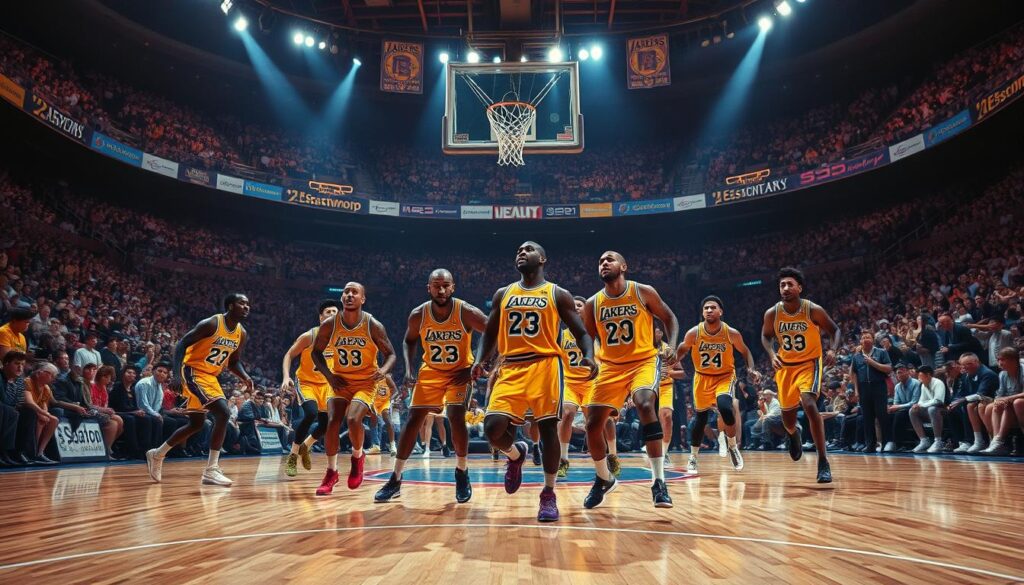
If basketball had a Hollywood script doctor in 1980, they’d have pitched the Showtime era as Ocean’s Eleven meets NBA hardwood. It was a heist movie where Magic Johnson stole assists and Kareem Abdul-Jabbar’s skyhook was the ultimate getaway car. This wasn’t just basketball. It was a $100 million studio production with five championship rings as its box office receipts.
The Lakers’ rise coincided with the NBA’s transition from ABA merger chaos to prime-time legitimacy. While Dr. J’s afro cast shadows in Philadelphia, Pat Riley’s slicked-back hair became the league’s new logo. It symbolized West Coast cool, saving basketball from grainy tape-delayed broadcasts.
Magic vs. Bird: The Original Streaming War
Magic’s no-look passes and Bird’s blue-collar grit weren’t just rivalry – they were cultural proxy wars. Lakers-Celtics games became must-see TV years before Netflix binges. Their contrast was sharper than VHS tracking lines:
| Showtime Lakers | Lunchpail Celtics | |
|---|---|---|
| Offense | Fast breaks (11.2 transition PPG) | Half-court grind (47.6% rebound rate) |
| Star Power | Magic’s smile (12.3 APG) | Bird’s scowl (24.3 PPG) |
| Legacy | 5 titles in 9 years | 3 titles in 6 years |
The numbers tell half the story. Magic’s behind-the-back dishes did for basketball what Spielberg did for cinema. They turned athleticism into spectacle. Bird’s Indiana grit played like Scorsese’s Raging Bull: raw, unfiltered, and Midwestern to its core.
HBO’s Winning Time gets the champagne showers right, but misses the real drama. This wasn’t just about Hollywood glitz versus Boston steel. The Lakers’ 1985 title win – their first against the Celtics in eight Finals meetings – marked basketball’s cultural tipping point. Suddenly, sneaker deals mattered more than steel mills.
Today’s pace-and-space NBA owes its existence to Showtime’s blueprint. Those 1987 Lakers didn’t just win 65 games – they averaged 115 PPG before three-pointers were cool. Kareem’s goggles and Magic’s baby hook? That’s basketball’s original influencer collab.
’90s Bulls: Jordan and the Triangle
Michael Jordan didn’t just dominate the ’90s; he made basketball a global sensation. Every game ended with him holding a trophy. The Bulls’ dynasty was all about building greatness and redefining it. They mixed Phil Jackson’s Zen with Tex Winter’s triangle offense, creating magic.
The 1996 season was a record-breaker, defying physics. Scottie Pippen guarded all five positions while Jordan scored 30 points on average. The triangle offense was the league’s secret code, making defenses struggle.
Pippen’s versatility allowed Jordan to shine. He scored 41 points in the ’93 Finals and 38 while sick in ’97. And then there was…
The Last Shot™.
Game 6 in Utah was a moment of pure drama. Jordan’s push-off on Bryon Russell was a masterclass. The 20 million viewers watching made the NBA Finals must-see TV. ESPN’s *The Last Dance* showed us the Bulls were like a rock band, with Dennis Rodman as the drummer.
Three things made this dynasty great:
- A scoring god (Jordan’s 33.4 PPG playoff average)
- A defensive wizard (Pippen’s 8 career All-Defensive nods)
- A system that made legends out of role players (Steve Kerr’s famous shot)
By 1998, Jordan was outstyling history itself. The Bulls won six titles in eight years. Their legacy is a blueprint for dominance, written in fadeaways and tongue wags.
2010s Warriors: Three-Point Revolution
Imagine Silicon Valley’s smart thinking on an NBA court. That’s what the Golden State Warriors brought. They made three-pointers as valuable as a startup unicorn. While others were planning, the Warriors were coding their game like NASA.
Their 2016 73-win season was a big middle finger to traditional basketball. Stephen Curry’s shots were like a three-point revolution guide. He turned long shots into reliable math problems.
The Durant signing was like the Avengers: Endgame of roster moves. Critics said it was crazy, but Golden State’s team just ignored rules. They won two more titles and showed how to build a dynasty.
Their Oakland-to-SF relocation was like a Silicon Valley upgrade. It was smooth, not like LeBron’s big announcement. The Warriors moved and kept winning, showing how to keep fans happy.
In 2022, they won the Finals without Durant. It was like a software update for the team. Curry’s fourth ring was a message to basketball: The revolution is ongoing.
Others Considered
While dynasties grab all the glory, the NBA has teams that almost made it big. Let’s look at basketball’s Almost Famous stories. These teams shone brightly but never became famous.
The San Antonio Spurs are a secret gem in the NBA. They’ve won five titles but don’t get much attention. Gregg Popovich’s coaching style may not excite fans, but it works.
They beat Miami in 2014, showing off their skill. It was like a chess master outsmarting a pop star.
Remember when LeBron James joined the Miami Heat? It was a big deal, but they won two titles. Pat Riley and Chris Bosh added drama, making it like NBA reality TV.
| Team | Era | Titles | Legacy |
|---|---|---|---|
| Spurs | 1999-2014 | 5 | Silent assassins |
| Heat | 2010-2014 | 2 | Reality TV champions |
| Spirits of St. Louis (ABA) | 1974-1976 | 0 | Greatest deal in sports history* |
*The Spirits got a great deal when they joined the NBA. They got 1/7 of TV revenue from four teams. This deal is remembered to this day.
These teams show that success isn’t just about winning. The Spurs are efficient, Miami is dramatic, and the Spirits are smart with money. They’re like cult classics in a world of blockbusters.
Dynasty DNA
If basketball dynasties had geneticists, they’d smell like Red Auerbach’s cigars and Phil Jackson’s incense. The greatest team lineups aren’t random. They’re carefully crafted. Let’s look at three key parts of their DNA:
The Coaching Genome
Phil Jackson’s 11 rings weren’t just about the triangle offense. His Zen approach turned players into focused assassins. Gregg Popovich’s system is like a gourmet menu. Every play is timed perfectly, like a fine dining experience.
Sixth Men: The Mitochondria of Momentum
Every dynasty needs a spark from the bench. John Havlicek was Boston’s energy boost in the 4th quarter. Manu Ginóbili’s Eurostep was more than just a move. It fueled the Spurs’ winning streak for 15 years.
| Dynasty Element | Coaching Blueprint | X-Factor Player | Secret Sauce |
|---|---|---|---|
| 80s Lakers | Pat Riley’s Armani-clad discipline | Michael Cooper (Defensive Catalyst) | Showtime meets lockdown D |
| 90s Bulls | Jackson’s Zen mind games | Steve Kerr (Clutch Gene) | Triangle offense as psychological warfare |
| 2010s Warriors | Kerr’s hybrid system | Andre Iguodala (Swiss Army Knife) | Three-point math + old-school defense |
Today’s dynasties mix old-school grit with new tech. Steve Kerr’s playbook is like a Silicon Valley startup. It combines mindfulness with modern offense. But the heart of a greatest team lineup is the same: stars and legendary sixth men who shine in the background.
Dynasty Legacy
What do Slovenian playgrounds, Chinese sneaker markets, and Serbian coaching clinics have in common? They’re all signs of NBA dynasties’ global impact. The league’s top teams didn’t just win championships. They changed basketball worldwide.
The Dream Team’s 1992 tour in Barcelona is a great example. It made kids from Vilnius to Buenos Aires dream of being like Barkley or Magic.
This global influence turned NBA team rivalries history into a big show. Bird vs. Magic was more than just a rivalry. It was a battle between East Coast and West Coast, between different cultures and styles. This rivalry helped the NBA grow from $400 million to $4 billion in a decade.
Phil Jackson’s coaching and Tex Winter’s triangle offense became key for most influential NBA coaches around the world. They were studied from Istanbul to Sydney.
| Dynasty | Global Export | Coaching Legacy | Media Impact |
|---|---|---|---|
| 80s Lakers | Showtime fast breaks | Pat Riley’s suits | Cable TV boom |
| 90s Bulls | Jordan brand mania | Triangle offense | Space Jam economics |
| 2010s Warriors | Three-point evangelism | Steve Kerr’s podcasts | Twitter highlights |
Today, the NBA tells a different story. When Luka Dončić does a step-back three, or Victor Wembanyama cites KD videos, we see a new era. Player empowerment has led to fast-changing teams. But does that mean lasting dominance is over?
The Warriors’ use of analytics shows a new path. Their three-point shots didn’t just win games. They changed how EuroLeague GMs think. Yet, for every team that follows, there’s a Jokić bringing new ideas from Serbia. Modern dynasties might not last long, but their ideas spread fast.
Are we seeing the end of dynasties, or just a new form? The answer might be in Manila’s streetball courts. There, kids debate Kobe vs. LeBron while shooting Curry-range threes.
Conclusion
History’s greatest NBA teams are like a hall of mirrors. Their dominance is warped by time, rule changes, and new teams. Bill Russell’s 11 rings stand out more today, as modern teams manage players carefully.
The Warriors’ three-point shots seem less groundbreaking when you think about George Mikan. He retired because the league widened the lane to stop his hook shot.
Defensive dynasties in NBA history face big challenges. Today’s defensive strategies would have given Pat Riley’s 80s Lakers headaches. Yet, Rudy Gobert’s rim protection is less impressive with the rise of long-range shots.
The game’s physics keep changing, but dynasties need talent, innovation, and rule gaming. Jordan’s talent, Phil Jackson’s triangle, and rule gaming by champions are key.
Modern superteams are caught in a salary cap paradox. They are both strong and fragile. Can they build lasting greatness when players might leave for big deals?
We’ve moved from Red Auerbach’s cigars to algorithms for dynasty success. The real trick is making fans believe in today’s teams as much as the Celtics or Magic’s Showtime crew.
Future historians might see today’s teams like paleontologists studying T-Rex bones. They’ll be amazed by the scale but puzzled by the teams’ decline. So, 2050s teams, your challenge is to win 11 titles while dealing with player management and rule changes. Good luck – you’ll need more than a time machine and a tampering-friendly phone.
