

Welcome! Have you ever felt that sudden panic on the court? Your teammate gets beat, the driver blows by, and you’re left in a desperate, reactive scramble. It’s exhausting, right?
That feeling is like having a vague “emergency fund” for your budget. You know you need something, but you’re never quite sure what for. Smart money management teaches us to plan for expected expenses with specific categories.
Basketball defense works the same way. Instead of treating every drive as a crisis, you can have a planned response. This is where a smart peel switch comes into play.
Its core job is containment—stopping the ball from reaching the rim. More importantly, it’s about foul avoidance. You use smart positioning instead of making desperate, reaching plays.
Think of it as assigning specific jobs. One player contains the ball. Another seamlessly switches onto the open man. Everyone stays organized and connected.
By adopting this proactive adjustment, you turn possible disasters into controlled, routine stops. Let’s learn how to make that happen!
Decision triggers and communication words
Effective late-switching isn’t about guessing. It’s about knowing when to swap assignments. The key is to act at the right time. Switch too early, and the offense gets an advantage. Wait too long, and you scramble.
Think of a decision trigger like a conscious choice. Just as author Oliver Burkeman advises, choose what to focus on. Is it when the ball-handler’s shoulders drop? Or when a teammate gets pinned by a screen? These are your triggers.
Recognizing these cues turns panic into a planned response. Your defense moves from “I hope someone helps” to “We know what to do.” This is what makes teams organized, not chaotic.
But seeing the trigger is only half the battle. You must communicate it. Your team’s voice is your most powerful tool. Researcher Ayelet Fishbach found that actions feel more meaningful with others.
On the court, clear words align your defense. A sharp “Switch!” call isn’t a suggestion; it’s a command. A follow-up “I’ve got ball!” confirms the action and eliminates hesitation.
We recommend adopting this simple vocabulary:
- “Switch!” – The universal call for an immediate swap.
- “I’ve got ball!” – The defender taking the driver announces it.
- “You’re good!” – The peeling defender confirms the switch is complete.
This isn’t just yelling. It’s structured communication that makes every defensive rotation intentional. When everyone uses the same words, everyone is on the same page. The emergency switch stops being an emergency and starts being a routine part of your defensive package.
By mastering these triggers and words, you transform breakdowns into seamless stops. You move from scrambling to saving possessions, one clear decision and call at a time.
Technique for handler/roller switches, including veer on drives
The veer switch is like setting aside money for car repairs. It’s a planned move, not a random choice. It turns a simple defense into a two-person strategy.
Let’s look at the roles. The defender on the ball-handler is the “handler.” The helper comes from the weak side, known as the “roller.” Each has a specific job to do together.
The handler defender aims to execute the “veer.” When the player drives, you don’t just move back. You take a sharp step to block their path. This step also guides them to your teammate.
Your footwork is key. Start with your outside foot and push off to change direction. Keep your chest facing the ball-handler as you angle. This shows the switch is happening.
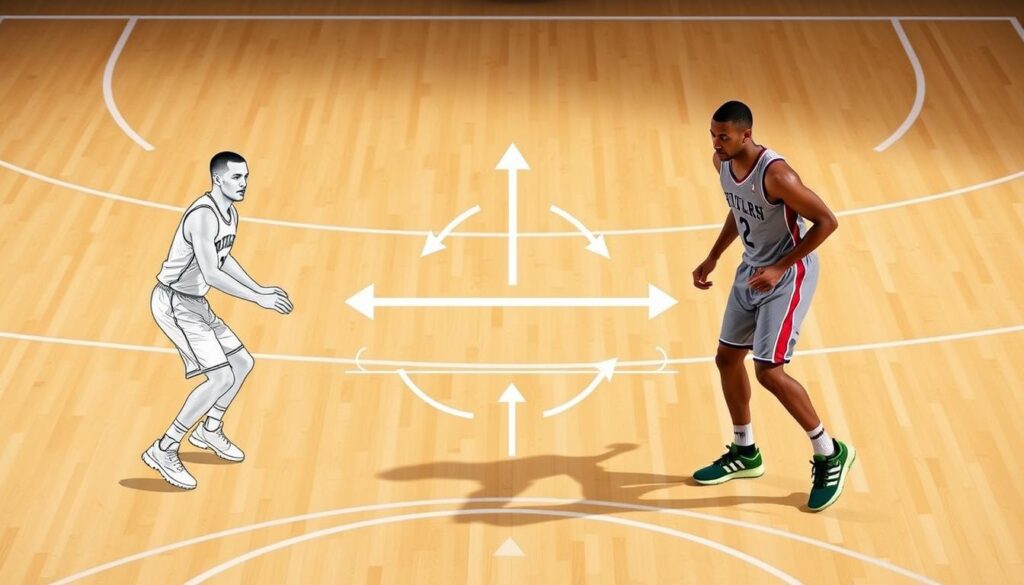
The roller defender needs perfect timing. You’re not just running to pick up someone. Wait for the handler’s veer and then rush into the lane to block the ball-handler.
Your main job is to block the pass back to your teammate. As you switch, use your body to block the pass. This seals off the pass and completes the defense.
Here’s a simple checklist for a perfect veer switch on a drive:
- Handler Defender: Angle your step, don’t retreat. Cut off the drive.
- Roller Defender: Read the veer, explode into the lane.
- Both: Communicate verbally (a sharp “Switch!”) and physically.
- Post-Switch: Handler defender seals the pass; roller defender contains the drive.
Why is this so effective? It’s like having a specific fund for car repairs. The veer switch is your plan for a known problem: a driving ball-handler with a helper nearby.
Doing this right avoids two big mistakes: fouling the driver and leaving the roller open. You stay in control because you’ve practiced this. It turns panic into control.
Imagine it in slow motion. The driver goes left, your teammate veers right, and you slide in. It’s a beautiful dance. By mastering this, you turn possible mistakes into controlled stops. You’re not just switching; you’re solving a problem with precision.
Backside organization: who becomes low man after the peel
After the peel, your team’s backside organization stops a defensive scram and an open shot. The initial switch is just the start. What happens next makes a big difference.
Think of it like rock climbing. Success comes from personal skill and trusting your team’s system. The “peel” is your move. The organization that follows is your team’s safety net.
Without clear rules, hesitation can creep in. A split-second of “Who’s got who?” is all the offense needs. A driver kicks to a corner, a roller slips free, and your defense scrambles.
To avoid this, your team needs a simple routine. We call it the “Next Job” rule set. When a peel happens, everyone has one immediate next job. This creates the defensive defaults every great team relies on.
So, who does what? Let’s break it down:
- The New Low Man: The defender who was originally on the ball handler’s direct teammate (often the roller) now has the most critical job. They must immediately “tag” or bump the rolling big man to slow their path to the basket. This player becomes the new “low man” in the paint.
- The Weakside Helper: The defender farthest from the ball, usually in the weakside corner, must now “load” to the paint. Their job is to be the secondary helper behind the new low man, ready to contest if the pass gets through.
- The Corner Cover: The remaining defender, often coming from the wing, must sprint to cover the now-open weakside corner shooter. This is a “skip pass” away, so urgency is key.
This isn’t about complex assignments. It’s about a chain reaction of responsibility. When each player knows their next job instinctively, you replace panic with purpose.
You build a culture of organized interdependence. Each player has individual accountability (like a climber on their own hold), but the system ensures the whole team moves up the wall together. This cohesion stops the drive, protects the rim, and closes out on shooters—all in one fluid sequence.
Master this backside organization, and you turn chaos into controlled defense. You won’t just stop the first action; you’ll be ready for the second and third. That’s how you shut down an offense without ever needing to scram.
Applications vs. Spain, ghost, Iverson-to-PnR, zoom actions
Think of these four common offensive actions like different financial emergencies. You budget separately for a car repair, a vet visit, and a home maintenance issue. In the same way, your late-switch defense needs a slightly adjusted plan for Spain pick-and-rolls, ghost screens, Iverson cuts, and zoom actions.
Mastering these applications turns you from a reactive defender into a proactive problem-solver. Let’s break down each one.
Spain Pick-and-Roll (Screener’s Screener)
This action adds a layer of complexity. You have the ball handler, the first screener, and then a second screener who “screens the screener” rolling to the basket.
Your key is identification. The initial screen might look like a normal pick-and-roll. The trigger is seeing that second player moving to set a back-screen on your big man who’s defending the roller.
The late-switch communication is key. The defender on the second screener must yell “Screen!” to alert your teammate. Your big man then fights over that back-screen, while you switch onto the rolling big. It’s a two-part defensive play.
A ghost screen is when a player fakes setting a pick and then quickly slips to the rim or pops for a shot. It’s designed to punish defenders who over-commit to fighting over a screen that isn’t really there.
Your read here is all about the screener’s feet and hips. If they don’t plant to make solid contact, they’re likely ghosting. Don’t get caught battling through air!
The adjustment? Stay attached to your original assignment. If you were going to switch, abort. Stick with the “screener” because they’ve now become the most immediate scoring threat.
Iverson Cut into Ball Screen
This is a favorite for scoring guards. A player uses two down-screens (the Iverson cut) to receive the ball on the wing, then immediately gets a ball screen.
The challenge is the speed and the double action. You’re defending through the initial cuts, and then suddenly you’re in a pick-and-roll.
Your principle remains: protect the paint first. As the ball handler comes off the Iverson cut, you must be ready to execute your switch technique the moment that final ball screen is set. The communication from the big man’s defender, “Switch!” or “Stay!”, dictates your next move.
Zoom Actions (Double Staggered Screens)
Zoom actions use two consecutive screens, often set close together, to free a shooter. It creates a maze for the defender.
Your goal isn’t to fight through both screens. That’s a losing battle. Instead, your team must pass the shooter off like a baton in a relay race.
The first defender takes the shooter to the first screen. The defender guarding the first screener switches onto the shooter. Then, that new defender takes the shooter to the second screen, where another switch occurs. It’s a smooth, communicative handoff.
The “Switch-to-Zone” Principle
Sometimes, the action is too quick, or the offense creates an overload. This is where a brilliant hybrid concept comes in: the switch-to-zone.
It’s not a full defensive scheme change. It’s a momentary, instinctive adjustment. When a Spain action or a complex zoom creates multiple threats on the strong side, the two or three defenders involved might momentarily “zone up.”
They cover areas instead of strictly sticking to men. This stops the immediate pass to the roller and the pop-out shooter simultaneously. After the initial threat is solved, you quickly match back up to your assignments.
Think of switch-to-zone as your emergency fund. It’s the flexible tool you use when your specific budget categories (your standard late-switch rules) are under unexpected, simultaneous pressure.
Each action has its own tell. Spain has the second screener. Ghost screens have no solid contact. Iverson cuts have the pre-staged movement. Zoom has the tight double screen.
By studying these reads, you’re never surprised. You have a plan for every common offensive playbook entry. Now your defense is truly prepared for anything.
Drills: 3v3 late-switch read game, 4v4 peel boxout, 5v5 constraints
Defensive drills are like training your team’s brain for quick responses. Just like a certain scent can remind you of studying, these drills make your team’s defense automatic. Let’s work on building these habits with a series of drills.
The 3v3 Late-Switch Read Game focuses on the core decision. Play half-court with one driver. The defense just needs to read the drive and switch. It’s simple, with no help or rotations.
Then, we add a key element. The 4v4 Peel Boxout Drill includes a shot. The offense drives and kicks. The defenders must switch late and box out after the shot. This drill teaches you to secure the rebound.

Next, we add real-game pressure with 5v5 Constrained Games. Here, you can only stop a drive with a late switch or a “stunt-and-peel“. A stunt-and-peel is a fake help action. It disrupts the driver and then peels back.
These games create cues for your team. The sight of a drive, the sound of a teammate yelling “switch!”, and the act of peeling become linked. You’re not just learning a tactic. You’re building a reflexive system that works under pressure.
Run these drills in order. Start with the 3v3 read, then the 4v4 boxout, and finish with the 5v5 game. This progression turns knowledge into reliable skills. Your team’s defense will no longer scramble. It will respond.
Metrics: blow-by saves, fouls avoided, corner 3 concessions
Just as a detailed budget can calm your financial worries, specific defensive metrics can show your defense’s progress. How do you know your late-switch defense is getting better? We need to look at data that tells the real story, not just vague ideas.
Tracking the right numbers gives you solid proof. It removes guesswork and shows where your defense excels. Let’s explore the three key metrics that show how well your late-switch system works.
Blow-By Saves count the drives you stop that would have been easy layups without a late switch. Think of a guard beating your primary defender. A successful late-switch by a helper “saves” that blow-by, forcing a contested shot instead of an open one. Tracking this metric shows your team’s ability to react and protect the rim.
Fouls Avoided on drives is another critical number. When a defender is beaten, the instinct is often to reach or bump, leading to a whistle. A well-executed late-switch allows for clean, vertical defense without desperate contact. A downward trend in these fouls means your team is using technique, not panic, to stop penetration.
Corner 3 Concessions measure how often you give up that deadly shot due to poor rotation after a switch. A late switch pulls a defender from the corner. If the low man doesn’t peel back in time, it’s an open three. This metric exposes whether your backside organization is working.
Imagine watching these categories improve week to week. Seeing your blow-by saves go up and your fouls avoided go down is like watching your savings grow—it builds undeniable confidence. You’re not just hoping your defense holds; you have evidence it will.
Here’s a simple way to visualize what you’re tracking and why it matters:
| Metric | What It Measures | Why It Matters |
|---|---|---|
| Blow-By Saves | Drives contained after a defender is beaten | Shows rim protection & reaction speed |
| Fouls Avoided | Whistles not called on drives due to clean switches | Proves disciplined technique over desperation |
| Corner 3 Concessions | Open corner shots allowed after a switch | Reveals backside communication & rotation |
By focusing on blow-by saves, fouls avoided, and corner 3 concessions, you move from feeling exposed to having a precise game plan for improvement. This data-driven approach gives your team the calm confidence of knowing exactly where they stand and how to get better.
Integration with base coverage packages
Your team’s defensive language is key on the court. The late-switch is like a new phrase in that language. It works best when used correctly.
A late-switch is a tool in your defensive toolkit. It must fit with your team’s defensive system.
Let’s see how it fits into two base coverage examples. In a “no-middle” defense, the late-switch is a smart move. If the on-ball defender gets beat, the low man can peel and switch to block a layup.
In a “drop” coverage, the late-switch is a planned move. If a top ball-handler is attacking your big in a pick-and-roll, your guard will fight over the screen. Your big will show hard, and the low wing will peel onto the roller. It’s a strategic move in your scheme.
The key to integration is to focus on one thing at a time. This is like Oliver Burkeman’s life advice: focus on one goal at a time. Choose one base coverage package and one trigger for the late-switch first.
Why focus? It helps your players learn without getting confused. Start by adding the late-switch to your “no-middle” drill when the drive comes from the wing. Master that before adding more.
This seamless integration makes the late-switch a proactive part of your defensive system. You’re not just teaching a play; you’re adding to your team’s defensive vocabulary. Start with one word. Soon, you’ll have game-saving conversations.
Film study protocol and practice scripting
The final step to lock in your late-switch defense is intentional review. A smart film study protocol turns game footage into your best teacher.
Start by cutting clips of every switch trigger. Look at Spain actions, ghost screens, and Iverson-to-PnR plays. Ask your team specific questions during the review. “What was the communication trigger here?” “Was the veer technique correct?” “Who became the low man after the peel?”
This process eliminates unhelpful habits. It uses team discussion to solidify understanding for everyone. The LIFE KIT method highlights this. Intentional learning with your group builds a shared defensive language.
Your film findings directly script your next practice. If you see blown switches, script 10 minutes of veer-switch footwork drills. Notice poor boxouts? Plan 15 minutes of 4v4 peel and recover scenarios.
This mindful approach to planning, like productivity expert Jose Briones’ time management, makes every minute count. You move from random drills to targeted skill development.
By studying film and scripting practice with purpose, you do something powerful. You democratize advanced defensive knowledge. You make complex NBA-level coverage accessible and actionable for every player on your roster.
