

Ever watch an NBA game and wonder, “How did they get that guy so wide open?” You’re not alone!
The secret often lies in a modern half-court chess move. It turns a broken play into a scoring bonanza.
We’re talking about the short roll. Think of it as the key link in a smart offense. It’s not just a simple pass to the big man anymore.
This action is an offensive hub. As JJ Redick and LeBron James highlighted on their “Mind The Game” podcast, the inverted pick-and-roll creates impossible choices for defenders.
Schemes like the Boston Celtics’ use it to force favorable 4-on-3 situations. It’s why this concept is so difficult to guard at the highest level.
Our mission is simple: we’ll break this complex idea into understandable parts. You’ll learn to see the game—and play it—much smarter.
Triggers to create short roll: baiting blitz/show, angle to force 2-on-ball, drag into trap windows
The short roll is a chance you can create. It’s not random. It’s a setup you plan. Think of it like a pitcher setting up a batter for a changeup after a fastball.
Defenses face a big dilemma, like guarding James Harden. A hard double-team can lead to a 4-on-3 situation. A soft hedge might let Harden shoot a three. You aim to make them choose the hard double-team.
To bait that double-team, use the right angle of attack off the screen. Don’t go straight. You need to “drag” defenders into a trap window. This is the spot where they think they have you cornered.
Imagine dribbling off a pick and taking a sharp angle to the sideline. This leads both defenders into a corner. They think you’re trapped and commit fully.
When you see two defenders on you, it’s time to switch. The trap is set, and a pocket pass is your only way out.
This “drag” action is a skill. You’re not trying to beat the trap with your dribble. You’re inviting it! By controlling your speed and path, you force the defense to send two players to the ball. This creates a 4-on-3 situation for your teammates.
The roller is now open in the short roll, waiting for a pocket pass. Remember, the trigger isn’t the pass itself. It’s you making the defense commit two players to you. Once they do, the play is alive. Your next move is to find the open man with a precise pocket pass.
Mastering this bait-and-switch is key to becoming a great short-roll playmaker.
Delivery to the roller: pocket pass timing, bounce vs lob, split dribble angles, late lift reads
Passing the ball to the roller is more than just a simple action. It’s about making smart choices based on timing and angles. This moment can either help your team or hurt it. It’s like a quarterback’s throw, needing precision.
Your footwork is key. Winning the first two steps and getting shoulder-to-hip with your screener is essential. This angle lets you pass the ball to the pocket pass without defenders getting in the way. Timing is everything – too early or too late, and the pass is off.
Choosing the right pass is important. A bounce pass is usually the best. It’s quick, low, and easy for your big to catch. Use it when the path is clear. A lob pass is better when a defender jumps the lane. It arcs over, giving your roller a chance to score.
Split dribble angles are your secret weapon. By dribbling at specific angles, you stretch the defense. This makes the big commit, opening a window. A fast touch pass is perfect for these tight windows. It’s a quick, one-handed pass that reaches the roller before the defense can react.
Reading the defense’s “late lifts” is also key. This is when a defender jumps into the lane at the last second. If you see this, switch to a lob or a quick touch pass to the opposite side. It keeps your advantage alive.
Think of it like this: your footwork is the foundation, and your delivery is the key. Practice these passes – bounce, lob, and touch – until they’re second nature. Your roller will score easily!
The 0.5-second decision tree: floater, lob, corner skip, slot cutter, kickout-to-swing, keep dribble into DHO
When you catch the ball on the short roll, you quickly think: floater, lob, skip, cutter, swing, or handoff. You have less than a heartbeat to decide. This is where the 4v3 advantage can be used wisely or lost.
Imagine you’re a quarterback who has just broken the blitz. The defense is scrambling, and you have a numbers advantage. Your job is to read the three remaining defenders and attack the open space before they can recover. It’s not about thinking; it’s about knowing your options ahead of time.
Let’s break down your six primary reads in that critical half-second window. Each one is a direct response to how the defense moves.
- Take the Floater: If the lane in front of you is clear, take the easy points! This is your green light when the defender guarding the roller stays attached to your teammate.
- Throw the Lob: If that same defender helps up onto you, your rolling teammate is now open at the rim. A well-timed lob pass results in a dunk.
- Skip to the Corner: This is a high-value pass. If the defender in the opposite corner rotates into the paint to stop you, that corner shooter is wide open. Data from teams like Houston shows most kickouts from a drive-and-kick situation go to the “opposite corner or wing,” proving this is a smart, automatic read.
- Hit the Slot Cutter: Sometimes, a teammate will see the defense collapse and cut hard across the lane. A crisp pass to the cutter is a guaranteed layup.
- Kickout to Swing: If the defense recovers quickly and your first options are covered, kicking the ball out to a wing player resets the offense. From there, they can swing it to the now-open corner—another pattern confirmed by that same Houston playmaking data.
- Keep Dribble into DHO: If a defender runs at you but doesn’t fully commit, you can keep your dribble alive and flow directly into a dribble handoff (DHO) with a shooter. This keeps the defense in rotation.
Your choice depends entirely on the movements of those three defenders. Are they all packed in the paint? The skip pass is open. Are they over-rotating to the ball? The cutter is coming free. This four-on-three scenario is a puzzle you solve with your eyes before you even catch the ball.
The best short rollers don’t hesitate. They’ve practiced these reads until they become instinct. By understanding this decision tree, you turn a chaotic, fast-break situation into a controlled, high-percentage scoring opportunity every time.
Mastering this half-second clock is what separates good players from elite playmakers. It turns the temporary 4v3 advantage into consistent points on the board.
Reading the tagger: early/late tags, split-the-difference top, low-man inside-out; auto-skips and shake timing
Think of the short roll as a high-speed puzzle. The “tagger” is your biggest clue. This defender leaves their spot to stop your drive. Reading them right can make a big difference.
Defensive rotations are like speed dating, with everyone shifting 1 man down. The tagger starts this chain. Your job is to read their move and make the defense pay.
To read the tagger, look at their chest and eyes. If they’re coming from the wing near you, it’s an early tag. This means the pass to the corner is open. If help is sprinting from the far corner, it’s a late tag, leaving the wing shooter free.
A smart defender might not fully commit. They might “split-the-difference,” contesting both your shot and a pass. This is where patience is key.
Also, watch the low-man (the defender closest to the basket). If they slide inside to protect the rim, the pass out to the opposite corner is often the right play.
Here’s your cheat sheet for quick reads:
- Full Sprint at You: This is an “auto-skip” signal. The man he left is wide open for a immediate spray pass.
- Hesitant Choppy Steps: They’re unsure. Use “shake timing”—a slight pump fake or hesitation dribble—to freeze them before you make your pass.
- Eyes Glued to You: They’re in “shot contest” mode. The skip pass is likely open.
- Eyes Darting Between You and a Shooter: They’re trying to do two jobs. A quick, decisive pass to either option will beat them.
The tagger’s aggression is your guide. An overzealous helper creates a major advantage elsewhere. A well-timed, accurate spray pass to that open shooter is how you punish that mistake every single time. It turns their defensive effort into your offensive highlight.
Practice looking for these cues. Is it an early or late tag? Are they splitting the difference? Your eyes should process this in a flash. That read dictates your entire next move and turns you from a passer into a playmaker.
Middle vs baseline short roll: elbow touches, short-roll DHO, push-dribble into re-screen
Houston’s big men strategy shows a key point: not all short rolls are the same. Where you catch the ball greatly changes your game plan. It’s like having a full menu versus just a few options.
Let’s look at the two main spots: the middle and the baseline.
The Middle Short Roll: Your Command Center
Receiving a pass near the elbows or the foul line extended puts you in the best spot. We call these elbow catches. It’s like having a view from a hilltop, seeing the defense’s moves.
From this spot, you can pass to the corner, find a cutter, or pass to the top. It’s great for making quick decisions.
Two advanced moves work well from the middle. First, the short-roll dribble handoff (DHO). As you catch, the original handler comes back for a quick re-screen. It puts the defense in a tough spot.
The second move is the push-dribble into re-screen. You dribble hard toward the rim, then pass to your trailing guard. It’s a simple way to change the game.
The Baseline Short Roll: The Simplified Attack
Catching the ball near the sideline is different. The defense’s moves are simpler, often pushing you to the corner. Your passing options are fewer.
But this isn’t bad! It makes your game more straightforward. The most common move is the lob pass behind the defender. When the defender jumps to stop you, your teammate has an open path.
So, how do you choose? The middle offers complexity and control. The baseline gives you simplicity and explosive plays. Being good at both elbow catches and baseline moves makes you unpredictable and complete.
Advanced counters: pushback to dribble-at, touch-pass to lift, behind-the-back swing, Spain behind the short roll
Mastering the short roll is just the start. The real magic happens when you use advanced counters to outsmart defenses. These counters aren’t just simple passes or shots. They are clever moves designed to take advantage of defensive mistakes.
Let’s explore four elite counters that can elevate a good short-roll player to greatness.
The Pushback to Dribble-At is a clever trick. It looks like you’re stepping back from pressure, maybe even giving up. But then, you quickly move forward, dribbling at the defender. This sudden move often freezes them, creating a path to the basket or forcing a foul.
The Touch-Pass to Lift is perfect for when a defender gets too aggressive. You pass the ball quickly to a shooter in the corner or wing. Then, you cut to the basket immediately after passing. This leaves the defender in a tough spot and can lead to an easy layup.
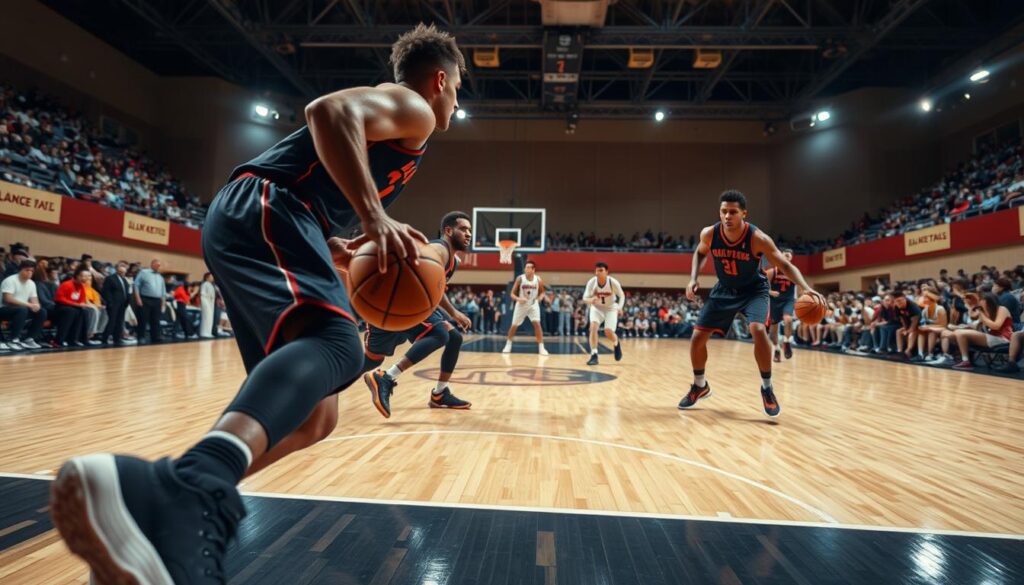
The Behind-the-Back Swing Pass is both flashy and useful. When a defender tries to block your pass, you can swing the ball behind your back. This way, you avoid their hands and find the open man. It takes practice but is a sure way to get the ball to your teammate.
Spain Behind the Short Roll is a game-changer for defenses that think they’ve got you figured out. It starts with you in the short roll, then a teammate sets a back-screen on the trailing defender. This is the Spain pick-and-roll action, but from the short-roll position. It often leads to an open three-pointer for the screener.
These advanced counters share a common thread: delay action. You might pause before taking the first opportunity to set up a better one. This hesitation makes the defense commit more, opening up new paths and shots.
Adding these plays to your game takes a lot of practice and trust in your teammates. But when done right, they are almost unbeatable. They turn the short roll into a powerful tool, keeping defenses on their toes.
Personnel fits: big-as-hub (Jokić-type), mobile short rollers (Draymond-type), wings as rollers vs switch
The short roll is like a chameleon. It changes based on who’s making the play. Your team’s players should dictate your entire approach. Let’s explore the three main types and find your fit.
The “big-as-hub” player, like Nikola Jokić, does more than just score. They use the short roll to control the offense. Their vision and passing skills make them a second point guard.
They often use the short-roll DHO (dribble hand-off). After catching the pass, they pivot and create a new play. This keeps the defense on their toes. For this player, the short roll is about unlocking the next advantage.
The “mobile short roller” is like Draymond Green. They use speed and defense to attack the rim or make quick decisions. They can score with a floater or finish at the basket, forcing the defense to collapse.
They’re great at making advanced plays, like the behind-the-back swing pass. They can also keep the dribble alive and push into a re-screen. This archetype loves chaos and creates openings with speed and decisiveness.
Using wings as rollers is also smart. When a guard gets trapped, and a wing like Jayson Tatum or Paul George short rolls, you get a big mismatch.
Now, a big man is guarding your wing on the move! Their ball-handling and shooting add a new dimension. They can pull up for a jumper, drive past a slower defender, or make a playmaking pass.
So, how do you apply this? If you have a Jokić-type, build your actions around his vision and that short-roll DHO. If you have a Draymond-type, empower him to attack gaps and make quick reads. Against switching teams, design plays that force your best wing into that short-roll pocket.
There’s no one-size-fits-all answer. The magic happens when you match the action to your players’ unique strengths. Your personnel is your playbook—start there!
Analytics: PPP on short-roll pass vs shot, turnover risk, window charts and release height, advantage durability
What’s the real value of a pass versus a shot from the short roller? The numbers have a surprising answer. Moving from “it feels right” to “the data proves it” is how we turn good decisions into great ones. Let’s break down the key analytics that measure the success and risk of your short-roll playmaking.
The ultimate metric is Points Per Possession (PPP). This tells us the average score of an action. For the short roller, the choice often boils down to: take the shot or make the pass. Here’s a typical data breakdown:
| Short Roller Action | Avg. PPP | Key Insight |
|---|---|---|
| Pass to Corner 3-Pointer | ~1.10 – 1.20 | Highest value play; leverages the created advantage fully. |
| Kickout to Slot/Wing 3-Pointer | ~1.00 – 1.10 | Excellent option, specially if defender “lifts” late. |
| Floater or Push Shot | ~0.85 – 0.95 | Efficient only for elite finishers; often a lower-percentage shot. |
| Turnover on Skip Pass | 0.00 | High risk if pass is telegraphed or release is low. |
This data is eye-opening! It shows why finding that open corner shooter is so valuable. The quality of the 3-point shot you create—measured by how open the shooter is—often has a higher PPP than even a good look for a floater.
Now, let’s talk risk. That dangerous cross-court skip pass? Analytics track turnover risk based on pass distance and defender positioning. This is where window charts and release height come in. Window charts visually map where passes are completed versus deflected. They teach us the safe passing lanes. Release height is simple: a higher release point makes it harder for defenders to intercept. The data is clear: passes released above the shoulders have a significantly lower turnover rate.
Perhaps the most fascinating metric is advantage durability. This answers: “How long do I actually have this 4-on-3?” Using player tracking, analysts found the created advantage often lasts only 2-3 seconds before the defense recovers. This quantifies why that 0.5-second decision tree we discussed is so critical. Hesitation literally melts your advantage away.
So, what does this mean for your game or your team? It moves practice from generic to precise. If your data shows your team’s short-roll floater is inefficient, you shift focus. Drill those corner skip passes twice as much. Use window chart data to teach safer release points. Time your drills to mimic that 2-3 second advantage window.
Analytics don’t complicate the game; they simplify it. They tell us what works, what’s risky, and how long we have to act. By understanding PPP, turnover risk, and advantage durability, you move from playing hope to playing probability—and that’s how you win.
Drills: 4v3 shell progressions, live constraints, scripted tag reads; film pack checklist
Let’s turn defensive breakdowns into offensive skills with drills. It’s one thing to know the theory, but it’s another to apply it against quick defenders. We have a four-step plan to boost your short-roll skills from scratch.
Begin with 4v3 Shell Progressions. This is your base. Start with a 4-on-3 setup without defense. The players move through a decision tree: floater, lob, corner skip. This builds awareness and timing.
Next, add passive defenders who follow basic rotations but don’t contest. Then, move to live defenders. This gradual increase helps solidify your reads without pressure.
To improve decision speed, use Live Constraints. These rules force specific actions. For example, the roller must pass within one second of catching. This eliminates hesitation and trains quick decision-making.
Another great constraint is allowing only one dribble after catching. This pushes you to pass or shoot immediately.
Scripted Tag Reads are your next step. You control the defense’s actions to teach recognition. A coach signals specific help patterns. The roller must find the open man based on that help.
This is where watching the slot cutter is key. Drill the read: when their defender tags the roller, the slot cutter must either lift for a shot or backdoor cut, and you must find them.
Learning isn’t just on the court. Create a Film Pack Checklist for self-study. Collect clips of successful short-roll actions from NBA games. Use this checklist as you watch:
- Trigger: What caused the trap? How did the ball handler angle the drive?
- Roller’s Catch: Was it a pocket pass or a lob? How did the pass timing affect the defense?
- Tag Source: Which defender helped? Was it the corner or the slot cutter’s man?
- Decision & Execution: What did the roller choose (shoot, lob, skip pass)? Was it the right read?
- Advantage Sustained: Did the offense get a great shot, or did the defense recover?
Repeating this analysis trains your brain to spot patterns faster during play. Combine these film sessions with your on-court drills. The synergy between mental study and physical repetition is what creates true, unthinking mastery. You’ll stop thinking and start reacting.
The goal isn’t to run through these drills once. It’s to make them part of your regular practice. This way, every possible read becomes automatic.
Scouting tells: which defenses over-help; how to pre-call counters
Before stepping on the court, studying defenses can give you an edge. It’s not about guessing; it’s about knowing. Players like James Harden use this knowledge to their advantage.
Scouting is like reading the opponent’s playbook. It reveals their tendencies. For example, some defenders always react to pump fakes, while others follow a predictable pattern.
During film sessions, you should answer specific questions. Which defender always jumps into the paint? Does the center tag early every time? Is there a defender who always watches the ball?
Most importantly, find out which defenses over-help from the dunker spot. This can lead to easy lob passes.
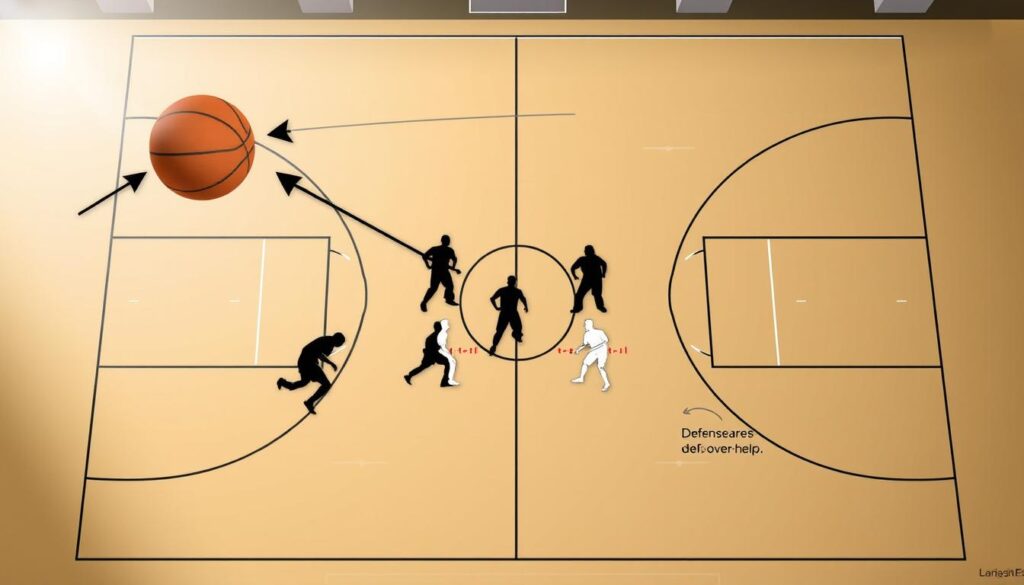
Once you spot these patterns, you can plan your strategy. You can “pre-call counters” in the huddle. This gives your team a script based on the opponent’s weaknesses.
Here’s how it works in practice. You identify a tell and create a simple command for your team:
- If their big man helps from the baseline, then we auto-skip the pass to the corner shooter.
- If the weakside wing crashes hard, then the roller looks for the lob to the dunker.
- If they always send two to the ball, then we pre-determine the swing pass to the slot for an open three.
This proactive thinking turns you into a strategist. You’re not just solving problems as they appear. You’re creating advantages before the defense can even get set. Your teammates play with more confidence because they know what’s coming next.
Make scouting a non-negotiable part of your routine. Watch for the tells, call the counters, and watch your decision-making—and your team’s success—soar to a new level.
Common errors and quick fixes
Even the smoothest short roll action can break down. A small mistake often kills the advantage. Let’s troubleshoot the most frequent errors you might see.
A common offensive error starts with the ball handler. They go around the screen instead of dragging their defender through it. This fails to create the trapping window needed for the short roll. The quick fix is simple. Drill shoulder-to-hip footwork to force that two-on-one situation.
Next, the roller makes a critical mistake. They catch the pass and immediately put the ball on the floor. This pause lets the defense recover. The solution is to practice a “catch-and-read” triple-threat position. From there, you can make your 0.5-second decision.
Defenses make errors too. A classic tell is when three defenders commit to the ball. This over-help leaves shooters wide open for a kickout. The quick fix is disciplined communication. The low man must stay home unless the roller attacks the rim directly.
By recognizing these common pitfalls, you can correct them fast. Keep your short roll game efficient and your offensive engine running smoothly.
