

Basketball is a mix of physics and hard work. To dominate, mastering the screen is key. It shows how smart you are on defense.
This play makes opponents make quick choices under pressure. I’ve studied film for years. I see how some sets fail when defenses switch everything.
The game now needs more than just being fast. It needs smart spacing and understanding defense moves. Why take a tough shot when you can score easily?
Defenses think switching solves the problem. But it doesn’t. Learning specific Spain pick and roll counters can turn screens into scoring chances.
Great teams punish mistakes by using timing and spacing. They read the defense well. When done right, the defense looks lost.
Calculated aggression beats lazy switching. These strategies are the best way to score against top defenses. They make the defense look silly.
Intro: Why switching disrupts Spain—and how to regain advantage
Switching defenses can really challenge the Spain pick-and-roll. But, there are ways to get back on top. The Spain pick-and-roll is a key offense that uses mismatches to its advantage. Yet, a switching defense can change the game.
The Spain pick-and-roll is simple yet requires high level coordination among players. It’s a play where the screener rolls to the basket, and the ball handler decides based on the defense. But, a switching defense can take away the initial advantage.
Switching defenses can disrupt the timing and spacing of the Spain pick-and-roll. It makes the offense have to adjust quickly. This often leads to unfavorable matchups or rushed decisions.
Understanding the Impact of Switching Defenses
When a defense switches, it can take away the initial screen advantage. This forces the offense to regroup. This can cause a few problems for the Spain pick-and-roll:
- Loss of the initial mismatch created by the screen.
- Increased difficulty in creating a clear scoring opportunity.
- Potential for the defense to recover and protect the paint.
To show the challenges of switching defenses, here’s a table comparing the Spain pick-and-roll against them:
| Defensive Strategy | PPP (Points Per Possession) | FG% (Field Goal Percentage) |
|---|---|---|
| Switching Defense | 0.9 | 42% |
| Non-Switching Defense | 1.1 | 48% |
As seen, switching defenses can make the Spain pick-and-roll less effective. For more on adapting your team’s strategy, check out our page on scheme tenets.
Understanding the effects of switching defenses and adapting can help teams keep using the Spain pick-and-roll effectively.
Counters menu: Early slip, switch-seal duck‑ins, back-screener pop, short-roll 3v2, re-screen “veer” action
Teams can use early slips and re-screens to counter defense changes. It’s like a chess game, where you plan ahead. Being quick and flexible is key.
The Spain pick-and-roll is a smart offense. It uses the short roll, duck-in, and veer to beat defenses. These moves make the offense strong against defense switches.
Breaking Down the Counters Menu
The counters menu for the Spain pick-and-roll has several important parts.
The early slip lets the ball handler quickly find a mismatch. It’s all about timing and teamwork.
The switch-seal duck-in makes space for the ball handler. The screener blocks the defender, opening up scoring chances. It also makes the defense rethink their plan.

The short-roll 3v2 gives the offense a numbers advantage. It stops the rolling player short of the rim, leaving a 3-on-2 situation. This can lead to big scoring chances.
This move needs great teamwork and understanding of the defense’s position. Players must be able to read the defense’s setup.
The re-screen “veer” action adds complexity. It makes it hard for the defense to guess what’s next. This can lead to more scoring chances and disrupt the defense’s flow.
In summary, a good counters menu is vital for the Spain pick-and-roll to succeed against defense changes. Using early slips, switch-seal duck-ins, short-roll 3v2, and re-screen veer actions helps teams outsmart opponents. This leads to more scoring chances.
Spacing tweaks: Empty corner, Spain flare, Spain “twist”
Spacing is key in the Spain pick-and-roll. It helps teams find weak spots in the defense. When defenses switch a lot, teams must get creative with their spacing.
The Spain pick-and-roll works well against many defenses. With a few strategic spacing tweaks, teams can find the right spots to counter.
Adjusting Spacing to Counter Switching Defenses
Using an empty corner is a smart move against switching defenses. It turns one side of the court into a 4-on-4 game. This lets the offense focus on mismatches and stretches the defense.
The Spain flare is another good tactic. A player moves to the weak side, opening up space for shots or drives. This move also makes the defense work harder to cover everyone.
The Spain “twist” is useful too. It involves a player moving to the ball, creating a new chance to score. This twist works best with other moves like the empty corner or Spain flare.
Adding these spacing tweaks to their game makes teams more unpredictable. The goal is to be flexible and use spacing and movement to outsmart the defense.
Matchup hunting: Forcing small-on-big seals; scram-read punishers
Matchup hunting is all about forcing small-on-big seals and using scram-read punishers. When defenses switch, they often create mismatches. These can be used by a smart offense to their advantage.
The key to matchup hunting is spotting these mismatches and using them. It’s a game of strategy, where the offense must quickly read the defense’s moves.
Identifying and Exploiting Mismatches
Spotting mismatches is a big part of matchup hunting. You need to know the strengths and weaknesses of both your team and the opponent.
For example, if a smaller player is matched up against a bigger one, the offense can use this to their advantage. The smaller player can “seal” the bigger one, opening up a scoring chance. On the other hand, if a bigger player is matched up against a smaller one, the offense can use post-up moves or create space for a shot.
To be good at matchup hunting, teams need to be flexible. Players should be able to play different roles. This could mean a point guard posting up against a smaller defender or a big man stepping out for a three-pointer.
Strategies for Matchup Hunting
| Strategy | Description | Benefit |
|---|---|---|
| Forcing Small-on-Big Seals | Using a smaller, quicker player to seal a bigger, slower defender. | Creates scoring opportunities in the paint. |
| Scram-Read Punishers | Reading the defense’s switch and punishing them with a quick pass or drive. | Catches the defense off guard, leading to easy baskets. |
| Versatile Player Roles | Having players who can adapt to different positions and exploit mismatches. | Increases the team’s overall flexibility and scoring ability. |
By mastering these strategies, teams can turn the tables on switching defenses. This gives them a big advantage on the court.
Teaching progression with constraints
Constraints are not limits but tools for coaches to improve player skills in the Spain pick-and-roll. By adding specific constraints to drills, coaches can work on key skills for the play.
For example, coaches might focus on spacing, timing, and decision-making. They could limit dribbles before passing or require a specific action from the roll man.
Player Development through Constrained Drills
Constraints in drills help players grow by making them adapt and be creative in the Spain pick-and-roll. A drill that limits the offense to a certain area can improve their ability to read defenses and make quick choices.
Imagine a drill where the offense is only in the half-court area, and the defense can switch. This forces the offense to be creative with Spain pick-and-roll counters. They must use screens and movement to find scoring chances.
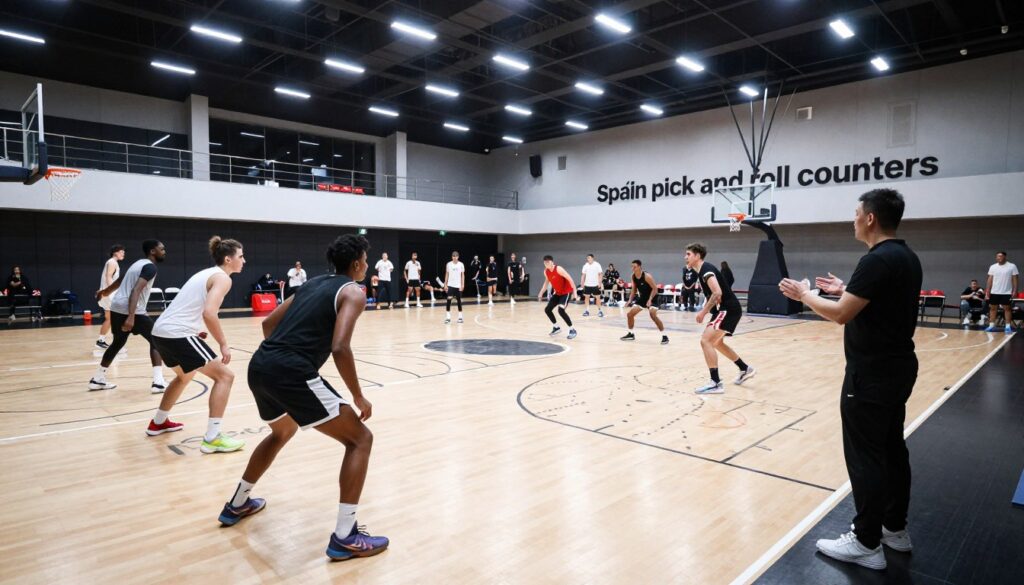
Using constraints well means picking them based on the skills you want to improve. The table below shows some common constraints and their benefits.
| Constraint | Developmental Benefit |
|---|---|
| Limiting dribbles before passing | Improves passing accuracy and decision-making |
| Restricting movement to a specific court area | Enhances spatial awareness and court vision |
| Requiring a specific roll action | Develops the roll man’s ability to read the defense and make effective decisions |
By choosing and using constraints wisely, coaches can make practice more focused and effective. This prepares players for the Spain pick-and-roll’s challenges.
Analytics checklist: Post-switch PPP, paint points, foul rate
Teams are now using switching defenses more often. They need to check how well it works against the Spain pick-and-roll. Analytics help break down complex strategies into numbers, showing what works and what doesn’t.
When looking at defensive performance, several key metrics are important. These include post-switch Points Per Possession (PPP), paint points, and foul rate. Each gives a different view of the defensive team’s weaknesses.
Evaluating Defensive Performance with Key Metrics
Let’s look at these metrics in detail. Post-switch PPP shows how well a team defends after switching. A high number means they’re not doing a good job.
Paint points show if a team is keeping the opponent out of the paint. If they’re not, it might be because of bad switching or not moving well.
The foul rate tells us if a team is playing too aggressively or having trouble without fouling. Too many fouls can lead to free throws for the other team, making things harder for the defense.
| Metric | Description | Implication for Defensive Performance |
|---|---|---|
| Post-switch PPP | Points per possession after the defensive team switches | High PPP indicates poor defensive efficiency post-switch |
| Paint Points | Points scored in the paint | High paint points suggest failure to protect the basket |
| Foul Rate | Frequency of fouls committed during defensive possessions | High foul rate may indicate overly aggressive defense or inability to contain offense without fouling |
By looking at these metrics together, teams can really understand how they’re doing against the Spain pick-and-roll. This info helps coaches make better decisions and improve the team’s defense.
Scouting cues: Opponent pre-switch, top-lock, peel-switch; counter choices
Scouting cues are key in basketball strategy, more so against switch-heavy defenses. Knowing how to counter an opponent’s defense can change the game, like in the Spain pick-and-roll.
First, you need to spot your opponents’ scouting cues. This means knowing their defensive habits, like when they pre-switch, use a top-lock, or peel-switch. By spotting these cues, teams can plan smart counters to use the defense’s eagerness or slowness.
Identifying Scouting Cues to Anticipate Defensive Strategies
To spot scouting cues, teams must study their opponents’ defensive moves. They look at how they handle different pick-and-rolls, like the Spain pick-and-roll. For example, some teams switch right away, while others wait for the roll man to move.
Understanding the opponent’s defensive style is also key. Do they play it safe or switch aggressively? Knowing this helps teams plan a counter that vs switch well, opening up scoring chances.
Against switching defenses, using a re-screen is a smart move. It can create a new matchup or free up a shooter. The re-screen also makes the defense talk and adjust, which can lead to mistakes in their switching.
Against switch-heavy defenses, having many counter strategies is vital. This might include using different screens, like a down screen or a flare screen. These can confuse the defense and use their eagerness to your advantage.
Mistakes to avoid and terminology
Executing the Spain pick-and-roll well needs precision and knowing common mistakes. One big error is not knowing when to use counters like the duck-in or veer. This is to counter the defense’s switch.
Teams often struggle to score when they don’t adjust their counters. It’s key to understand these counters well for success.
Key Terminology Review
Knowing terms like “duck-in” and “veer” is vital for team communication. These terms help players make fast decisions during the game.
By avoiding common mistakes and mastering these terms, teams can do better with the Spain pick-and-roll. This leads to more scoring chances.
