Atlanta Preseason Depth gave both local teams a useful, if limited, set of offensive clues before their 2026 regular-season work took over. The Falcons used August exhibition games to examine protection, short-game timing, and running back options behind established starters. The Hawks used October preseason minutes to test whether pace, passing volume, and broader shooting responsibility could hold across lineups. Preseason does not settle a scheme by itself, but it can show what a staff wants to inspect under game pressure.
The common thread was not simply “more players got minutes.” The more useful reading is that Atlanta’s staffs tested whether reserve groups could execute the same offensive priorities as front-line units. For the Falcons, that meant controlled passing concepts, quick decisions, and depth auditions along the offensive line and at running back. For the Hawks, it meant ball movement, transition pressure, and spacing from players outside the primary creation slots. Those are different sports, but the roster-building question was similar: can the second wave keep the offense on schedule?
Why Atlanta Preseason Depth Changed Offensive Tests
Starter Series As Control Groups
The Falcons’ first preseason game on August 12, 2026, against Denver was framed around a small starter sample. Atlanta planned to give starters at least a series or roughly 10 plays, while the published depth chart placed reserves in several relevant offensive roles, including Wanya Morris at left tackle and Kyle Hinton at left guard. The team’s posted chart also listed multiple running back options behind Bijan Robinson, including Brian Robinson Jr., Tyler Goodson, Nathan Carter, and Cash Jones, according to the Falcons preseason depth chart.
That structure matters because a brief starter run can act as a reference point. Coaches get a baseline for cadence, spacing, protection calls, and tempo. Once reserves enter, the evaluation shifts from raw production to continuity. Did the tackle handle the timing of the pass set? Did the guard keep the inside lane clean enough for quick-game throws? Did the backs hit the correct aiming points when the front changed after the snap? Those questions are more useful than reading a preseason box score in isolation.
Reserve Linemen And Backfield Reads
Atlanta Preseason Depth was most visible in the way the Falcons could rest or limit key players while still testing core offensive mechanics. Bijan Robinson was rested in the Week 1 preseason opener, and Brian Robinson Jr. received the starter snaps in that setup. That did not make August a referendum on the top running back role. It made the game a live exam for the next layer of the depth chart.
For an offense built around staying ahead of the chains, backup backs have to do more than carry the ball. They need to identify pressure, release into short routes, and protect the quarterback’s rhythm. The research set also noted that other backs held reserve roles, which expanded the staff’s chance to compare decision speed and fit within the same general run-game structure. In that sense, the preseason was less about finding a surprise star and more about mapping which players could support the weekly call sheet without narrowing it.
The Falcons’ Short-Game Evidence
Atlanta Preseason Depth And Short Passing
The most telling Falcons-related offensive signal in the available research was the reduced downfield passing profile. Sharp Football Analysis reported that Tagovailoa attempted zero passes traveling even five yards downfield in early preseason action, with an average depth of target of minus-0.2 yards at that point, the lowest among preseason quarterbacks in that sample, via Sharp Football Analysis. The same research notes tied the approach to short, quick throws rather than shot volume.
There are two cautious readings. The first is protective: preseason staffs often avoid exposing quarterbacks, linemen, and receivers to unnecessary long-developing concepts. The second is developmental: a quick passing menu gives coaches cleaner evidence on timing, route spacing, and yards-after-catch chances. If the ball is designed to leave early, the evaluator can isolate whether the receiver separated on schedule and whether the blocker in space arrived with the proper angle.
On August 28, 2026, against Miami, the research notes said the starter finished 7-of-8 for 95 yards while using short, quick passes to weapons such as Kyle Pitts and Jahan Dotson. Without adding unsupported conclusions, that profile points toward a rhythm-based preseason plan. It did not prove Atlanta would avoid deep throws once games counted. It did suggest the staff valued completion rhythm, lower-risk sequencing, and skill-player touches during those controlled reps.
Receiver Roles In 11 Personnel
The research also identified Jahan Dotson as a prominent starter-group receiver in the preseason opener, with Olamide Zaccheaus and Dotson paired often in 11 personnel sets. That matters because 11 personnel gives an offense flexibility without substituting: three receivers can stretch spacing horizontally, the tight end can detach or stay attached, and the back can remain a run or outlet threat.
For Dotson, the key developmental point was not only usage. It was the type of offense that usage supports. Short-game structure demands receivers win with route tempo, body positioning, and immediate transition after the catch. If a wideout is being evaluated with the starters, the staff is not only checking hands. It is checking whether the quarterback can trust the landmark and whether the receiver’s spacing helps the next progression stay alive.
What Atlanta Preseason Depth Revealed For The Hawks
Ball Movement From Multiple Units
The Hawks’ October evidence carried a clearer basketball identity. In the October 19, 2026 preseason finale against Dallas, the research notes credited Atlanta with 36 assists on 40 made field goals, 21-of-51 three-point shooting, and a 19-6 edge in fast-break points. Those numbers are preseason numbers, so they should not be stretched into a regular-season forecast. They do, however, align with a staff testing pace, quick decisions, and advantage preservation across several groups.
For a basketball offense, that assist rate tells a story about the ball not sticking. The Hawks were not only asking lead handlers to create. They were asking the pass after the pass to arrive on time. That is where depth changes the quality of a preseason test. If only starters can keep the ball moving, the style is fragile. If bench units can maintain tempo, run to spacing spots, and fire the next pass without holding, the coaching staff has more lineup combinations available.
Bench Roles With Specific Jobs
Atlanta Preseason Depth showed up in the Hawks’ bench evaluations through role specificity. The research notes credited rookie guard Kingston Flemings with 21 assists and five turnovers over five preseason games. That ratio, taken within preseason limits, points to decision-making value. It suggests he was not simply occupying minutes; he was being assessed on whether he could organize possessions without overhandling.
The frontcourt competition between Asa Newell and Zuby Ejiofor also fit the same theme. The research notes described Newell through rebounding and shot-blocking traits, while Ejiofor was linked to scoring upside. Those are different offensive effects. A rebounder can trigger transition and extend possessions. A scoring frontcourt reserve can punish smaller lineups or finish plays created by guards. The development question is which skill set best supports the lineups around them.
Dyson Daniels’ three-point volume was another useful signal. The research notes said he attempted 12 threes in four preseason games, making two, with at least three attempts in three separate games. The makes were modest, but the attempt profile mattered. If a defense has to guard Daniels farther from the rim, driving lanes and passing windows can widen for everyone else. That is a strategic experiment, not a finished answer.
Cross-Sport Lessons For Offensive Staffs
Development Is Not Just Volume
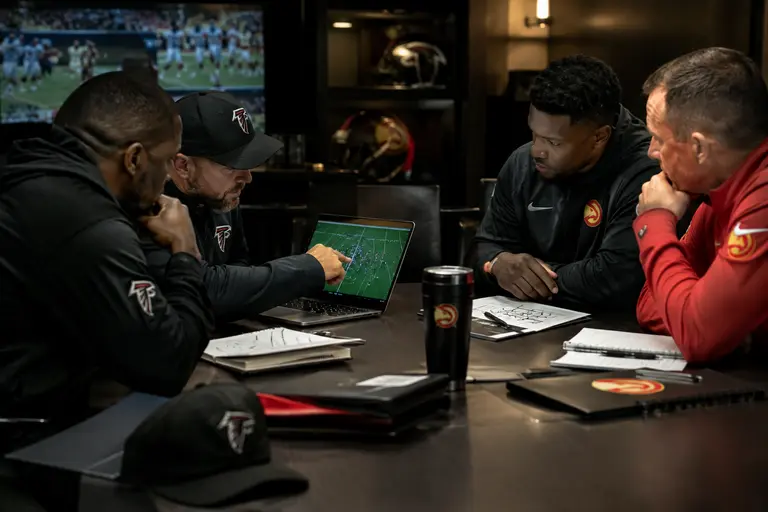
Player development is often discussed as if minutes alone create progress. These Atlanta examples argue for a narrower definition. Development depends on giving players tasks that resemble the regular offense. The Falcons’ reserves were not just filling time; they were working inside pass-protection demands, short-game timing, and backfield responsibility. The Hawks’ reserves were not just taking shots; they were tested on passing speed, spacing discipline, transition running, and role fit.
That idea connects with a broader roster process. Exhibition games can clarify what a player can execute against unfamiliar opponents, but the sample is still small and opponent plans are limited. A deeper look at how preseason roster decisions take shape shows why staffs weigh practice, film, health, and role fit alongside box-score production. For more insights into these dynamics, readers can explore related content at Scar Sports.
What Coaches Can Trust
Coaches can trust some preseason signals more than others. They can trust whether a player knew the assignment. They can trust whether the ball came out on time. They can trust whether a wing sprinted to the corner, whether a guard made the simple pass, or whether a lineman communicated a pressure look. They should be more cautious with shooting spikes, touchdown totals, or single-game scoring bursts.
That distinction is central to evaluating Atlanta Preseason Depth. The Falcons’ short passing did not prove a full-season offensive ceiling. The Hawks’ hot shooting night against Dallas did not guarantee elite spacing after opening night. Yet both sets of games gave coaches evidence about habits. In football, the habit was staying on schedule. In basketball, the habit was moving the ball before the defense could reset.
Atlanta Preseason Depth In Offensive Strategy
What The Evidence Supports
The supported reading is that Atlanta’s 2026 preseason depth affected offensive strategy by widening the evaluation field. The Falcons used August games to test backups in meaningful offensive structures, especially along the line, in the backfield, and in short passing concepts. The Hawks used October games to see whether pace, passing, and three-point willingness could extend beyond the starting group.
- The Falcons’ preseason evidence pointed toward rhythm passing, controlled starter exposure, and reserve evaluation at protection and skill positions.
- The Hawks’ preseason evidence pointed toward ball movement, transition pressure, expanded shooting responsibility, and clearer bench role competition.
- Both teams treated depth as a way to preserve offensive identity when starters sat, rather than as a separate second-unit style.
The cautious takeaway is that preseason depth is most valuable when it reveals transferable skills. For the Falcons, those skills were timing, protection reliability, and role comfort in a low-risk passing structure. For the Hawks, they were quick decisions, spacing, and the ability to keep pace with bench-heavy groups. Atlanta Preseason Depth did not answer every regular-season question by October 31, 2026, but it did show how both staffs were using exhibition games to connect player development with offensive design.
