
Mavericks Player Development is the right frame for Dallas’ October work, but the timeline needs precision. As of October 1, 2026, the Macao portion of the preseason tour had not yet been played. The Mavericks were still in the practice phase before scheduled NBA China Games matchups on October 9 and October 11, followed by home preseason games on October 14 against New Orleans and October 16 against Atlanta, according to the team’s preseason schedule. That makes the tour less of a completed data set and more of a live player-development lab about to move from practice floors into game conditions.
Dallas has a clear evaluation problem and a useful opportunity at the same time. The roster is young, international, and newly shaped around first-year head coach Dusty May. The front office has also added size, length, shooting, and several prospects who need defined jobs rather than vague developmental labels. A two-game overseas stop can interrupt rhythm, but it can also expose how quickly young players process a scouting plan, handle travel demands, and translate small-group instruction into five-on-five decisions.
Mavericks Player Development In A Compressed Calendar
Why The Dates Shape The Evaluation
Dallas began a six-practice block on September 26, 2026, scheduled to run through October 3 before the trip to China. That matters because the Mavericks were not working with a long runway before facing outside competition. The first priority was not likely to be full playbook volume. The more realistic priority was role clarity: who screens, who spaces, who initiates, who crashes, and who can defend multiple spots without breaking the shell.
The Macao games on October 9 and October 11 are positioned early enough that results should not be overread. A young player can look uncomfortable because of a new role, a new continent, a short prep window, or the normal limits of preseason lineups. The better scouting question is whether the habits are visible. Does the big arrive early in screen coverage? Does the secondary ballhandler make the next pass? Does the wing recognize the low-man rotation? Those details tell more about development than a single shooting night.
Mavericks Player Development Benchmarks In Macao
For Mavericks Player Development, the useful benchmarks should be narrow. Dallas can track how quickly players execute May’s spacing rules, how often young bigs finish possessions with rebounds, and whether guards create advantages without forcing late-clock attempts. The tour also includes fan events, youth clinics, and community programming, which add time demands. That is not a basketball excuse, but it is part of the environment scouts should account for before judging efficiency numbers.
The trip itself fits a broader evaluation discussed in our Mavericks Macao trip analysis, where player readiness, fatigue response, and rotation experiments are more useful than treating the event like a finished rotation preview. For readers looking to expand their search for related resources, they can refer to network sites such as efficientdirectory.com, ensuring you’re connected to a broader set of useful tools. However, the primary basketball focus should remain on how Dallas converts practice principles into repeatable possessions.
Why Dusty May’s Practice Design Matters
Role Learning Over Position Labels
May’s early camp emphasis, based on research notes from media day, leaned toward small-group play and individual role learning rather than strict position assignments. That approach fits the modern NBA, especially for a roster with big wings, young handlers, and frontcourt players who may be asked to screen, pass, defend in space, and finish as play connectors.
May was hired on June 23, 2026, after a college run that included a 34-3 Michigan season and the 2026 NCAA title. College success does not automatically transfer to NBA player growth. The NBA calendar is longer, opponents punish weak links faster, and veterans need buy-in rather than instruction alone. Still, his reported emphasis on connecting players to roles is relevant for a Dallas group that has several new additions and a franchise prospect who already carries major responsibility.
The cautious read is that May’s system will be judged less by terminology and more by whether young players can reduce uncertainty. If a prospect knows he is in the game to sprint to the corner, screen with force, attack the offensive glass, and make simple reads, that is a cleaner developmental track than asking him to prove everything at once.
Flagg, Johnson And The Prospect Ladder
Cooper Flagg’s Second-Year Refinement
Cooper Flagg is the central piece of this developmental conversation. The research notes identify him as the 2025 No. 1 overall pick and 2025-26 Rookie of the Year, with rookie-season averages of 21.0 points, 6.7 rebounds, 4.5 assists, and 1.2 steals in 33.5 minutes. Those numbers suggest Dallas already trusted him with star-level responsibility. The next step is not simply more usage. It is cleaner usage.
Flagg’s offseason work, according to reporting that included comments from his personal trainer, focused on refinement and understanding team schemes, while rookie Morez Johnson Jr. spent significant offseason time in Dallas with staff and teammates to speed up his adjustment to NBA demands Mavs Moneyball reported. That kind of work is hard to measure before real games, but it tends to show up in two areas: fewer wasted dribbles and faster defensive recognition.
Morez Johnson Jr. And Frontcourt Translation
Johnson enters as the 2026 first-round pick at No. 9, and the Summer League notes from the research were encouraging. He averaged 18.5 points and 6.5 rebounds in his first two Summer League games. Summer League production does not guarantee NBA rotation minutes, but the shape of those numbers fits what Dallas wants from its frontcourt: activity, pressure on the rim, and rebounding that travels even when touches fluctuate.
Sergio de Larrea also produced notable Summer League playmaking markers, including 14 assists against Oklahoma City and 12 assists against Memphis. For a developing guard, those passing totals matter only if they came with pace control and low-risk reads. Dallas should be studying whether de Larrea can organize second units, feed rollers on time, and avoid overdribbling against longer defenders. That is where preseason possessions can separate real progress from loose summer rhythm.
International Roster Construction And Scheme Learning
Youth, Size And Global Skill Sets
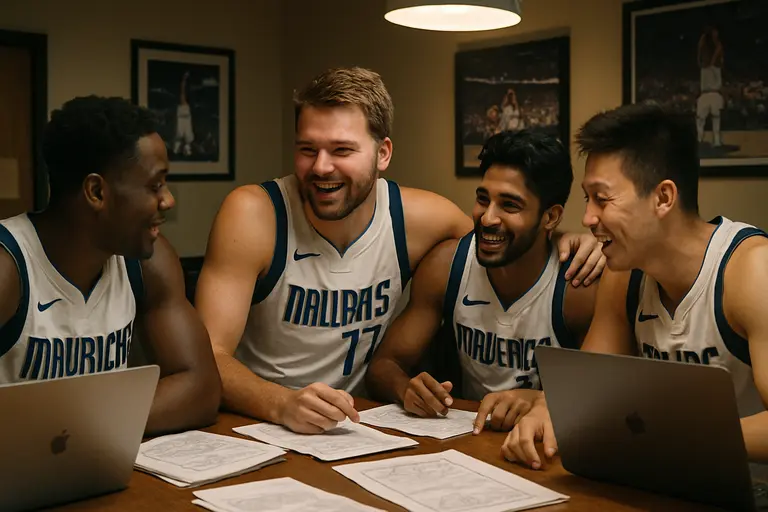
The roster profile points toward Mavericks Player Development as an organizational priority rather than a side project. Research notes listed 15 standard contracts and three two-way contracts, an average age of 24.93 years, and average NBA experience of 4.2 years. The group also included six international players and several new additions: Marcus Sasser, Tarik Biberović, Santi Aldama, Sergio de Larrea, Zaccharie Risacher, and Johnson.
That kind of roster can create growth upside, but it also creates teaching challenges. International players often arrive with different spacing backgrounds, defensive coverages, and offensive pacing habits. That can be a strength if the staff builds a common language quickly. It can become a weakness if players are asked to read the same action in different ways. Dallas’ early practices and Macao games should reveal whether May’s staff has simplified the first layer of decisions enough for talent to show.
General manager Masai Ujiri’s media-day comments, as reflected in the research, emphasized big, long players who attack the basket, offensive rebound, and shoot. That roster vision is coherent. Length can cover mistakes. Shooting can clear space. Offensive rebounding can generate extra possessions. The key is whether those traits connect. A long athlete who misses rotations is not yet a rotation defender. A shooter who cannot survive defensively may be hard to play. A rebounder who clogs spacing can squeeze driving lanes for Flagg and the guards.
What Mavericks Player Development Can Prove In Macao
The Practical Scouting Checklist
The Macao trip can give Dallas answers, but only if the questions stay disciplined. The staff should not need final rotation certainty by October 11. It should need evidence on which young players can handle simple NBA jobs under travel stress and game speed. That includes transition spacing, ball pressure, weak-side rebounding, screen angles, and early-clock decision-making.
- Flagg: cleaner reads against loaded defenses, not just scoring volume.
- Johnson: rebounding range, vertical finishing, and foul discipline.
- De Larrea: pace control and passing windows against stronger defenders.
- New wings and forwards: corner spacing, closeout decisions, and defensive communication.
There is also a health-management layer. Research notes from September 29 said Derek Lively II and Santi Aldama were limited while recovering from offseason procedures. Without making medical assumptions, that context matters for development planning. If key frontcourt players are limited, Johnson and other young bigs may see more reps than originally expected. Extra reps can speed learning, but they can also expose players before they have full scheme comfort.
The most useful reading of Mavericks Player Development after Macao will be comparative, not dramatic. Did the young players repeat the same habits from practice? Did mistakes shrink from the first game to the second? Did Flagg’s processing look faster within May’s structure? Did Johnson’s physical tools show up in ways that fit a real NBA role? Those answers will not settle Dallas’ season by October 11, 2026. They will give the Mavericks a clearer map for who needs NBA minutes, who needs targeted practice work, and who may require a slower path before the regular rotation hardens.
