

SoFi Stadium upgrades are not an NBA story in the narrow sense of a confirmed league schedule item. The available public research does not identify a dated NBA game, showcase, or tournament at the Inglewood venue. The relevant angle is different: on September 1, 2026, SoFi Stadium completed major audio, video, lighting, and control-room changes that would shape how any NBA-scale basketball event could be presented inside a football-sized building. That distinction matters because basketball depends on intimacy, timing, sightline clarity, and in-arena rhythm in a way that differs from football or concerts.
The venue’s changes point to a clear sports-business pattern. Large buildings are no longer judged only by seating capacity, premium inventory, or the headline event. They are judged by whether production can make the last row feel connected to the floor, stage, or field. For basketball, that challenge is sharper. The court is smaller, dead-ball windows are shorter, and the best arena environments depend on sound that feels immediate rather than distant. SoFi’s 2026 work gives event operators more tools, but the research does not prove how a future basketball court would be configured there.
Why SoFi Stadium Upgrades Matter For NBA Events
SoFi Stadium Upgrades And Bowl Presentation
The SoFi Stadium upgrades start with the building’s most visible feature: the dual-sided 360-degree Infinity Screen. The system received a full refresh with a new Ross Video Tessera and XPression UHD graphics system, according to the venue’s September 2026 announcement on SoFi Stadium enhancements. For a basketball event, that matters because many seats in a stadium bowl would not replicate the viewing angle fans expect in a traditional NBA arena. A stronger in-bowl video system can close part of that gap by making replays, score context, lineup graphics, and entertainment cues easier to read from distance.
That does not mean video can replace proximity. Basketball remains a geometry-driven sport for spectators. Fans follow spacing, help defense, weak-side cuts, and ball-screen timing. A large stadium risks flattening those details if the presentation plan treats the event like a concert with a court placed in the center. Better screens and graphics can support the live view, but they cannot fully recreate the lower-bowl feel of an arena such as Crypto.com Arena or Madison Square Garden. The strongest use case is supplemental: quick replay clarity after controversial calls, better player identification from upper levels, and cleaner pacing during timeouts.
Audio Timing In A Basketball Setting
The new d&b audiotechnik Soundscape system is the more interesting basketball variable. The research says the spatial audio system allows engineers to direct sound around the seating bowl so fans can feel sound move through the stadium. In football, that can enhance entrances, third-down sequences, and halftime production. In basketball, the best application would be restraint. A college-style neutral-site event, an All-Star-style showcase, or an international exhibition would benefit from energy, but basketball’s in-game sound bed cannot drown out whistles, public-address timing, or crowd reaction.
Sound design also affects competitive perception. Even in a neutral venue, fans read momentum through noise. A well-mixed building can make a run feel larger without becoming artificial. A poorly mixed building can make the same moment feel detached from the action. SoFi’s spatial system gives production crews a wider palette, but execution would decide whether the experience feels connected to the court or overly produced.
Control Rooms, Replays, And Event Operations
SoFi Stadium now has three production control rooms, including a newly built 17-position auxiliary Control Room 3. The venue’s infrastructure also includes expanded fiber, enhanced lighting controls, and modern switching panels in existing production rooms. For large basketball events, this operational capacity may be as meaningful as the headline screen or sound system. A stadium basketball event can involve league broadcast crews, in-venue entertainment, sponsor obligations, team content, security messaging, and halftime production. Redundancy reduces the chance that one production issue affects the entire fan experience.
The upgrades were first used publicly during Rams and Chargers preseason games in summer 2026, according to Pollstar’s report. That public debut is relevant because it moved the work from installation to live-event use. Football does not answer every basketball question, but it does test timing, operator workflow, visual clarity, and crowd response inside the same venue.
- The refreshed Infinity Screen can support replays and score context from distant seats.
- Spatial audio can target sections of the bowl without relying only on volume.
- Three production rooms give operators more flexibility for broadcast and in-house presentation.
- Lighting upgrades can improve entrances, halftime shows, and sponsor-driven segments.
This is where SoFi’s model intersects with a wider venue trend across basketball and hockey buildings. The same pressure appears in arena projects that try to improve circulation, premium zones, and team operations without losing the feel of the game. A useful comparison is the Capital One Arena overhaul, which focuses on an NBA and NHL building rather than a stadium. The scale differs, but the shared question is the same: can infrastructure upgrades help fans feel closer to the competition?
What The Enhancements Can And Cannot Solve
The Court Configuration Question Remains Open
The strongest caution is simple: the research does not provide a court map, seating chart, or league-approved basketball configuration for SoFi Stadium. Without that information, any claim about exact sightlines, capacity, ticket tiers, or player-area placement would be unsupported. The SoFi Stadium upgrades create a better production platform, but they do not automatically solve the physical layout problem that comes with staging basketball in an NFL venue.
Basketball fans judge access differently from football fans. In the NBA, the lower bowl can see bench communication, defensive matchups, and body language after timeouts. In a large stadium, those details may depend more heavily on screen direction and camera selection. That places more weight on the in-house producer. The wrong replay angle or delayed graphic can make a premium event feel less immediate. The right sequence can help a far-away seat follow the game with more confidence.
Lighting And Entertainment Windows
The lighting upgrades to grandMA3 and grandMA Replay, installed by Kinetic Lighting, matter most around the game rather than during live possessions. Pregame intros, halftime entertainment, and stoppage segments can be sharper. That is useful for a showcase environment, where the event is partly a basketball game and partly a media production. Yet basketball presentation still needs rhythm. Too much lighting movement during live action would be a mistake. The sport’s best in-arena atmospheres leave room for the game to breathe.
There is also a practical sports-business layer. SoFi Stadium is scheduled to host Super Bowl LXI on February 14, 2027, and events connected to the 2028 Olympic and Paralympic Games. Those dates explain why the venue invested in systems that can serve multiple event types. For basketball operators, the takeaway is not that SoFi has become a traditional hoops venue. It is that the building now has more production flexibility if a major basketball property chooses to use the space.
Food, Retail, And The Fan Day
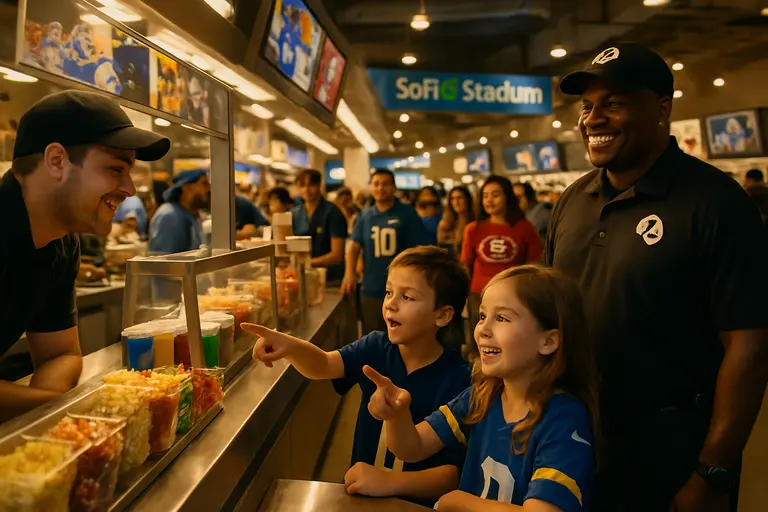
The research also points to expanded food, beverage, and retail offerings in September 2026 through SoFi Stadium and Legends Global, including new culinary concepts, extra dessert locations, more merchandise kiosks, souvenir vessels, and expanded team merchandise locations. Those details matter because a stadium basketball event would likely draw many fans who treat the event as a full-day destination rather than a standard two-and-a-half-hour arena visit.
Food and retail do not decide whether a basketball event succeeds competitively, but they shape fan patience. A large venue creates longer walks, more decision points, and more potential friction before tipoff and during breaks. If concession and merchandise distribution improves, the production investment has a better chance to be felt as part of a coherent event day. If not, fans may remember lines and distance more than audio movement or screen resolution.
For readers curious about the intersection of building systems, design planning, and venue technology in sports, CadCamNet offers insights into related technological and production topics within the same network.
SoFi Stadium Upgrades And NBA-Scale Events
The fair assessment is measured. The SoFi Stadium upgrades make the venue more credible for large basketball-adjacent presentations, neutral-site showcases, or NBA-sized entertainment events, but they do not answer every basketball-specific question. The completed audio and visual work should improve replay clarity, sound direction, control-room flexibility, and show pacing. Those gains are real based on the cited venue information.
The unresolved part is the court. Basketball’s fan experience begins with seeing the game properly, not just seeing a stronger screen. Until a specific NBA event plan, court placement, and seating layout are published, the best analysis is conditional. SoFi now has a stronger production backbone. Whether that backbone creates a convincing basketball environment would depend on how carefully organizers match the technology to the sport’s smaller playing surface, faster rhythm, and need for crowd proximity.
