

Hawks defensive strategy changed materially during the 2026 offseason because Atlanta added two players whose value starts on defense. The Hawks acquired Luguentz Dort from Oklahoma City on July 19, 2026, and added Dorian Finney-Smith from Charlotte on September 22, 2026. Those moves did not guarantee a leap, but they gave Quin Snyder more credible options against strong guards, bigger wings, and lineup groups that force repeated screen decisions.
The context matters. Atlanta finished the 2025-26 regular season with a 113.7 defensive rating, ranked ninth in the NBA in that metric, according to the research supplied for this analysis. That is already a solid base rather than a broken structure. The question is not whether Dort and Finney-Smith can rescue a weak defense. It is whether they can raise the floor of Atlanta’s toughest possessions: late-clock isolations, spread pick-and-rolls, and wing actions that previously forced help into rotation.
Hawks defensive strategy After Two Trades
Hawks defensive strategy Starts With Matchup Allocation
The clearest tactical change is assignment clarity. Dort gives Atlanta a point-of-attack defender with a reputation built on strength, pressure, and willingness to absorb contact. His official Atlanta profile lists him with the Hawks after the move from Oklahoma City, marking the roster change that reframed the backcourt defense Hawks player page. That matters because many modern offenses begin by forcing the weakest perimeter defender into the first screen. If Dort takes the primary initiator more often, Atlanta can reduce the number of early possessions that require emergency help.
Finney-Smith fills a different need. Atlanta acquired him from Charlotte in a deal that sent Buddy Hield, Ryan Nembhard, and cash away, according to the research. That swap also changed the offense-defense balance around the rotation, a roster trade-off explored in this site’s breakdown of Atlanta’s spacing change. Finney-Smith does not need to be the first defender on every star. His value comes from taking larger wings, switching select actions, tagging rollers, and staying connected when the ball moves.
The Difference Between Adding Talent And Changing Habits
Personnel upgrades are not the same as defensive improvement. Atlanta still has to decide how aggressive it wants to be at the screen, how often it wants to switch, and where it can afford to help. Dort and Finney-Smith make those choices less fragile. They also create new trade-offs. Dort’s value is highest when he can press the ball and use his strength. If he is stationed away from the action too often, some of that edge can be muted. Finney-Smith’s 2025-26 defensive rating in the research was 116.6, which was not an elite mark. That number should be read cautiously because role, minutes, and team context can shape defensive rating.
How Dort Changes The First Line Of Defense
Point-Of-Attack Pressure
Dort’s defensive profile is easy to understand and hard to replicate. He can take contact from downhill guards, fight through screening angles, and make ball handlers work before the main action begins. The research credited him with a 110.4 defensive rating in the 2025-26 regular season with Oklahoma City and a +1.36 defensive RAPM across 1,849 minutes. Those numbers support the broader scouting read: he tends to help team defense beyond basic box-score production.
For Atlanta, that can alter the first five seconds of a possession. If Dort contains the first drive or delays the ball handler long enough for the big to recover, the weak-side defenders do not have to collapse as far. That can protect the corners. It can also keep the defense out of the long closeouts that lead to second-side drives. In practical terms, Hawks defensive strategy can become less dependent on scrambling if Dort wins more of the first contact points.
Where The Trade-Offs Sit
The research also flagged a limitation: Dort is less impactful away from the ball and does not generate many turnovers. That matters for a defense trying to climb from good to higher-end. A strong on-ball defender can still be targeted through movement if he is made to chase cutters, screeners, or relocation shooters. Snyder’s staff has to place Dort where his strength matters most without allowing opponents to drag him into low-value help positions.
That is why Dort should be viewed as a stabilizer rather than a cure-all. He can absorb star guard assignments. He can make isolation possessions harder. He can reduce blow-by pressure at the top of the floor. He cannot, by himself, solve rebounding responsibilities, back-line communication, or every weak-side rotation.
How Finney-Smith Expands The Wing Rotation
Size And Help Defense
Finney-Smith gives Atlanta a veteran forward who can fit into several defensive tasks. The research noted that he averaged 3.3 points, 2.5 rebounds, and 1.0 assist in 16.8 minutes per game for Houston in 2025-26. Those offensive numbers do not define his purpose in Atlanta. The more relevant point is that he has been used as a multi-position defender and help defender, particularly against high-usage wings.
On a roster with added perimeter pressure, Finney-Smith’s job can be narrower and more valuable. He can guard the wing who is too big for a guard but too mobile for a traditional frontcourt defender. He can sit in the gap against drives, switch onto secondary creators, and help Atlanta keep more size on the floor without abandoning perimeter coverage.
Health, Minutes, And Defensive Efficiency
The caution is clear. The 116.6 defensive rating attached to Finney-Smith’s 2025-26 season should prevent any assumption that he will instantly play at peak defensive level. Defensive rating is not a perfect individual measure, but it is a signal to test against film, role, and availability. Atlanta’s staff will need to determine whether he is best used in shorter defensive bursts, as a closing lineup connector, or as a matchup-specific forward.
If Finney-Smith is healthy and moving well, his value is tied to decisions rather than volume. He does not need a high usage rate. He needs to be in the right place early, communicate switches, avoid fouling on late contests, and help Atlanta finish possessions with secured rebounds. Readers who follow this network beyond NBA tactics can find more engaging content at Bass Lake Roadhouse.
The Combined Fit With Atlanta’s Defensive Core
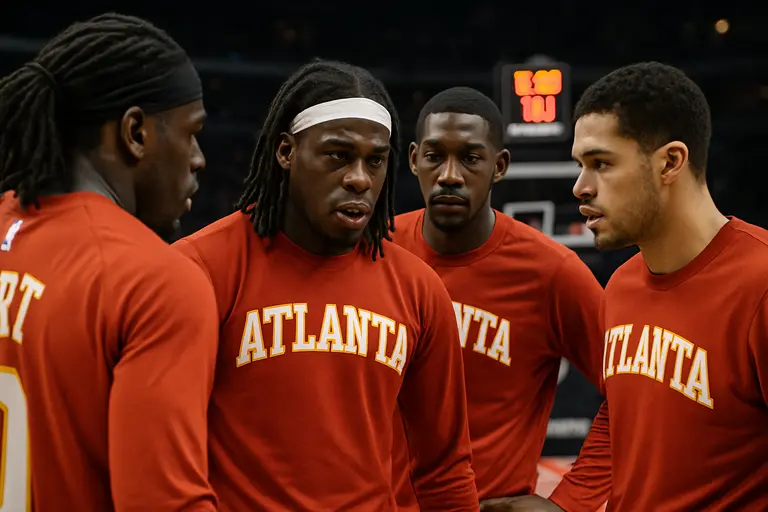
More Ways To Guard The Same Action
The strongest case for the pairing is optionality. Dort can take the most forceful guard or wing creator. Finney-Smith can take a larger forward or serve as a low-usage connector. That gives Snyder more room to vary coverage based on opponent personnel. Atlanta can switch some actions, chase others, and avoid placing one defender in every difficult matchup.
Sports Illustrated’s Hawks analysis framed the broader perimeter group involving Dort, Dyson Daniels, and Nickeil Alexander-Walker as a notable defensive trio while also pointing out Dort’s off-ball limits Sports Illustrated’s Hawks analysis. Finney-Smith adds another wing-sized option to that equation. The result is not a fixed identity yet. It is a deeper menu.
- Dort can pressure primary ball handlers and stronger guards.
- Finney-Smith can handle bigger wing matchups and help rotations.
- Atlanta can reduce the burden on smaller guards in difficult defensive pairings.
- Snyder can test switch-heavy groups without giving up as much size.
Why Integration Will Decide The Ceiling
Atlanta’s 2025-26 defense already ranked ninth by defensive rating, so marginal gains will be harder than a simple personnel story suggests. The next step requires coordination. Dort’s pressure has to connect with the back line. Finney-Smith’s help has to arrive without opening corner threes. The guards must rebound down when the forwards contest. If those details lag, the new names may not change the results as much as expected.
This is where Hawks defensive strategy becomes more interesting than a transaction recap. The additions allow Atlanta to match physicality on the perimeter, but the staff has to choose the right combinations. Too many limited shooters can squeeze the offense. Too many small guards can invite matchup hunting. The best lineups may depend on opponent type rather than one default closing group.
What Hawks defensive strategy Can Become
The supported read as of September 28, 2026, is measured optimism. Dort brings a proven point-of-attack profile, supported by strong 2025-26 defensive indicators in the research. Finney-Smith brings size, experience, and multi-position usefulness, though his recent defensive rating and reduced minutes add fair caution. Together, they give Atlanta a better chance to keep the ball in front, switch with more size, and reduce help stress around the arc.
The key is whether those traits translate from roster theory into possession-by-possession execution. Hawks defensive strategy can be more physical and flexible after these moves, but it still depends on health, role definition, and lineup balance. Atlanta did not need to rebuild its defense from scratch. It needed more answers for the possessions that decide close games. Dort and Finney-Smith give the Hawks more of those answers, even if the final grade has to wait for actual 2026-27 game evidence.
