

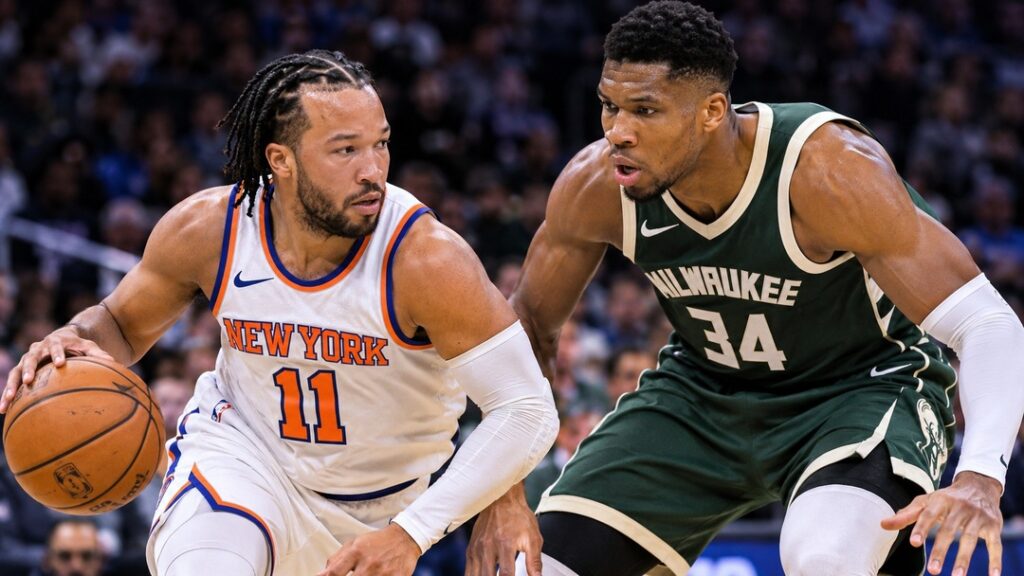
Clashes between the New York Knicks and the Milwaukee Bucks have evolved into one of the Eastern Conference’s most revealing tactical tests. What used to be a predictable contrast between Milwaukee’s rim-protecting drop coverage and New York’s grind-it-out half-court sets has transformed into a dynamic battle of perimeter efficiency, spacing, and frontcourt versatility.
Recent meetings showcase a shifting balance of power. New York has seized momentum across recent head-to-head fixtures by pulling rim defenders away from the basket, punishing help assignments, and dictating tempo through disciplined offensive execution. For Milwaukee, neutralizing the Knicks requires disciplined weak-side rotations, winning the transition points battle, and controlling defensive glass against New York’s relentless pursuit.
Examining the strategic friction points shows how these rosters match up across the floor.
Offensive Identity: Perimeter Spacing Against Drop Schemes
New York’s offense hinges on creating leverage out of middle pick-and-roll actions. Jalen Brunson’s footwork and change-of-pace dribbling constantly challenge perimeter defenders, forcing opposing bigs into uncomfortable drop depths. When paired with stretch big Karl-Anthony Towns, the geometry of the court changes completely. Towns forces opposing centers out beyond the arc, creating gaping driving lanes for Brunson, Mikal Bridges, and OG Anunoby.
Milwaukee’s defensive structure has traditionally prioritized walling off the paint and challenging shots at the rim. Against high-volume perimeter attacks, however, deep drop coverage leaves soft spots in the mid-range and above the break. If Milwaukee drops too deep against Brunson, he steps into pull-up jumpers with clinical rhythm. If the Bucks step up high to take away those looks, back cuts and skip passes to shooters like Anunoby and Landry Shamet punish the backline help.
To counter this, Milwaukee must rely on disciplined point-of-attack screen navigation. The Bucks need their guards to fight over screens without conceding baseline blow-bys, allowing their interior defenders to stay closer to passing lanes. Teams looking to study how modern spacing dismantles traditional coverage schemes can review our in-depth NBA playbook breakdowns for diagrammed half-court sets.
Frontcourt Clashes and Interior Defense
The interior battle dictates the physical tone of this matchup. Milwaukee relies heavily on Giannis Antetokounmpo’s unique blend of downhill force, rim deterrence, and secondary rim protection. When Antetokounmpo is active, his weak-side shot blocking and recovery speed compensate for perimeter breakdowns.
New York counters this by playing five-out sets or deploying dual-big alignments depending on game flow. Towns provides offensive stretch, while Mitchell Robinson offers traditional vertical spacing, offensive rebounding prowess, and drop protection inside. Robinson’s ability to crash the offensive glass places extreme pressure on Milwaukee’s box-out assignments. Second-chance points frequently tilt the margin in New York’s favor, giving them multiple possessions to crack open set defenses.
Containing Antetokounmpo requires coordinated team defense. New York typically uses Anunoby as the primary on-ball defender, leaning on his lower-body strength to hold ground before sending controlled baseline double-teams. The goal is not necessarily stopping Antetokounmpo entirely, but forcing him to pass out to shooters rather than finishing through contact at the rim.
Wing Defense and Perimeter Matchups
On the perimeter, New York features one of the most versatile defensive wing tandems in basketball with Bridges and Anunoby. Both possess the lateral agility and length to switch across four positions, extinguishing dribble penetration and deflecting kick-out passes. This defensive backbone allows New York to play tight on off-ball shooters without giving up straight-line drives.
Milwaukee’s perimeter rotation depends on quick ball movement and accurate perimeter shooting from pieces like A.J. Green, Gary Trent Jr., and Kyle Kuzma to keep defenses honest. When the Bucks generate clean drive-and-kick looks, their offensive rating climbs sharply. If their wing complementary scoring goes cold, the offense stalls into stagnant isolation sets that play directly into New York’s half-court strengths.
Official league data tracked through the NBA advanced stats portal underscores how defensive turnover creation correlates directly with transition differential in cross-conference regular-season series. When Bridges and Anunoby jump passing lanes, the resulting live-ball run-outs give New York high-percentage scoring opportunities that bypass set half-court defenses altogether.
Recent Head-to-Head Trends
Recent meetings reflect New York’s tactical adjustments, especially regarding pace control and shot quality.
| Date | Location | Result | Key Matchup Dynamic |
| Feb 27, 2026 | Fiserv Forum | NYK 127, MIL 98 | 21 Knicks 3-pointers; Towns and Anunoby dominate spacing |
| Nov 28, 2025 | Madison Square Garden | NYK 118, MIL 109 | Knicks control glass; 28 made free throws seal late lead |
| Oct 28, 2025 | Fiserv Forum | MIL 121, NYK 111 | Bucks push transition pace; interior paint scoring controls tempo |
| Mar 28, 2025 | Fiserv Forum | NYK 116, MIL 107 | New York records 12 steals; second-chance points decide game |
| Jan 12, 2025 | Madison Square Garden | NYK 140, MIL 106 | 58% shooting display; Brunson orchestrates pick-and-roll clinic |
The numbers illustrate a clear theme: when New York knocks down outside looks at a rate above 40%, Milwaukee’s defensive configuration gets stretched beyond its recovery capability. Conversely, Milwaukee’s victories correspond with games where they control the pace, minimize live-ball turnovers, and turn defensive rebounds into immediate fast-break opportunities.
Tactical Keys to Victory
For the New York Knicks to dictate terms:
- Pull opposing bigs away from the rim via pick-and-pop actions featuring Towns.
- Generate 12 or more offensive rebounds to preserve extra possession volume.
- Funnel dribble penetrators toward baseline traps rather than letting them turn the corner into middle paint.
For the Milwaukee Bucks to turn the tide:
- Wall off the paint in early transition to prevent open pull-up wing 3-pointers.
- Force Brunson to give up the ball early with aggressive hedging rather than retreating in deep drop coverage.
- Win the turnover battle by avoiding crowded paint entries against New York’s active wing defenders.
Concluding Strategic Assessment
The New York Knicks versus Milwaukee Bucks series highlights two contrasting philosophies of modern roster construction. New York relies on switchable perimeter wings, high-IQ floor general play, and perimeter-oriented frontcourt spacing. Milwaukee relies on unmatched physical presence inside, fast transition attacks, and perimeter floor-spacers.
Execution in the half-court will decide these contests. If New York stretches the floor and wins the offensive rebounding battle, they hold the upper hand. If Milwaukee protects the lane, controls defensive rebounds, and turns stops into open-court run-outs, they have the weapons to dismantle New York’s defensive structure. Every quarter represents a high-stakes chess match between two Eastern Conference heavyweights.
