
Let’s go back in time. Before the modern analytics era, there was an art form. I’m talking about the early days of designing after timeout plays. It wasn’t just drawing on a whiteboard. It was a deep philosophy.
Think of Red Holzman’s Knicks. His system was a symphony of brutal efficiency. Every cut was clear. Every pass had a purpose. This was play-calling at its most basic.
Then, Phil Jackson came along. His Triangle Offense was more than a set play design. It was a study in constant motion and quick reactions. It offered layers of options for defenses to solve.
The common thread? A coaching legacy. Chuck Daly learned from Larry Brown. Gregg Popovich picked up from both. This history, from Holzman’s creativity to Jackson’s innovations, is the foundation for today’s coaches. It’s like studying Da Vinci to understand modern architecture. The brilliance of those early after timeout plays is in their lasting strategic value.
Play design evolution from simple screens to complex misdirection concepts
Today’s inbound plays are all about creating a viral meme in players’ muscle memory. Gone are the days of simple calls and screens. Now, it’s about creating a complex heist that the defense can’t stop.
The goal is to play the percentages so well that the defense has to give up the shot you want. It’s not guesswork. It’s a mix of physics and psychology. True coaching creativity is about building layers of deception.
James Jones breaks down a killer ATO into three parts. First, it must give the best shot for your players. Second, it uses misdirection to keep defenders guessing. Third, it has many options, so if one plan fails, another can take over.
The Algorithm of Deception: Dissecting a Modern ATO
Let’s look at a Cavaliers play Jones loved. It started with a simple screen. But that was just the beginning. It hinted at a lob, a cross-screen, and a three-pointer all at once.
This is the evolution in a nutshell. We’ve moved from simple instructions to complex plays. The initial screen is just the start of a cascade you designed. The play is a funnel that guides chaos to your preferred outcome.
This shift shows the peak of strategic coaching creativity. Coaches are now behavioral programmers. They write algorithms for human movement. The creativity is in anticipating what players and the defense will do.
The philosophy has changed. It’s no longer just about getting the ball to the star. It’s about creating chaos that leads to the star. Today’s best inbound plays are like postmodern poetry. They’re full of references and meanings that reveal themselves only when executed.
Scouting element how teams prepare for opponent tendencies and counters
Forget the chalkboard genius—the real magic of playoff execution starts in a dark room. It’s filled with a blinking cursor and stale coffee. This is the espionage wing of the NBA, where brilliance is about digging deep.
The dirty little secret? Every brilliant after timeout play is usually stolen. Brad Stevens, a film study guru, said, “I’ve literally stolen from everybody.” He means scouting is all about learning from others.
So, what’s this “PhD” all about? It’s about spending thousands of hours breaking down video. Scouts look for tells, not beauty.
They’re searching for patterns:
- Does the opposing center always drop back on side pick-and-rolls?
- Does their best wing defender always fight over a screen, leaving him vulnerable to a back-cut?
- When they switch a certain action, is there a size mismatch they consistently fail to protect?
This isn’t about art anymore. It’s forensic science. They look for habits from early-season games for the playoffs.

The design of a season-saving ATO isn’t pure creativity. It’s a precise plan to exploit a weakness. You don’t out-create; you out-prepare.
This is where playoff execution meets preparation. A coach doesn’t just draw up a play; he uses months of data. It’s why detailed playoff adjustments are key—the game is won in the film room.
So, the next time you see a winning after timeout play, remember the real work was done weeks ago. It was in a quiet room, where a tired coach spotted a flaw and thought, “I’m stealing that.” Scouting is the unglamorous, yet essential, part of it all.
Execution under pressure players who thrived in ATO situations throughout history
Great ATO moments are more than just smart set play design. They’re about the people who make those plays work. The coach writes the script, but the players must perform under pressure. This is where theory meets reality.
James Jones, a former NBA sharpshooter, said the magic is not just with the ball. “Everyone must be engaged in action away from the ball,” he noted. The player in the corner isn’t just waiting. He’s a key player, keeping a defender busy. A slight hesitation by the screener can ruin the whole play.
There are different types of players who shine in these moments. You have your sharpshooters, your smart passers, and your decoys. The best inbound plays need everyone to work together.
Let’s look at the types of players who make these plays work. The table below shows the key roles in turning a plan into a winning basket.
| Player Archetype | Key Traits | Iconic Examples | ATO Role |
|---|---|---|---|
| The Shot-Maker | Ice-water veins, unlimited range, clutch gene. They want the ball when the play breaks down. | Michael Jordan, Damian Lillard, Kyrie Irving | Primary scoring option; the play’s designed conclusion. |
| The Connector | High basketball IQ, precise passer, understands spacing and timing. The play’s central nervous system. | Magic Johnson, Draymond Green, Steve Nash | Orchestrates the action; makes the hockey assist or decisive read. |
| The Decoy/Screener | Selfless, savvy, understands defensive tendencies. Masters the art of the “almost” cut. | Shane Battier, Robert Horry, Dennis Rodman | Creates chaos and distraction; frees the shooter through movement or a bone-jarring screen. |
| The Spot-Up Specialist | Pure, quick-release shooter. Their mere presence on the floor warps the defense. | Steve Kerr, Ray Allen, Klay Thompson | Spacing weapon; forces defenders to stay home, opening driving lanes. |
Robert Horry, known as “Big Shot Rob,” was a master of timing. He knew when to move to an open corner. Steve Kerr was always ready to shoot, thanks to Michael Jordan’s drawing double-teams.
Draymond Green is another example. He might not shoot last, but his screens and passes are key to Golden State’s success. He’s like a chess player, moving pieces quickly.
These players have a special trait: they perform well under pressure. The crowd, the clock, and the defenders all fade into the background for them. They execute with both their bodies and minds.
The beauty of a great after-timeout play is the mix of coach’s strategy and player’s skill. The diagram sets the stage, but the athlete must have the talent, courage, and smarts to make it happen. Without the right players, even the best plans fail.
Coaching creativity Rick Pitino innovation and modern offensive coordinators
Step into the world of today’s top coaches. Here, the whiteboard is more than a tactical plan. It’s a canvas for psychological battles. This is where coaching creativity shines brightest.
Rick Pitino was a pioneer in this field. His innovation wasn’t just one play. It was a system of full-court pressure and sets that seemed chaotic. His teams didn’t just play; they presented a philosophy. Pitino’s creativity was loud, relentless, and system-driven.
Today’s coaches are more subtle but aim for the same goal: to gain an edge. They’ve taken Pitino’s chaos and upgraded it. Now, they see the after-timeout playbook as dynamic, not fixed.
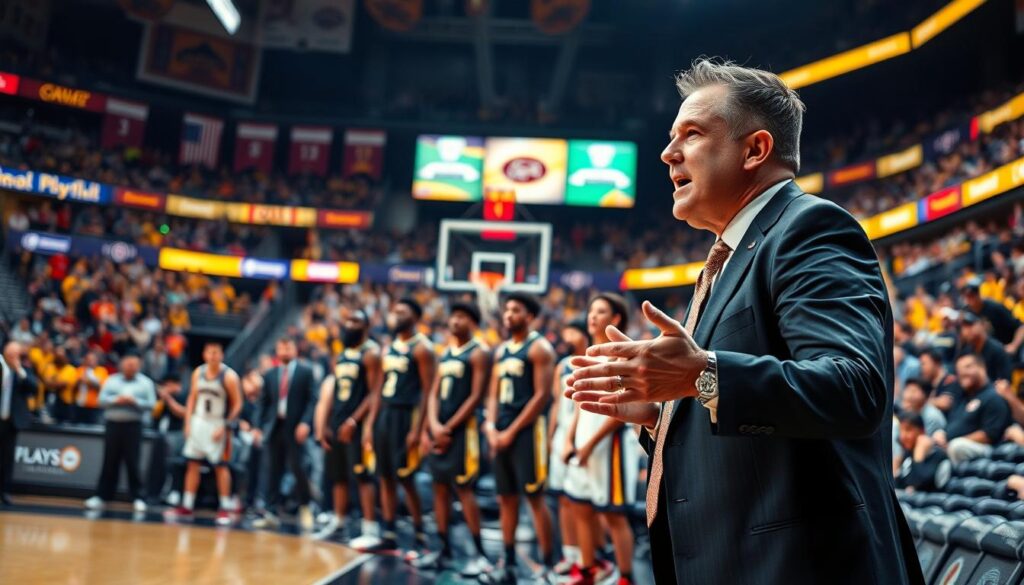
Who are these modern leaders? Names like Brad Stevens, Rick Carlisle, and Gregg Popovich top the list. They’ve inspired a new generation of coaches, including Terry Stotts and Mike Budenholzer. It’s a team effort, not a solo act.
Rick Carlisle is known for his ATO designs, blending drama and strategy. Doc Rivers, on the other hand, creates hundreds of plays, preparing for any defensive look.
Erik Spoelstra’s “Heat Culture” is a prime example of modern coaching creativity. It’s built for playoff execution, focusing on preparation and adaptability. The plays are designed for the system, not just the star.
This marks a shift from Pitino’s era. Yesterday’s creativity was about imposing a system. Today, it’s about adapting within a framework. It’s like the difference between sculpting and coding.
| Category | The System Architect (Pitino Era) | The Adaptive Engineer (Modern Era) |
|---|---|---|
| Philosophy | Impose our chaotic will. Force the game into our preferred, frenetic style. | Diagnose your scheme. Exploit the specific mismatch you present tonight. |
| Primary Tool | Full-court pressure and relentless tempo. | Misdirection, decoy actions, and secondary options. |
| Playbook Mentality | A sacred text. Master our complex sets. | Living software. Updated after every game, even every quarter. |
| Success Metric | Forcing turnovers and creating fatigue. | Points per possession (PPP) in clutch ATO situations. |
| Key Example | Pitino’s Kentucky teams overwhelming opponents with “40 Minutes of Hell.” | Spoelstra’s Miami Heat running a “Zoom” action for a game-winner, perfected through repetition. |
So, what does this mean for playoff execution? Today’s coaches are judged by their ability to adapt, not just their creativity. Every play is analyzed. The key is finding new, unseen strategies.
The best coaching creativity today is hidden. It’s the work done in film rooms before timeouts. It’s about building a playbook that’s as flexible as the game itself. The timeout is just when they share their plan.
Defensive counters how great defensive coaches disrupted ATO execution
Every after timeout play has a defensive mastermind ready to mess it up. James Jones called set play design “chess, amplified.” This is when the other team turns the tables.
It’s not just about hard work. It’s about being smart and paranoid. A great defensive counter is like a sneak attack, planned by a genius in a wrinkled suit who has watched the same tape over and over.
The Preemptive Strike: Scouting and Communication
Boston Celtics coach Brad Stevens was known for being unpredictable. He never ran the same play twice. This is the challenge for defense.
To deal with unpredictability, teach players to recognize formations like they’re old friends. Practice communication until it’s automatic. The goal is to guess the opponent’s after timeout play before the ball is even passed.
Think of Tom Thibodeau’s teams. They were all about constant pointing and shouting. It was like organized noise to break the opponent’s silence. This scouting makes defense proactive, not just reactive.
Controlled Chaos: Breaking the Defensive Rules
Sometimes, following the rules can get you beat. The best defensive counters break the rules in a smart way.
It’s about the right double-team at the wrong time. Or a defender jumping a lane they shouldn’t. It’s also about the strategic foul to reset the game. This kills the opponent’s rhythm in a perfect set play design.
Coaches like Ime Udoka are experts at this. They teach players to create chaos. It’s like throwing a wrench into the opponent’s well-oiled machine. The offense does everything right, only to find a defender in the way.
| Defensive Counter Strategy | Key Principle | Coach/Team Example | Effect on ATO Play |
|---|---|---|---|
| Formation Recognition & Pre-Switch | Communicate and adjust before the play initiates. | Tom Thibodeau (Knicks, Timberwolves) | Nullifies initial action, forces offense to Plan B. |
| Aggressive Passing Lane Jump | Gamble based on scouting, not reaction. | Miami Heat “Zone” Principles | Creates live-ball turnovers from “safe” passes. |
| Unexpected Blitz/Double | Bring pressure from a non-traditional helper. | Ime Udoka (Celtics, Rockets) | Speeds up the primary decision-maker, causes panic. |
| Strategic “Foul-to-Deny” | Stop clock, reset defense, prevent high-value shot. | Gregg Popovich (Spurs) | Resets possession, trades free throws for a killed play. |
This is where the beautiful play meets beautiful resistance. The most memorable after timeout plays in history aren’t just the ones that scored. They’re the ones that survived this level of defensive scrutiny and won despite it.
Playoff intensity ATO plays in elimination games and championship moments
When the stakes are high, coaches turn to their deepest strategies. The regular season tests, but the playoffs reveal true talent. Every play is critical, every second of the clock heavy.
Every inbound plays in a Game 7 is more than just points. It’s a moment etched in history.
What changes in the playoffs? Everything. Safe plays become risky. Defenses know your moves. The margin for error is zero.
This is where coaching creativity is tested. It’s not about new plays. It’s about executing old ones flawlessly.
Take Brad Stevens’ 2017 masterpiece against Cleveland. Down, Stevens used ATOs without his star. He used plays his role players could execute under pressure. That’s coaching genius.
The pressure can shrink or expand a coach’s imagination. It’s a high-stakes game. The inbound pass is the most critical in sports.
It’s not just about passing the ball. It’s about setting the game’s direction. A well-designed inbound plays can break any defense, as any team knows from studying playoff series breakdowns.
This environment turns role players into legends. Coaches become oracles. The timeout in Game 7 is a moment of truth. The play is a gamble, a chance to leave a mark.
Stevens’ moment was a testament to his coaching creativity. It didn’t rely on stars. It relied on system and timing.
So, watch closely when a team huddles with the season on the line. Look for the off-ball screens and decoy cutters. That’s where championships are won. Not with a miracle shot, but with a well-planned inbound plays.
Player archetypes who mastered ATO execution from Magic to LeBron leadership
Forget positions for a moment. In the heat of an after timeout play, players become archetypes. These are recurring characters in the drama of playoff execution. The coach writes the script, but the players bring it to life.
Let’s explore the key roles, from the visionary floor general to the silent specialist. These roles have shaped high-leverage moments for decades.
The Floor General: Coach on the Court
This archetype has ultimate control. Think of Magic Johnson, LeBron James, and Chris Paul. They don’t just run a play; they audible it.
Their value lies in reading the defense quickly and adapting the plan. A screen can become a decoy. A pass can turn into a drive. LeBron’s late-career playoff execution is a masterclass in this.
They make everyone else’s job simpler, which is key to any successful after timeout play.
The Pure Scorer: The Human Bail-Out Plan
When the design fails and the defense smothers the initial action, you need a supernova. Enter Michael Jordans, Kobe Bryants, and Kevin Durants. Their job is simple: get the ball and create a shot from nothing.
This isn’t about system fit; it’s about gravitational pull. The play might be designed for them, or they might be the emergency outlet. Kyrie Irving, alongside LeBron, is a perfect example.
They are the ultimate insurance policy for playoff execution when complexity fails.
The System Specialist: The Flawless Executor
Some players see their value skyrocket in ATO situations. Think of Steve Kerrs, Robert Horrys, and Danny Greens. They are low-maintenance, high-efficiency cogs.
Their archetype thrives on precision, not improvisation. They run the curl off the double-screen perfectly every time. They spot up in the exact corner, ready for the kick-out. They set the bone-jarring screen that frees the star.
You don’t need to draw up a second option for them. You just need them to do their one thing, perfectly.
The Decoy/Distractor: The Invisible Hand
The most underrated role in the after timeout play. Often a big man or a stationary shooter, their primary skill is occupying space and attention. Think of a player like Brook Lopez parking in the corner.
He might not touch the ball, but his defender dares not help off him. That simple presence warps the geometry of the floor, creating driving lanes for others. Their success is measured in what doesn’t happen—the help defense that never comes.
A great ATO scheme uses all five players, and the decoy is the silent architect of the space the stars operate in.
| Archetype | Primary Skill | Iconic Example | ATO Value Proposition |
|---|---|---|---|
| Floor General | Basketball IQ & Audibling | LeBron James | Adapts the play in real-time; coach on the floor. |
| Pure Scorer | Isolation Shot Creation | Kobe Bryant | Bail-out option when plays break down; gravitational pull. |
| System Specialist | Precision & Reliability | Steve Kerr | Flawless execution of a specific, practiced action. |
| Decoy/Distractor | Spatial Awareness & Threat | Brook Lopez | Warps defense without touching the ball; creates space. |
The evolution from Magic’s passing genius to LeBron’s cerebral command isn’t just about talent. It’s about how these legends redefined archetypes. They understood that mastering after timeout plays meant accepting a specific, high-leverage role in the theater of playoff execution. The best players don’t just fit the system; they become the system, one archetypal performance at a time.
Analytics revolution measuring ATO success rates and efficiency trends
Basketball used to rely on gut feelings and chalkboard notes. Now, it’s all about data. The analytics revolution changed the game, making every play a test to be measured.
Coaches now use data like a Wall Street expert. They track success with Points Per Possession (PPP). This metric shows what really works, beyond flashy plays.
Today, coaches have a database, not just a playbook. They know the PPP of different plays. They can pick the best inbound plays to beat a zone defense. It’s about using data to back up their instincts.
Rick Carlisle said ATOs can change the game. Analytics proves this, showing the value of each possession. A small difference in PPP can mean a win or loss over time.
The art of set play design has been tested by data. A pretty play isn’t enough if it doesn’t work. Now, it’s about proving a play’s worth.
For inbound plays, data is key. It shows which plays work best in tight spots. The goal is to find the play with the highest chance of success.
Does this make coaches robots? No. They use data to guide their decisions, not control them. The data helps, but coaches must also read the game and manage their team.
The revolution is complete. We now design plays for maximum success. The final score reflects talent, timing, and data.
Memorable moments championship defining ATO plays and coaching brilliance
Imagine a chess match from *Searching for Bobby Fisher*. Now, picture it on a basketball court with 20 seconds left. This is where the whiteboard magic comes to life. We’ve talked about the theory. Now, let’s see the highlight reel where coaching meets raw talent to create legends.
It’s not just the shot. It’s the setup. Michael Jordan’s “Shot” over Craig Ehlo was a masterpiece. Derek Fisher’s 0.4-second miracle was a symphony of timing. Damian Lillard’s famous series-ender? It was pure misdirection, showing a coach’s genius.
Brad Stevens’ playoff playbook is a clinic. His actions gave Kawhi Leonard the chance to win with a bouncing game-winner. These moments share a common thread: multiple options, a defense forced to blink, and the best shot coming from chaos.
This is the hidden art that wins championships. It’s the ultimate playoff execution, a 20-second stoppage that makes history. The pressure leaves only genius. The coach draws, the players trust, and the net swishes. Legends are born from a timeout.
