
Throughout the existence of the league, fans have always seemed to appreciate the guy on the court that helps his team excel by doing the little things. Whether it’s boxing out, running the floor hard or setting good screens, these players usually build a cult following. Thanks to advanced stats like adjusted plus/minus, we even have a way to somewhat quantify that player’s value these days.
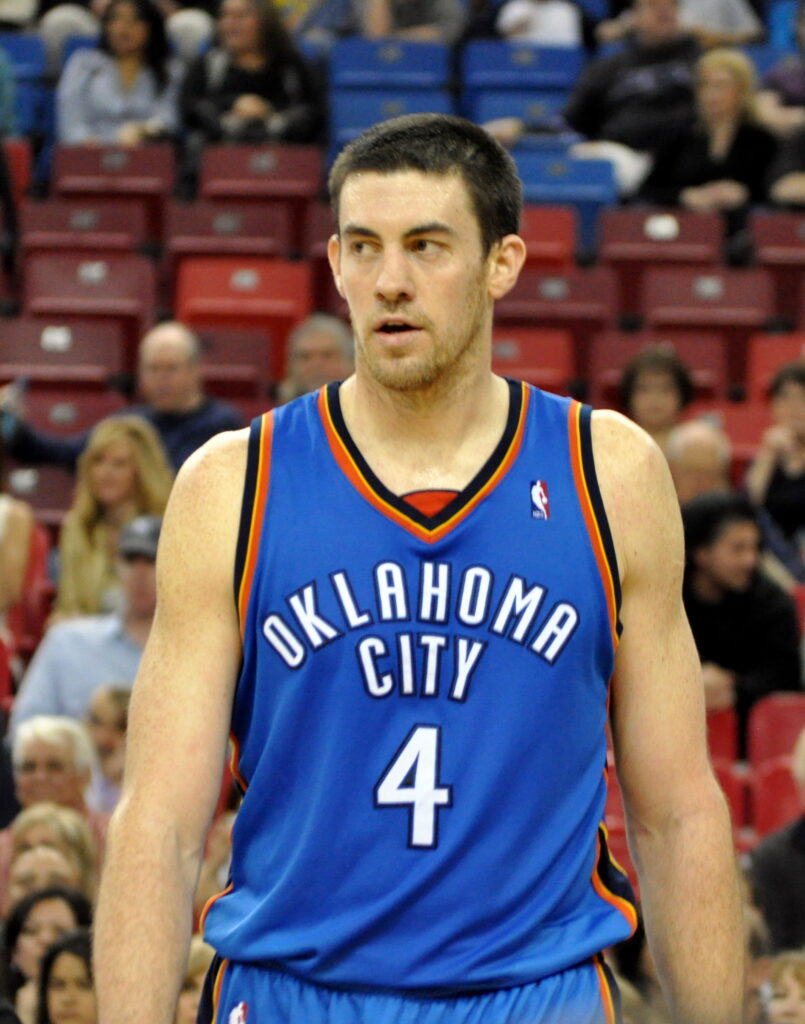
“I got you, Perk. Just grab a spot on the bench.”That is how someone like Nick Collison grew to become a stat geeks dream. His bone crushing screens, is activity on both ends of the floor and ability to pile up charges by the dozen by and large makes it easier for any team (like the Thunder) to win when he’s playing. Yet perhaps the biggest contribution to Collison’s plus/minus wizardry is due to his rare ability to simply deter plays from happening. You read that correctly, Collison is valuable for his role in the plays that don’t happen.
How does that work exactly? Well, along with Kevin Garnett, and a handful of other big men in the league, Collison excels in an area appreciated solely by film nerds and coaches: defensive positioning. To master this tactical nuance a player has to be smart, active and driven to constantly hunt the optimal place to disrupt offensive flow without turning his own man into a threat. They do all this despite a scarcity of statistical rewards.
Only three play results (a charge, a blocked shot or a missed field goal) show a job well done and even then, those outcomes are often attributed to something else. A blocked shot is naturally credited to the rim protector’s athleticism. A charge is met with a celebration of personal sacrifice and a missed field goal is ascribed to the offensive player with the label of a ‘tough’ or ‘bad’ shot. Often it is forgotten that the key ingredient to those denials comes in the form of dedicated movement off the ball.
The greatest return from a player who excels at positioning himself in offensive hotspots doesn’t even show up in any box score. Sometimes it comes in the form of an offensive player forced to drive to another gap with his weak hand. Other times the big does his defensive three second call samba to perfection to produce a stalemate, with precious time ticking off the shot clock while the offenses rushes to find a new place to attack.
The result of the play is a missed jumper from LeBron James in the paint. Seems more like a simple miss than anything else. However, let’s rewind and look at the subtle movements Collison makes throughout the play to make it much more difficult for James than it originally appears.
In the first freeze frame we see Collison totally engaged off the ball. He uses his off arm to make contact with who he’s marking in order to avoid losing track of him while his vision stays on the ball.
This is precisely why Collison is so valuable to the Thunder during the Finals. Take a look at the following play from Game 1:
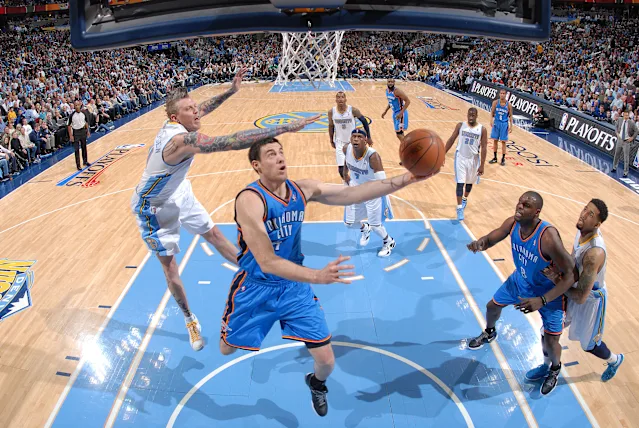
As James moves into a pick-and-roll with Wade, look how quickly Collison is able to make his rotation. Wade hasn’t even moved to deliver the pass and Collison is already streaking across the lane.
Thanks to that early break, Collison already has deterred any possibility of James catching and ripping baseline for a drive toward the rim, something that might have been possible given Westbrook still moving to get back into a good defensive position. This is one example of Collison not allowing a positive play for the opponent to even occur.
Another example happens in his recovery. As he retreats back, Collison does so with his hands high in the passing lane to prevent a direct pass to Udonis Haslem cutting into the middle of the paint.
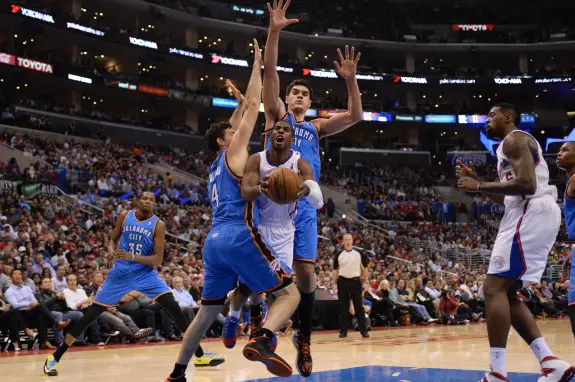
In his final act on this possession, Collison simply puts forth a second effort to rise up and contest the James shot in the lane, raising the degree of difficulty and forcing the miss.
That one play shows the value of his presence on the court for OKC and why it seems nearly inexcusable for him to play a mere 15 minutes in Game 2. Kendrick Perkins is misfit to play major minutes against a team without a bruising post player while Serge Ibaka gets glorified for his shot-blocking when at times it’s actually zero-sum game. Most blocked shots end up staying with the offensive team while charges (or simply being in a position to deny a shot attempt completely) are much better results.
It’s the classic case of substance versus style (or in Perkin’s case, substance versus ineffectiveness) that will help decide the series against the star-studded team from Miami. And if Scott Brooks doesn’t wise up soon, it will be the Larry O’Brien trophy that’s taking its talents to South Beach.

