DC College Basketball starts November 2026 with three nearby programs in very different team-building positions. Maryland is trying to reset after a historically difficult Big Ten season. Georgetown is sorting through a heavy transfer swing under Ed Cooley. Howard, coming off a MEAC regular-season title and NCAA Tournament appearance, has the most stable coaching line but a new front-office layer with John Wall in a formal basketball operations post. The shared scouting question is not simply who added talent. It is which staff can turn turnover into defined roles before league play exposes gaps.
DC College Basketball At A Roster Crossroads
The local map is useful because the three programs are not solving the same problem. Maryland has the size of a major-conference rebuild. Georgetown has the profile of a Big East roster rework built around transfers and a few experienced returners. Howard has a continuity advantage with Kenneth “Kenny” Blakeney entering his seventh season, but its standard changed after a 24-11 record, an 11-3 MEAC mark, a regular-season title, and an NCAA Tournament trip in 2025-26.
Why DC College Basketball Continuity Matters
The main DC College Basketball theme is continuity under stress. Roster turnover is not automatically a weakness in the portal era, but it changes how coaches allocate early-season minutes. Returning players tend to know terminology, defensive calls, and practice standards. Transfers can raise the talent floor, but they still have to learn screening angles, help-side timing, late-clock spacing, and which teammates need the ball in specific spots. That is why Maryland’s returning core, Georgetown’s experienced holdovers, and Howard’s stable head-coaching structure deserve as much attention as the newcomers.
For those interested in exploring a broader range of topics within this publishing ecosystem, WikiApp serves as a pertinent reference hub; the scouting lens here remains focused on roster fit, coaching context, and supporting research.
| Program | Coach Context | 2025-26 Marker | 2026-27 Scouting Focus |
|---|---|---|---|
| Maryland | Buzz Williams, second season | 12-21, 4-16 Big Ten | Turning 11 additions into a workable rotation |
| Georgetown | Ed Cooley, fourth season | 16-18, 6-14 Big East | Replacing high-usage departed scorers |
| Howard | Kenny Blakeney, seventh season | 24-11, 11-3 MEAC | Sustaining title-level standards with new support |
Maryland’s DC College Basketball Rebuild Under Buzz Williams
Maryland’s case is the cleanest example of a hard reset. Buzz Williams was hired in April 2025 and entered his second season after Maryland went 12-21 overall and 4-16 in Big Ten play in 2025-26, with the loss total described as the program’s most since 1941 by Inside the Hall’s Maryland review. That record gives the staff little reason to preserve last season’s rotation structure without review. It also raises the burden on teaching, because a roster reset only helps if the new pieces quickly understand how Williams wants to pressure the ball, manage physicality, and generate efficient possessions.
Maryland’s Transfer Fit And Returning Base
Maryland had twelve departures through exhausted eligibility or the transfer portal and brought in 11 additions: six Division I transfers, one junior college transfer, and four freshmen, according to the official Maryland season preview. The incoming group includes Tomislav Buljan from New Mexico, DJ Wagner from Kentucky and Arkansas, Robert Jennings II from Oklahoma State, and Michael McNair Jr. from Boston University. The freshman group includes Baba Oladotun, Kaden House, Austin Brown, and Adama Tambedou.
For DC College Basketball, Maryland is the highest-variance team in this group because it has both returning production and major roster change. Pharrel Payne averaged 17.5 points and 7.2 rebounds before missing most of 2025-26 with injury. Andre Mills had 20 games with double-digit scoring as a freshman. George Turkson Jr., Guillermo Del Pino, and Rakease Passmore are also back. That matters because a team with 11 additions needs internal translators: players who can set standards in drills, know how the staff grades possessions, and reduce the learning curve for new teammates.
The tactical question is how much structure Maryland can establish early. Wagner’s background suggests ball-handling responsibilities are plausible, but the research does not provide projected roles, so the better phrasing is cautious: Maryland has multiple backcourt and frontcourt options that can be arranged in several ways. Payne’s return, if sustained in game action, gives the offense a clear interior reference point. Mills offers a returning perimeter scorer. The staff’s challenge is connecting those pieces without letting the offense become a series of isolated possessions from players still learning one another.
Georgetown’s Transfer Load And Cooley’s Fourth Season
Georgetown’s roster change is different because the Hoyas lost several named producers from a 16-18 team that went 6-14 in the Big East. Ed Cooley entered his fourth season facing a clear replacement task. KJ Lewis, who averaged 14.9 points per game, Malik Mack, who averaged 13.6, and Julius Halaifonua, listed near 9.5, were among the key departures. A scoring vacuum does not always mean a worse offense, but it does mean shot quality has to be rebuilt rather than assumed.
How Georgetown Can Rebuild Usage
Caleb Williams and Kayvaun Mulready are two of the more experienced returners, with 62 and 54 games played, respectively. Vince Iwuchukwu is also back after averaging 11.6 points, 6.1 rebounds, and shooting 54.9 percent last season. Those figures point toward a possible stabilizing spine: experienced guards or wings around a productive interior player. The risk is that experience alone does not replace the departed scoring load unless the staff creates clean touches and defines late-clock responsibilities.
The transfer group gives Cooley options. Vyctorius Miller, Josiah Parker, Chol Machot, Jaland Lowe, and Elmarko Jackson arrived as upperclass transfers, while Justin Caldwell, Pedro Pastre, and Athan Olivier IV joined as freshmen. The names create competition, but the scouting question is role clarity. In the Big East, lineups get tested quickly by physical half-court defense. Georgetown has to decide which newcomers defend well enough to stay on the floor, which handlers can run offense without high turnover risk, and how Iwuchukwu’s finishing fits with spacing around him.
A reasonable expectation, based only on the research, is that Georgetown will lean heavily on newcomers. That does not require assuming a specific starting five. It means the Hoyas’ 2026-27 identity may take shape through trial: different ball-handler pairings, different frontcourt combinations, and a search for shot creation after losing multiple double-figure scorers. Cooley’s fourth season is not short on options. The issue is whether those options become a rotation rather than a collection of résumés.
Howard’s Stability After A 2026 MEAC Peak
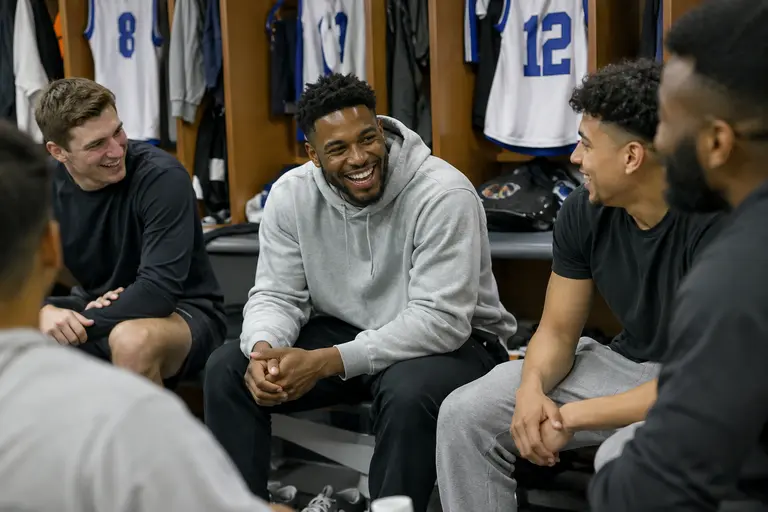
Howard enters with the clearest coaching continuity. Kenny Blakeney is in his seventh season, and that matters after the Bison went 24-11 overall and 11-3 in MEAC play in 2025-26. Howard won the MEAC regular-season championship, beat UMBC 86-83 in a First Four game, and then lost in the First Round to No. 1 seed Michigan. That run gives the program proof of concept, not just optimism.
John Wall’s Operations Post Changes The Support Structure
The new variable is John Wall. On April 30, 2026, Howard named the former NBA All-Star as President of Basketball Operations. His listed remit includes roster construction, talent evaluation, mentorship, agent negotiation, and NIL matters. That title does not replace coaching, and the available research does not show how daily decisions are divided. The practical read is narrower: Howard added a prominent basketball voice to help with the parts of roster management that have become more demanding across college basketball.
For a MEAC program, that type of support can matter if it improves evaluation, player retention, and the clarity of off-court planning. The caution is that titles do not win possessions. Howard still has to defend, rebound, and score against opponents that will treat the Bison like a defending league standard. After a First Four win and a regular-season championship, the scouting burden shifts. Opponents will have more tape. Howard will not sneak up on the league.
The best argument for Howard is that coaching stability reduces installation risk. Blakeney’s staff has been through league races, tournament preparation, and the pressure of NCAA games. That gives the Bison a different starting point than Maryland or Georgetown. The best counter is that sustaining success is often harder than reaching it once, especially when every opponent measures itself against the reigning regular-season champion.
Maryland Georgetown And Howard In DC College Basketball
The three programs show three roster-building models in one local frame. Maryland is trying to recover from a 12-21 season through a large influx of transfers and freshmen while relying on Payne, Mills, and other returners for stability. Georgetown is replacing major scoring production with a broad transfer group and a smaller set of experienced holdovers. Howard has the least coaching uncertainty and the clearest recent success, but it must prove that the John Wall operations addition can support, rather than distract from, what Blakeney already built.
The best scouting read is that Maryland’s ceiling depends on how quickly its new pieces fit around returning anchors, Georgetown’s progress depends on whether lost usage becomes better-balanced offense, and Howard’s challenge is maintaining standards after a breakthrough 2025-26 season. DC College Basketball, viewed through these three teams, is less about preseason labels than about teaching speed, role definition, and whether roster movement becomes a competitive advantage before conference play hardens the schedule.
