

Eastern Conference meetings between the Charlotte Hornets and the Boston Celtics present a study in contrasting basketball philosophies. Boston constructs its identity around positional length, five-out spacing, and structured defensive rotations. Charlotte relies on pace, open-court playmaking from LaMelo Ball, and high-variance perimeter volume.
Success in this series rarely hinges on raw shooting talent alone. It comes down to half-court execution against structured drop or switch schemes, control of the defensive glass, and which squad dictates the tempo across forty-eight minutes.
Tactical Tendencies and Core Team Profiles
The Celtics enter matchups with a blueprint built around perimeter versatility. Boston forces opponents to defend every inch of the three-point line, relying on Jayson Tatum and Jaylen Brown to break down primary coverage before kicking to open shooters along the arc. Defensively, Boston switches across perimeter positions with ease, limiting clean looks for opposing lead ball handlers.
Charlotte operates under a different rhythm. When the Hornets push the ball after defensive rebounds, their offense thrives on fast breaks and early secondary actions. In stalled half-court sets, Charlotte leans heavily on high screen-and-roll action, searching for mismatch isolations or drive-and-kick sequences to keep defenders scrambling.
| Tactical Category | Charlotte Hornets Profile | Boston Celtics Profile |
| Offensive Pace | High-tempo, transition-heavy attack | Deliberate, possession-oriented execution |
| Primary Scoring Zone | Paint attacks and pull-up triples | Five-out spacing and catch-and-shoot threes |
| Defensive System | Drop coverage with aggressive ball-traps | Switch-heavy scheme with active weak-side help |
| Rebounding Priority | Crash defensive glass to trigger breaks | Structural box-outs to prevent second chances |
Half-Court Execution and Defensive Schemes
Boston’s defensive scheme creates immediate friction for Charlotte’s primary actions. With versatile wings capable of sliding between perimeter containment and interior deterrence, Boston can switch ball screens without surrendering immediate mismatches. This forces Charlotte into deep isolation possessions late in the shot clock, pulling their offense away from collective passing sequences.
Charlotte’s defensive discipline faces an equally demanding test against Boston’s spacing. The Celtics force opposing big men to play away from the rim by utilizing center options who can pop out beyond the three-point line. If Charlotte drops its interior rim protectors into the paint, Boston punishes the space with rhythm pull-up jumpers. When Charlotte pushes its bigs out to the perimeter, backdoor cuts and drive-and-kick lanes open up immediately.
Tracking real-time possession efficiency through official resources like NBA.com highlights how Boston’s assist-to-turnover ratio rises dramatically whenever opposing defenses fail to communicate through cross-matches in early transition.
Key Matchups on the Floor
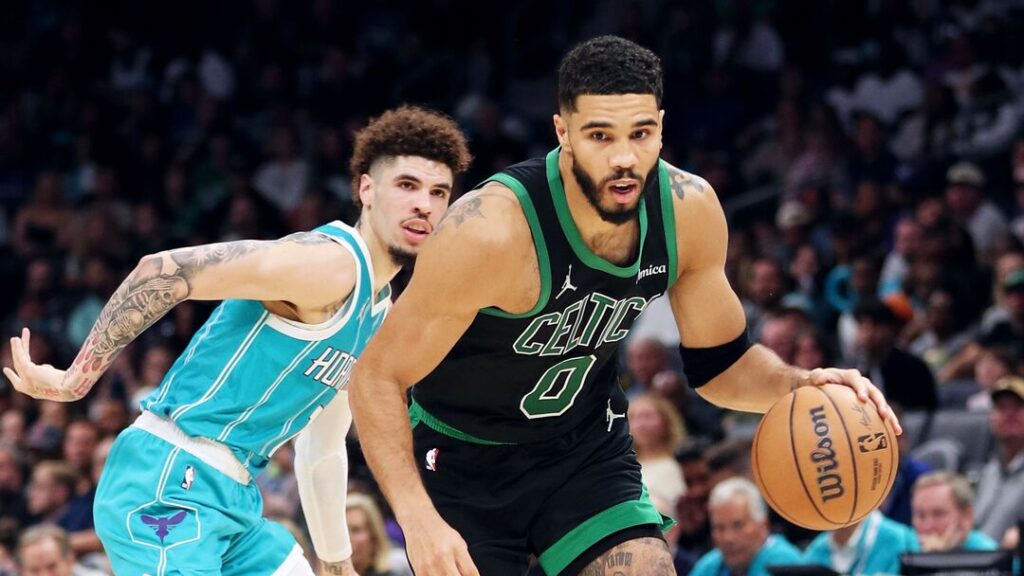
The battle at lead guard sets the tone for this meeting. LaMelo Ball’s size, vision, and deep shooting range make him a difficult cover in single coverage. Boston routinely throws physical wing defenders at him, attempting to disrupt his passing angles and force him into crowded mid-range pockets. Charlotte needs Ball to maintain ball security and avoid costly live-ball turnovers that fuel easy Boston breakaways.
On the opposite end, containing Boston’s perimeter tandem demands complete collective awareness from Charlotte. Jaylen Brown attacks downhill with force, testing Charlotte’s point-of-attack defenders. Jayson Tatum operates as both a primary shot creator and a secondary playmaker out of double-teams. If Charlotte overcommits to Tatum on the perimeter, Boston’s secondary ball handlers find wide-open shooting pockets in the corners.
Brandon Miller provides Charlotte with length and fluid shot-making, serving as an offensive foil on the perimeter. For Charlotte to keep pace over four quarters, Miller must convert contested attempts and hold his ground defensively against physical straight-line drives.
Rebounding Leverage and Transition Battles
Possession volume determines the margin of error in this matchup. Boston consistently ranks near the top of the league in defensive rebound percentage, ending opposing possessions on the first miss and preventing offensive putbacks. That discipline neutralizes Charlotte’s athletic frontcourt, which attempts to generate extra scoring possessions through offensive rebounds.
Charlotte finds its greatest advantage when it forces Boston into stagnant possessions. Active deflections and contested defensive boards allow the Hornets to run before Boston’s half-court defense sets up. Readers studying tactical adjustments can explore our breakdown on defensive rotation fundamentals to see how weak-side tags disrupt pick-and-roll sets across the league.
When Boston maintains control of the offensive glass, second-chance points tilt the score heavily. The Celtics do not send all five players crashing the paint; instead, they balance floor balance with opportunistic interior positioning, preventing run-outs while collecting loose balls in crucial stretches.
Blueprint for a Charlotte Upset
Charlotte faces a narrow tactical path to victory against Boston’s structured attack. To stay competitive and secure a win, the Hornets must execute several precise elements:
- Win the turnover margin by at least four possessions, turning live-ball steals directly into transition buckets.
- Maintain a three-point conversion rate above thirty-eight percent to punish Boston’s switching rotations.
- Limit Boston to single-shot trips by securing clean defensive rebounds with all five players boxing out.
- Force Boston’s secondary playmakers into difficult mid-range pull-ups rather than conceded corner threes.
If Charlotte allows Boston to dictate a methodical half-court game, the Celtics possess the positional size, shooting depth, and defensive structure to grind out the victory. Charlotte’s speed and perimeter shot-making present real challenges, but sustained poise against Boston’s defensive pressure remains the decisive factor.
