

The 2026-27 NBA regular season tips off for the Toronto Raptors and Chicago Bulls at Scotiabank Arena on Wednesday, October 21. The scheduling office delivered a massive storyline for opening night. Kawhi Leonard returns to the franchise he led to a championship in 2019, concluding a months-long trade saga that dominated the offseason news cycle. The Raptors aim to re-enter the upper echelon of the Eastern Conference hierarchy. The visiting Chicago Bulls arrive in Canada featuring a completely rebuilt roster focused entirely on youth development and pace.
This matchup presents a clear contrast in organizational timelines. Toronto expects to compete for a championship immediately. Chicago wants to evaluate their recent draft picks and establish a long-term offensive identity. We evaluate the massive roster changes, the tactical advantages on the floor, and the specific matchups that will decide this opening night contest.
The Historic Return Of Kawhi Leonard
The Toronto front office pulled off an unprecedented maneuver. Bringing Kawhi Leonard back to Canada changes the entire geometry of the Eastern Conference. Leonard provides the exact archetype the Raptors lacked over the past few seasons: a primary half-court creator capable of generating high-efficiency offense late in the shot clock. He forces opposing defenses into impossible choices and punishes single coverage from mid-range.
The defensive implications look terrifying for the rest of the league. The Raptors will pair Leonard with Scottie Barnes on the perimeter. Both forwards possess massive wingspans, elite lateral quickness, and the physical strength to guard all five positions. Head coach Darko Rajakovic can deploy switching schemes that completely neutralize opposing pick-and-roll attacks. Opposing guards trying to force switches will simply find themselves guarded by another elite perimeter defender.
Leonard’s presence immediately relieves the offensive pressure on Barnes. During the previous campaign, defenses keyed entirely on Barnes, forcing him into difficult contested shots. Leonard will command the opponent’s best perimeter defender. This spacing allows Barnes to operate as a secondary creator, attacking shifting defenses and finding cutters from the high post. The synergy between these two forwards dictates the absolute ceiling of the Toronto offense.
The Reconstructed Chicago Bulls Roster
The Chicago Bulls front office finally committed to a full rebuild. The current starting lineup features a collection of young, unproven talent mixed with reclamation projects. Josh Giddey operates as the primary ball-handler. The Australian guard possesses exceptional court vision and passing accuracy. He thrives in transition, advancing the ball quickly to exploit retreating defenses. His lack of a consistent perimeter jump shot remains a massive structural problem in the half-court.
The Bulls look to surround Giddey with athletic finishers and shooters. Matas Buzelis and Patrick Williams occupy the forward positions. Buzelis brings floor spacing and weak-side shot blocking. Williams offers physical perimeter defense. The frontcourt relies on Jalen Smith and Nick Richards to protect the rim and secure defensive rebounds.
The backcourt rotation features dynamic scoring punches. Rob Dillingham and Collin Sexton provide explosive isolation scoring off the bench. Chicago wants to play extremely fast. They know they cannot execute in a slow, grinding half-court game against elite defensive units. Head coach Billy Donovan will instruct his team to secure defensive rebounds and immediately sprint down the floor. The Bulls generate offense through chaos and speed.
Tactical Breakdown: The Point Of Attack
The matchup at the point guard position carries heavy significance. Immanuel Quickley orchestrates the Toronto offense. He forces defenders to respect his deep three-point range, pulling rim protectors away from the basket. Quickley attacks closeouts and finishes with an array of floaters in the paint.
Giddey faces a severe challenge guarding Quickley on the perimeter. Quickley uses quick hesitation moves to gain an advantage. If Giddey fails to contain the initial drive, the Bulls must rotate their big men early. This opens up lob opportunities for Jakob Poeltl or kick-out passes to RJ Barrett on the wing. Barrett shot the ball efficiently last season and continues to punish defenses that leave him open in the corners.
On the other end of the floor, the Raptors will likely assign Quickley or Jamal Shead to pressure Giddey the full length of the court. By picking him up at 94 feet, Toronto prevents Chicago from setting up their offensive sets quickly. If Giddey attempts to post up smaller guards, the Raptors will send timely double-teams from the blind side to force live-ball turnovers. You can track exact lineup efficiency metrics by consulting advanced tracking data throughout the opening weeks of the season.
Frontcourt Battles And Rebounding Margins
The interior collision features contrasting styles. Jakob Poeltl anchors the middle for Toronto. He operates as a traditional drop-coverage center, protecting the restricted area and executing precise screens on offense. Poeltl rarely shoots from outside the paint. He excels at offensive rebounding and finishing through contact.
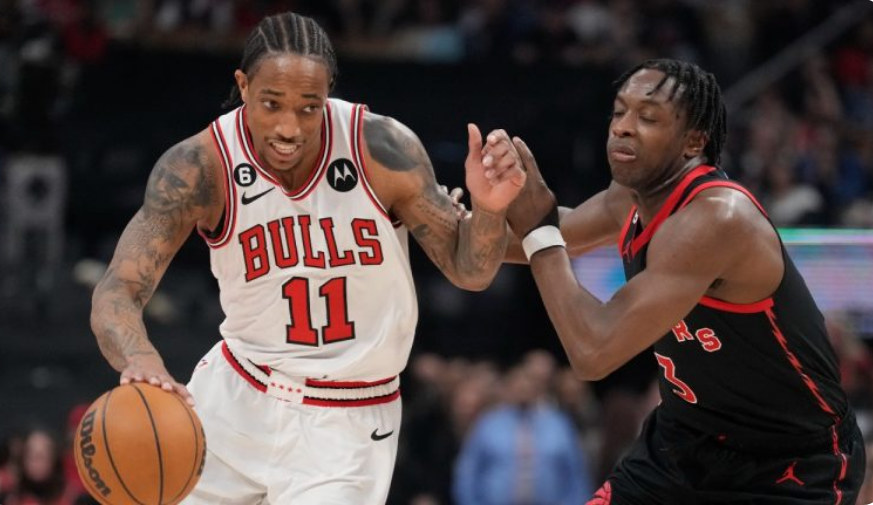
Chicago counters with a center rotation lacking elite bulk. Jalen Smith provides floor spacing from the center position. If Smith hits early three-pointers, Poeltl must extend his defense beyond his comfort zone. This creates driving lanes for Giddey and Dillingham. If Smith misses, Poeltl will simply camp in the paint and erase any attempts at the rim.
Rebounding determines possession volume. The Raptors dominated the glass in their matchups against Chicago last season. A massive size advantage across the positional spectrum allows Toronto to secure second-chance points effortlessly. Barnes and Leonard crash the defensive boards, allowing Quickley and Barrett to leak out in transition. The Bulls must execute flawless team-rebounding fundamentals to prevent the Raptors from generating an overwhelming shot volume advantage.
Analyzing The Bench Units
Regular season success relies heavily on second-unit production. The Raptors feature a deep, versatile bench. Trayce Jackson-Davis provides elite rim protection and vertical spacing as the backup center. Kyle Anderson offers veteran playmaking and defensive intelligence. Ja’Kobe Walter and Jamison Battle bring fresh legs and perimeter shooting. The Toronto coaching staff can mix and match lineups based on the specific requirements of the game.
The Chicago bench relies entirely on individual shot creation. Sexton attacks the basket with reckless abandon. Dillingham uses a tight handle to separate from defenders and launch pull-up jumpers. Guerschon Yabusele provides physical toughness in the frontcourt. If Sexton and Dillingham get hot, the Bulls second unit can erase deficits quickly. If they struggle with their efficiency, the offense stalls completely.
The disparity in defensive execution between these two reserve units looks massive. The Toronto bench features multiple players capable of executing complex defensive rotations. The Chicago bench features players known primarily for their offensive output. When the starters rest, Toronto holds a severe structural advantage.
Managing The Pace Of Play
The tempo of the game heavily favors the team that controls the defensive glass. Chicago must force missed shots to ignite their transition offense. If Toronto scores efficiently in the half-court, the Bulls must inbound the ball against a set defense. This scenario spells disaster for a Chicago offense lacking a true primary isolation scorer.
Toronto plays a methodical, calculated style. They probe the defense, run multiple screening actions, and wait for the opponent to make a mistake. Leonard operates with extreme patience. He holds the ball, reads the defensive shell, and attacks the weakest link. The Raptors limit unforced turnovers and maximize their offensive efficiency.
The Bulls need to inject variance into the game. They will launch a high volume of three-pointers early in the shot clock. They will gamble for steals in the passing lanes. High-variance strategies sometimes yield massive upsets. If the Bulls connect on 40 percent of their three-point attempts, they can compete with anyone. If they shoot poorly, the Raptors will dismantle them systematically. For fans looking to evaluate the broader league landscape, our NBA season previews provide detailed breakdowns of every roster.
Game Prediction And Final Outlook
The projection models heavily favor the Toronto Raptors in this opening night contest. The combination of a raucous home crowd at Scotiabank Arena and the emotional return of Kawhi Leonard provides a massive psychological edge.
The Toronto roster boasts superior top-end talent, greater defensive versatility, and a more cohesive offensive structure. The combination of Leonard, Barnes, and Quickley presents too many matchup problems for a young Chicago defense. The Bulls will struggle to generate consistent offense against the massive length of the Toronto wings.
Expect the Raptors to establish control early in the first quarter. They will dictate the pace, dominate the rebounding margins, and execute their half-court sets with precision. The Bulls will provide moments of athletic brilliance, but the veteran composure of the Toronto roster will ultimately prevail. The Raptors should secure a comfortable victory to launch their 2026-27 campaign, sending a clear message to the rest of the Eastern Conference that they intend to challenge for the highest seed.
| Positional Advantage | Team | Justification |
|---|---|---|
| Backcourt | Toronto Raptors | Quickley and Barrett offer superior shooting and half-court creation compared to Giddey and Buzelis. |
| Wings | Toronto Raptors | The pairing of Kawhi Leonard and Scottie Barnes represents one of the elite forward duos in basketball. |
| Frontcourt | Toronto Raptors | Jakob Poeltl provides reliable rim protection against a rotating cast of Chicago big men. |
| Bench Depth | Toronto Raptors | Kyle Anderson and Trayce Jackson-Davis offer two-way stability against Chicago’s volatile scoring guards. |
The opening tip marks the beginning of an eighty-two game marathon. The Raptors look prepared to sprint from the starting line. The Bulls face a steep learning curve. The basketball world watches closely as one of the defining players of the last decade takes the floor once again in a Toronto uniform.
