

NIL reforms have moved from policy debate to roster-building reality for college athletic departments. As of October 17, 2026, the Protect College Sports Act remained unfinished federal legislation, but its path through Congress had already signaled how schools, coaches, athletes, agents, and collectives may have to adjust. The bill was introduced on May 27, 2026, advanced out of the Senate Commerce Committee by a 19-9 vote on June 18, and had cloture filed on August 5, according to the Senate Commerce Committee release. The research record also states that the Senate passed the package on September 29, 2026, with further reconciliation and a presidential signature still needed before full effect.
Why NIL reforms Matter To College Rosters
NIL reforms And A National Rulebook
The clearest sports impact is not a single dollar figure. It is the attempt to replace uneven state rules with a national framework. College coaches have been working in a setting where compensation, transfers, eligibility, and third-party deals can affect recruiting conversations as much as playing time or player development plans. A federal standard would not remove financial gaps between programs, but it could make the operating rules more consistent.
The Protect College Sports Act would affirm student-athletes’ rights to NIL deals while setting national standards around eligibility and transfers. The proposal includes a five-year window to complete competition and would limit how often athletes can transfer. For coaches, that matters because player development depends on time. Strength programs, skill work, nutrition support, academic planning, and role definition are harder to keep aligned when rosters reset sharply every offseason.
Retention Funds And Roster Continuity
The proposed retention fund is one of the most direct roster-management tools in the legislation. The bill would create a $22.5 million annual retention fund for schools to retain athletes. That amount could rise to $27.5 million if schools make significant investments in women’s and Olympic sports. In practical terms, retention money could become part of how athletic departments keep second- and third-year players who might otherwise enter the portal after a limited role or a bigger outside offer.
Continuity is not just a football concern. In basketball, one extra year in the same player-development system can change a player’s passing reads, defensive discipline, shooting habits, and strength profile. A point guard who understands a coach’s spacing rules or a center who has spent multiple offseasons improving mobility can give a team more than raw talent. NIL reforms that reward retention could give coaches a better chance to build those progressions.
Financial Pressure Inside Athletic Departments
The Spending Base Was Already Large
The reform debate sits on top of a college sports economy that was already under strain. The U.S. Government Accountability Office reported that 352 NCAA Division I schools spent $20.8 billion on athletics in the 2023-24 academic year, with major costs tied to team and game operations, staff compensation, and athletic scholarships. The same GAO report noted that, under the 2025 settlement of In re College Athlete NIL Litigation, Division I schools may share up to $20.5 million in revenue with student-athletes beginning in the 2025-26 year; see the GAO report on Division I finances.
Those figures explain why athletic directors are reading the legislation through a budget lens. Revenue sharing can improve athlete compensation, but it also forces schools to decide where money comes from and which teams receive support. Programs with large media revenue, donor support, and ticket demand may be better positioned to absorb new costs. Schools with tighter budgets may have to make harder choices about staffing, travel, roster size, and facility plans.
The Nine-Year Revenue Share Question
The Protect College Sports Act also includes a long-term issue: the revenue share cap now in force would be eliminated in nine years, or earlier if the House settlement ends first, unless Congress votes to retain it. That timeline creates planning pressure. Athletic departments may not know the final cost structure for most of the next decade, yet they must still recruit, extend coaches, support Olympic sports, and fund athlete services.
For player development, that uncertainty could cut two ways. Higher compensation may help athletes remain in school longer if their college situation offers meaningful earnings, coaching, exposure, and academic support. At the same time, departments facing budget stress may scrutinize non-revenue spending more closely. The strongest programs will be the ones that connect compensation strategy with training quality rather than treating pay and development as separate offices.
Contract Protections And Athlete Decision-Making
Clearer Deals Could Reduce Off-Court Drag
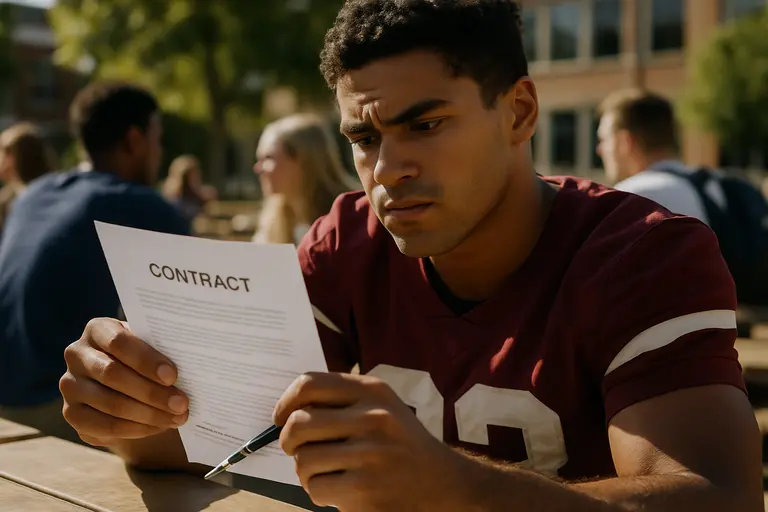
The legislation would require NIL contracts to include clear terms, including duties required of the athlete, payment amount, and other contract details. It also seeks to cap agent fees at 5% of earnings. Those are not minor administrative items. A poorly explained agreement can pull an athlete into disputes, missed obligations, or unexpected costs. Clearer contracts may give athletes more time and attention for school, training, film study, and recovery.
That point is especially relevant for younger athletes who enter college with public profiles but limited experience reviewing commercial agreements. A freshman basketball player may be asked to balance practice, class, travel, media, social content, appearances, and family expectations. Rules that define what must be in a deal do not guarantee good advice, but they can make bad terms easier to spot. Sports law will remain part of the athlete experience, but the goal is to reduce confusion.
Transfers, Development, And Athlete Choice
Transfer limits are more contested. Coaches often value roster continuity because it allows systems to mature. Athletes value mobility because it can open playing time, academic options, family proximity, or a better competitive fit. A national transfer rule may reduce some yearly uncertainty for teams, but it also has to preserve fair movement for athletes whose situations change.
The development question is whether a player is better served by staying through a difficult role or moving to a program with a clearer pathway. There is no single answer. A wing who needs strength and shooting reps might benefit from a patient staff that has already invested two years. A guard buried behind older players may need live minutes elsewhere. Any NIL reforms tied to transfer rules should be judged by whether they improve decision quality, not simply by whether they reduce movement.
- Schools may gain more predictable roster planning if national eligibility and transfer rules are adopted.
- Athletes may benefit from clearer contract terms and proposed limits on agent fees.
- Development staffs may need closer coordination with compliance, NIL education, and financial planning teams.
How NIL reforms Could Shape Player Development
The Basketball Lens
Basketball shows why the off-court rules matter on the court. The sport has small rosters, visible individual roles, and a direct link between opportunity and professional evaluation. A national NIL structure could influence whether a sophomore stays to become a lead creator, whether a big develops defensive coverage skills over several seasons, or whether a role player leaves for a clearer financial and playing path.
The strongest case for NIL reforms is that they can bring order to a system that now affects every recruiting visit and every retention meeting. The weakest assumption would be that legislation alone solves competitive imbalance. Money, coaching, facilities, conference exposure, and institutional support will still separate programs. For readers tracking the wider sports-business side of these changes, a related site in the same network can help place college policy debates within the broader industry.
For athletes, the best outcome would be a structure that protects earning rights without turning development into an afterthought. For schools, the challenge is to build compensation systems that do not weaken coaching, academics, health care, or long-term skill growth. The Protect College Sports Act had not fully become law by October 17, 2026, but its direction was clear enough: college sports is trying to define how athlete pay, roster stability, and development can exist in the same model.
